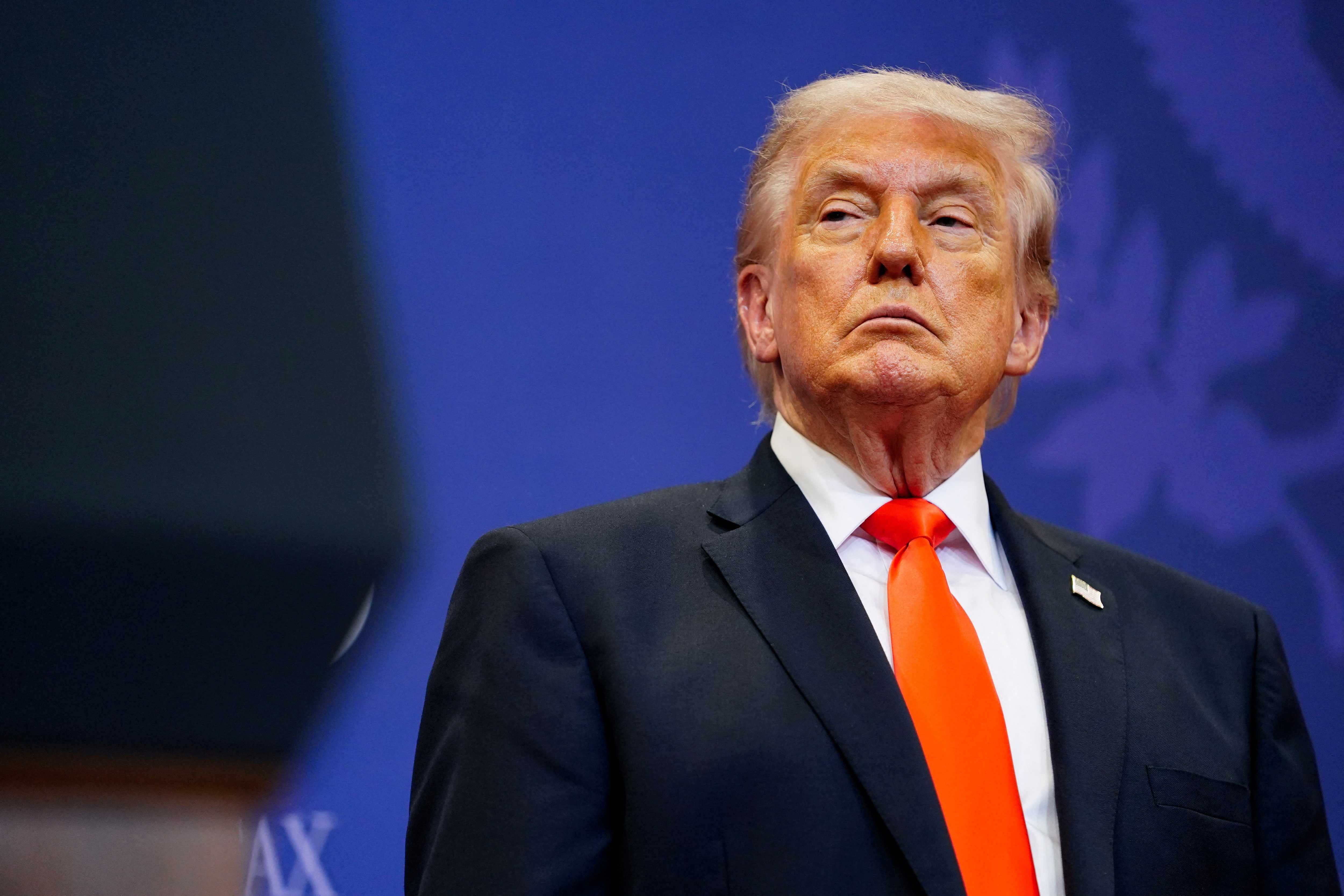
U.S. President Donald Trump at The Villages, Florida, U.S., May 1, 2026. REUTERS/Nathan Howard
With the 2026 midterms only half a year away, President Donald Trump is facing the possibility that one or both branches of Congress could be in Democratic hands in 2027 — which would make it much more difficult for him to advance his legislative agenda. The two-term president isn't literally on the ballot in 2026, but Democratic organizers are trying to make the midterms a referendum on his presidency — not unlike 2018, when Democrats recaptured the U.S. House of Representatives during his first term.
The New York Times' Thomas B. Edsall, in his May 5 column, argues that Trump is feeling increasingly desperate in his efforts to "stave off" a "mortifying defeat" in November.
"Heading into the 2026 midterm elections," Edsall explains, "you can't say that the president hasn't warned us, over and over, that he will do all he can to prevent the congressional contests from turning into a humiliating Republican rout…. In Trump, we have a president whose hatred of losing drove him to provoke the insurrection at the Capitol on January 6, 2021, a president who expanded the mandate of the federal Joint Terrorism Task Force to include the investigation, arrest and prosecution of individuals engaged in 'domestic terrorism' and created a multimillion-dollar domestic terrorism unit to pursue those cases."
Edsall adds, "He is a president who asserts national control over state-administered elections, a president who has overseen the seizure of ballots and federal attempts to get access to voting machines and voter lists, and a president who has gutted the institutions that are supposed to ensure a fair election process and fired the people who work for them."
Trump's fear of defeat, according to Edsall, was evident in the National Security Presidential Memorandum issued on September 25, 2025 — a memo that, the columnist warns, gives the U.S. Department of Justice (DOJ), the U.S. Treasury, the Internal Revenue Service (IRS) and other federal agencies "a license to label left-wing groups as domestic terrorist organizations."
"There are other danger signals," Edsall observes. "One is the possibility that a majority of the Supreme Court justices would hesitate to block Trump if, just days before the election, he asserted constitutionally questionable powers to disrupt the process under the doctrine of the 'Unitary Executive Theory,' which supposedly grants the president unrestricted authority to control the executive branch. Another is that the Republican majorities in the House and Senate would continue their passive submission to Trump and take no steps to block potentially unconstitutional actions."
University of Wisconsin-Madison political scientist Kenneth Mayer, in an interview, told Edsall that Trump "has obliterated the boundaries and guardrails that we had long thought would serve as meaningful constraints on presidential extremism."
Mayer warned, "He is acting as if his will is law, the government and everything in it belongs to him, and everyone owes their allegiance to him, not to the Constitution, the law or the public good."