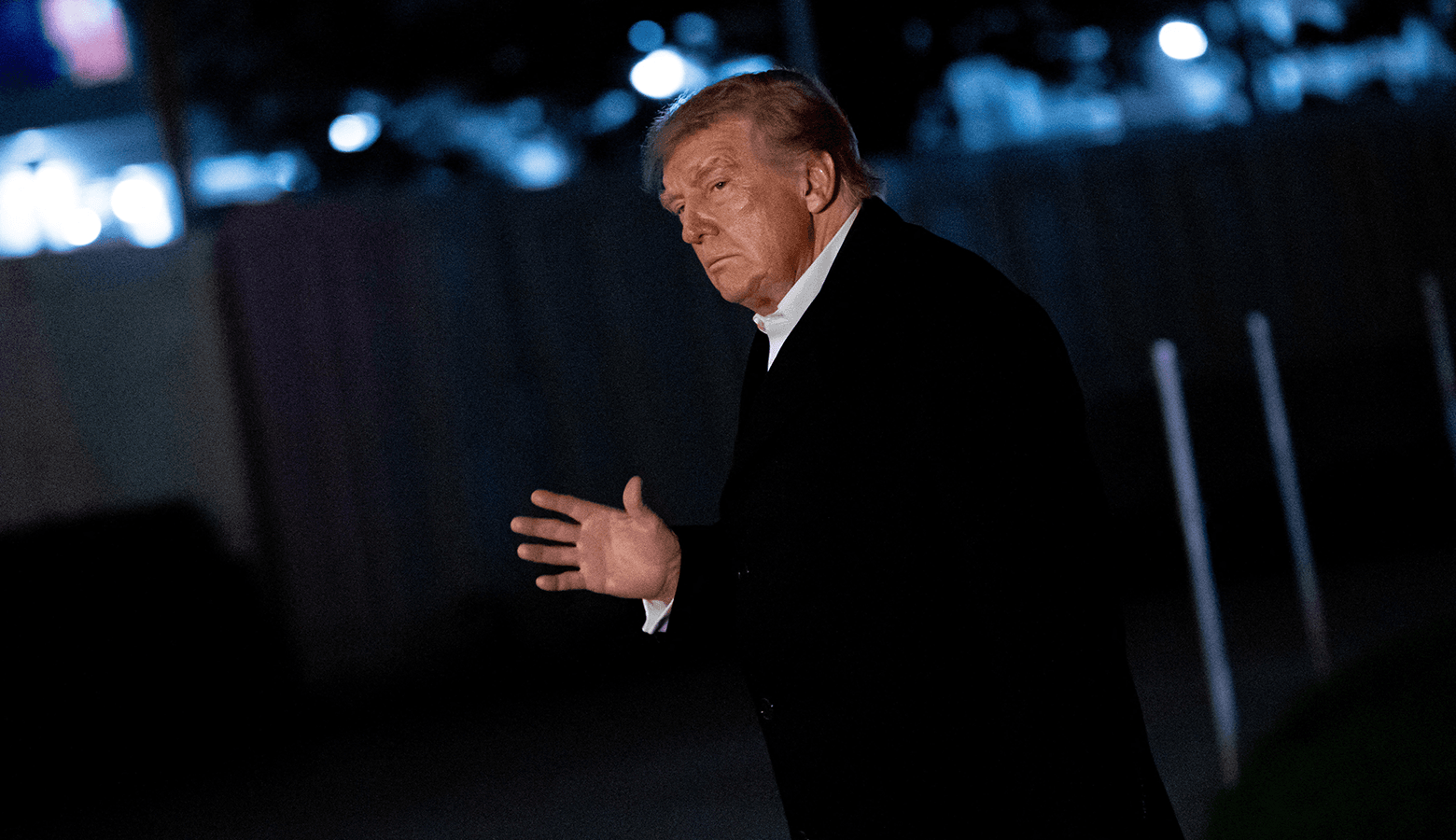
President Donald Trump gestures while walking across the South Lawn as he returns to the White House after traveling to Kansas, in Washington, DC, October 20, 2026. REUTERS/Nathan Howard
The economy is almost always the main issue at the top of mind for American voters, and according to a new piece from The New Republic, President Donald Trump might have inadvertently helped usher in a "new economic era" as he destroys the GOP's ability to leverage that issue to maintain power.
As New Republic staff writer Monica Potts explained in a Sunday morning piece, Republicans have, "for decades," been more trusted on the economy with voters than Democrats. However, that streak appears to be coming to a crashing halt in the 2026 midterms, as polling indicates that voters now trust Democrats more on the issue, signaling a "seismic change" in the American political landscape that runs much deeper than simple headlines about gas prices.
"For decades, voters have trusted the GOP to keep the gross domestic product growing based on one misleading idea: They know that the GOP is the party of business, so they just assume surely the pro-business party is better for the economy," Potts wrote. "But voters are turning away from that, and the reason why could mark a seismic change in American politics: Now, they aren’t so sure that what’s good for businesses is good for them. They’re looking for candidates with not just answers but different kinds of answers than they’ve heard before. If Democrats win next Tuesday and actually deliver next year, it could usher in a new era of policy that finally closes the door on the neoliberalism that has dominated for nearly half a century."
Potts further attributed the notion "that what’s good for the private sector is good for working people" predominantly to the Reagan-era GOP, though noted that it generally has "deep roots" within the party. That was the era that coined the idea of "trickle-down economics," the idea that enriching the wealthy would allow them to pass more money down to the rest of us, which has stuck in the collective understanding of the economy despite having been disproven many times.
"Many voters still think the government causes inflation and is massively inefficient compared to the venerated private sector. They voted for Donald Trump because they believed he was a businessman who could turn things around," Potts added. "Today, as corporations continue to rake in record-high profits and billionaires are sending rockets to the moon, the idea that working people’s fates are tied to theirs is less sellable. Voters appear to be ready to turn back to the kinds of economic policies that FDR enacted, in which the government actually makes life better for workers across the income scale. They’re increasingly willing to tax the wealthy in order to do it and are listening to Democratic candidates who promise a renewed sense of government responsibility to provide."
She later concluded: "In sum, people are furious at corporations, and they no longer see their well-being tied to what boardrooms want. That creates a new opportunity to tell a story about the role the government can play in making the economy fair and providing the basics—like housing and health care—that people need for a good life. The key is that Democrats can’t just win on that message. They’ll actually have to deliver next year. But if they do, 2026 could stand as one of the most consequential midterm elections in modern history: the year when voters stopped buying the argument that what’s good for Wall Street is good for Main Street."