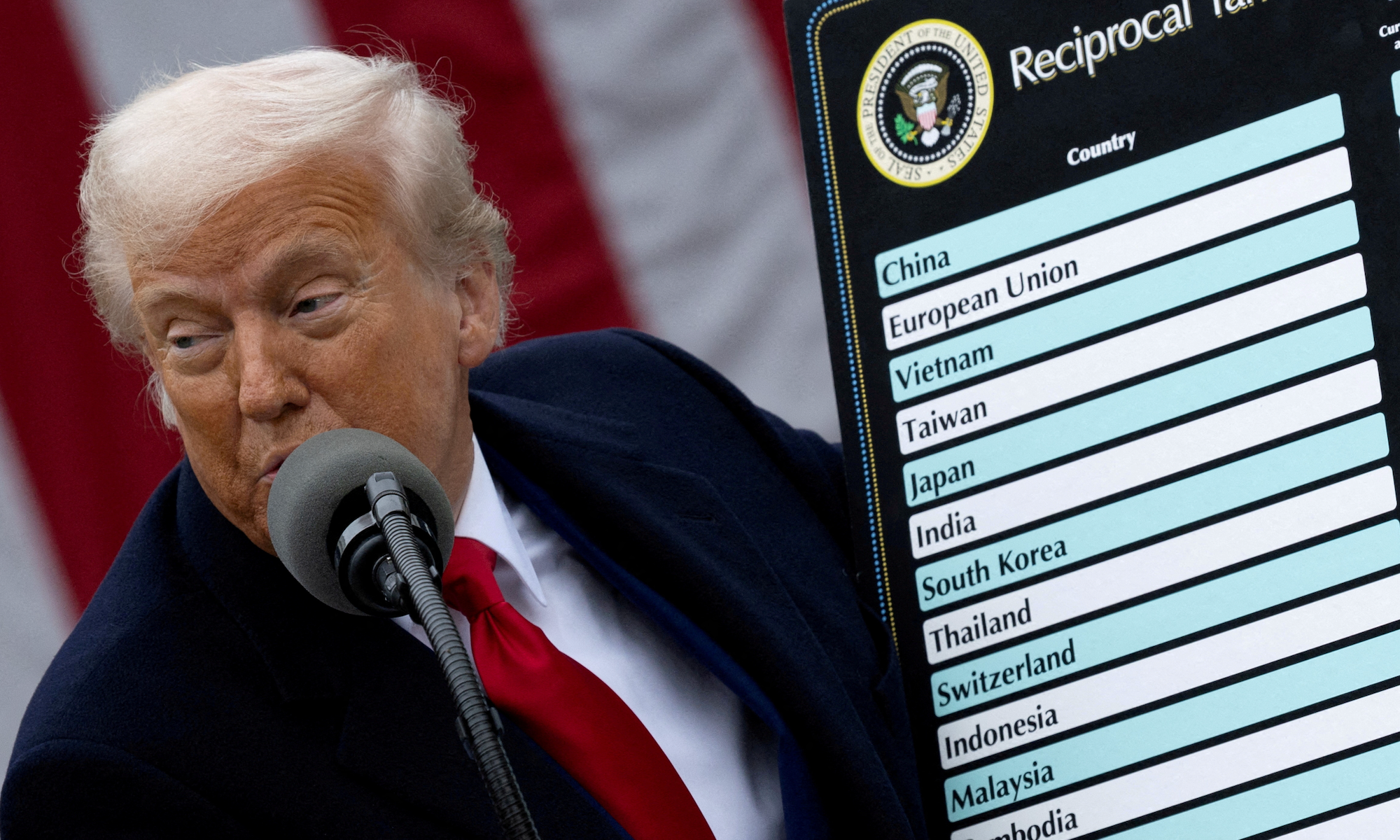
U.S. President Donald Trump delivers remarks on tariffs in the Rose Garden at the White House in Washington, D.C., U.S., April 2, 2025. REUTERS/Carlos Barria
U.S. President Donald Trump delivers remarks on tariffs in the Rose Garden at the White House in Washington, D.C., U.S., April 2, 2025. REUTERS/Carlos Barria
As Donald Trump expresses frustration over his meager approval ratings despite claims of "unprecedented success," a report from The Dispatch found the GOP lawmakers remain in denial over the political cost of tariffs, "like the GOP’s biggest self-inflicted wound."
During a Tuesday address to House GOP members, Trump said that he wished the assembled lawmakers "could explain to me what the hell’s going on with the mind of the public," which continues to sour on his presidency even as he claimed to have "the right policy." As The Dispatch explained, Trump's overall approval rating with voters has hovered around 40 percent in recent months, a considerable decline from last January, when he returned to the White House with a near 50 percent ratings. His handling of the economy and cost of living has largely been blamed for this decline, as his approval on those issues has been even worse.
The Dispatch's Friday report highlighted numerous key reasons why Trump's sweeping tariff policy had done the most damage to the economy, as, despite his repeated claims that foreign countries pay the cost of them, the new tariffs have amounted to a massive new tax on American consumers and small businesses.
"Tariff revenue has jumped to about $30 billion per month under Trump’s second term—up from about $6 billion per month in 2024," the report explained. "In other words, Trump’s tariffs translate to a nearly $300 billion a year — $3 trillion a decade — tax increase paid by American consumers and businesses. A Marist/PBS poll in December found that only 36 percent of Americans approved of Trump’s handling of the economy. According to Gallup, the percentage of Americans satisfied with the direction of the economy has declined by 14 percentage points since Trump’s tariffs took effect last spring. A YouGov poll from November found that 73 percent of Americans said Trump’s tariffs had increased prices they’ve paid."
In the face of all that evidence, however, the GOP lawmakers that The Dispatch spoke to were "largely still singing the praises of Trump’s tariff policy."
I’m very supportive of the president’s agenda when it comes to tariffs — renegotiating our trade deals and making sure we’re not getting ripped off by foreign countries,” Rep. Eli Crane, an Arizona Republican and member of the House Freedom Caucus, told the outlet. “There was no way to change the system that we had without some pain points for certain industries. But on the whole, I think it was a very good move.”
When pressed as to why Trump's approval was so low, Crane deflected, saying only that he is "not a pollster" and that he still approves of the tariffs.
Rep. Chip Roy, a Texas Republican, took the stance that many in the party have taken in response to Trump's economic woes: that it's the Democrats' fault.
“Affordability is getting crushed by disastrous health care [policy] that Democrats created and by housing costs have been going up both because of regulatory issues and, frankly, a whole lot of meddling—institutional buyers, foreign buyers," Roy said. "It’d be hard to blame tariffs on where we stand now."
Rep. Harriet Hageman, the Wyoming Republican whom Trump backed to unseat Liz Cheney, and who is now running for Senate, opted to blame biased media coverage.
“I think there’s been a lot of misinformation about [tariffs], and I think that the mainstream press especially has been trying to find anything that they can to undermine President Trump," Hageman told The Dispatch.
Rep. Kevin Kiley, a California Republican, was among the few who the outlet found who were willing to be less than glowing about the tariffs, as is more common from GOP lawmakers from otherwise blue states.
“Obviously the affordability issue is centrally important, and the cost of living continues to be far too high and far too many people,” Kiley said.