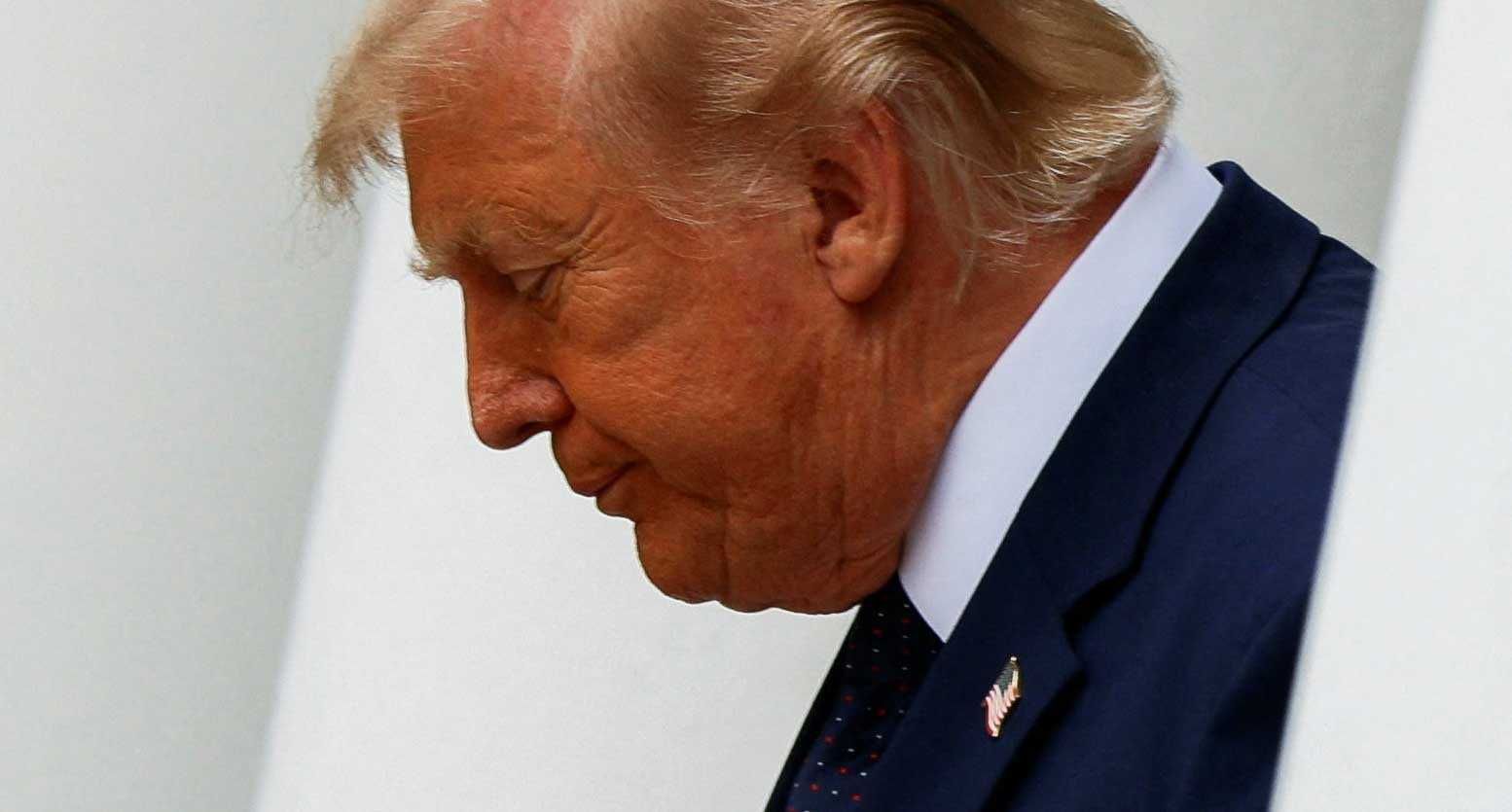
President Donald Trump arrives for a Rose Garden Club Lunch at the White House in Washington, D.C., July 6, 2026. REUTERS/Evan Vucci
President Donald Trump's toxic leadership led to a historic wipeout for the GOP in last week's midterms, and according to one prominent New York Times columnist, there was proof that such a brutal swing was coming a year ago.
As the results continue to trickle in, Democrats are expected to end the midterms with a staggering 56 Senate seats and around 260 House seats, having handily won majorities in each chamber before Election Night wrapped up. This blue wave — widely touted as a "blue tsunami" — now represents the worst midterm performance for the GOP since 1974, the first election cycle after the Watergate scandal.
In the latest of his series of videos interpreting last week's results, liberal Times columnist Jamelle Bouie tried to articulate a timeline of events for what led to the public souring on Trump after he came to the White House with a popular-vote win and an approval rating above water. As he argued, the turn did not begin with the high-profile scandals at the start of 2026, as many pundits have argued, but back in 2025.
He backed this up by noting that Trump suffered a "steady deterioration" of his approval ratings right from the start of his second term.
"Although people do not express it in these terms, I think what that represents is a reaction to the president's authoritarian designs. One of the first big pivot points in public opinion was the attempt to rendition Kilmar Abrego Garcia to CECOT in El Salvador, that weird gulag prison place. The administration touted their renditions of immigrants to CECOT. It was a big part of their public-facing message.
He continued: And the public did not like it. Did not like it so much that the Supreme Court, full of people happy to grant discretion to the president when it comes to the use of immigration authority, refused to let the administration ship people to that prison. What you see throughout, with every single gambit, with every single attempt to consolidate some kind of authoritarian regime in this country, is the public recoiling. They recoiled at the National Guard deployments. They recoiled at the aggressive use of ICE and Customs and Border Protection. They recoiled at the attacks on universities. They recoiled at the ugliness of the assault on civil society. They recoiled at Elon Musk and DOGE in that effort to destroy the federal bureaucracy."
In the face of this unrelenting tide of ugly stories, voters went to the polls in the 2025 off-year elections and handed Republicans decisive defeats in places like New Jersey, Virginia and New York City. As Bouie noted, the margins for those Democratic victories align closely with the popular vote margin they just posted in the midterms, signalling that Trump's fate was already sealed last November.
"It's one thing after another, one thing piling up after another that is driving the president's decline," Bouie continued. "Such that by last November in the Virginia and New Jersey statewide races, you saw 12, 13, 14-point swings toward the Democrats. Swings that replicated themselves all across the country in other places where there were special elections. At the time, I thought those swings were indicative of something happening below the surface, of a public that had grown truly tired of the president. Others were skeptical. But what's clear is that I was right. What's clear is that that was the case, that those swings were harbingers of things to come."
Many have argued, including Vice President JD Vance, that the Iran war was the single overriding issue that led to the GOP's defeat on Tuesday. Bouie argued, instead, that the war was instead the issue that made it impossible for Trump to turn things around with voters to any meaningful degree.