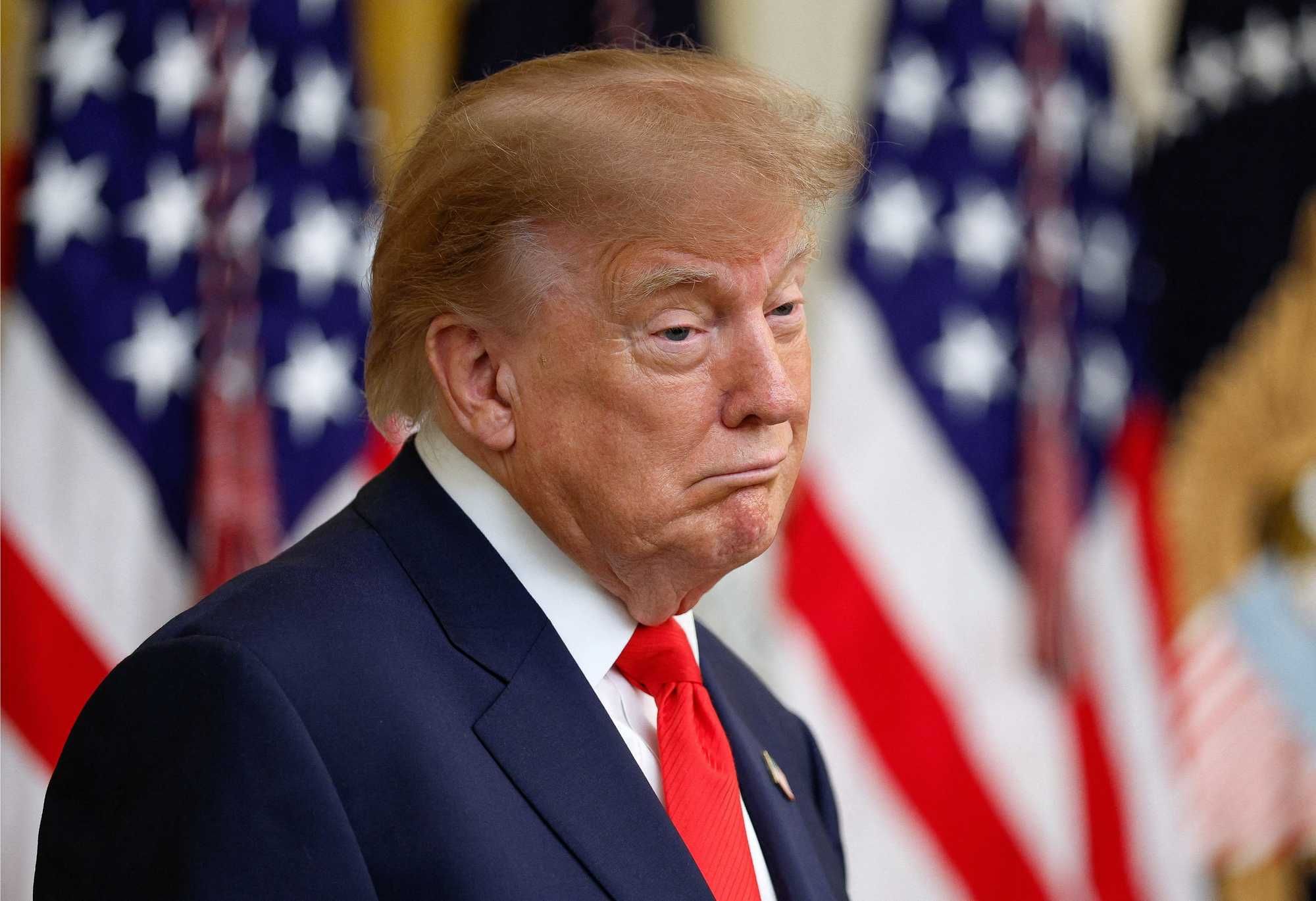
US President Donald Trump reacts during a Columbus Day celebration in the East Room of the White House in Washington, D.C., US, October 9, 2026. REUTERS_Evan Vucci
On Friday, a new report revealed the bizarre lengths to which the Trump administration was willing to go when attempting to justify its noncitizen voter claims. According to election officials who spoke with NPR, the Department of Justice was so avid to identify examples of these voters that it found them in the future.
In California’s Santa Cruz County, for example, top election official Tricia Webber said that in the run-up to the midterms, her office received a list of 81 people the DOJ had marked as suspected noncitizens registered to vote in her county. But according to Webber, there were a few problems with the names included on the list as "more than half are not registered in Santa Cruz County,” “some names do not match any person currently registered or previously registered," and some dates of birth "were wildly inaccurate with some dates appearing well into the future like 2044."
According to NPR, Webber’s story was far from unique. While President Donald Trump claimed before the midterms that there were 250,000 noncitizens registered in four states, including California, once state officials began to push back against the assertion, administration officials admitted that number was merely what they considered the “ceiling” of potential noncitizen voters. Then in mid-October, federal officials sent California a list of what it said were 20,000 "likely" noncitizens registered to vote in the state. But after a federal judge allowed data experts from the University of California to analyze the list in the final days before the midterms, the analysis revealed that 42 percent did not appear on California's current voter roll and that naturalized citizens were included on the list. Beyond that analysis, several California counties have pointed out that the lists were riddled with duplicates and obvious inaccuracies – like the 2044 birthdays.
In court hearings under questioning from judges, even DOJ attorneys have admitted the lists are flawed. According to NPR, U.S. District Judge David Carter, a Clinton nominee who was presiding over the federal government's lawsuit against California, was going to hold proceedings to assess the accuracy of DOJ's lists. That will no longer happen, however, after the DOJ dropped its lawsuit.
According to Loyola Law School professor Justin Levitt, questions remain about whether federal officials violated the Privacy Act by using California voter roll data to create these lists without following required public notice procedures. And according to David Becker, the executive director for the Center for Election Innovation and Research, once the Democratic majority assumes control of Congress, lawmakers could hold hearings to determine how the Trump administration produced its list. "I think we're going to have some very serious scrutiny of the Department of Homeland Security and their methodology as they assisted the administration in its failed effort to try to demonstrate there was widespread noncitizen voting in this country," Becker said.