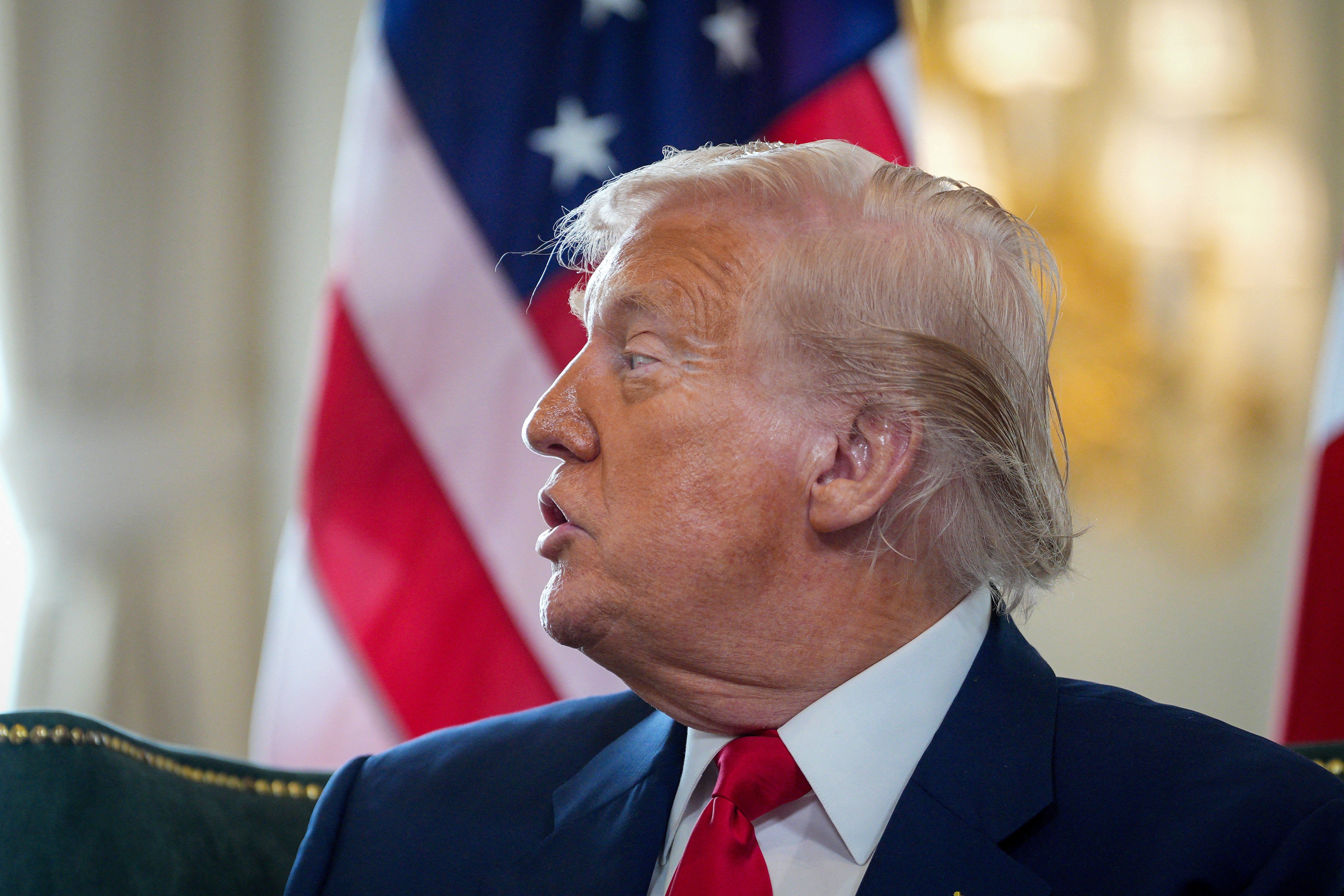
U.S. President Donald Trump speaks during a meeting with British Prime Minister Keir Starmer (not pictured) at Trump Turnberry golf club on July 28, 2025 in Turnberry, Scotland, Britain.
President Donald Trump has made it very clear that, if it is within his power, he will steal the 2026 midterm elections rather than allow Democrats to win them. If he succeeds, America will cease to be a democracy — yet even if he fails, he has already made democracy in America into an "if" rather than a given.
That, at least, is the assessment of Dr. Steven Levitsky, Professor of Government at Harvard University. When he spoke with me for AlterNet, Levitsky made it clear that there is a non-zero chance of Trump successfully turning America into an effective dictatorship before the 2026 election cycle is over. The question is not whether he has the legal authority to declare martial law, send the military (and/or ICE and/or other forms of law enforcement) to seize ballots or to demand Republicans in Congress simply refuse to seat Democrats. From a strictly legal perspective, he cannot do any of those things.
The concern is that Trump also has what Levitsky described as "de facto" power — that is, the capacity to effectively implement these or other anti-democratic measures in defiance of the law. After all, Trump has already engaged in mass deportations, silenced media critics, levied tariffs, destroyed national monuments and slapped his name all over the place regardless of the legality behind those measures. Perhaps most notably, he attempted a coup after losing the 2020 presidential election to Joe Biden and was able to regain power thanks to the complicity of right-wing media and the complacency of America's top legal and business institutions.
In that sense, as Levitsky pointed out, American democracy is already in a sense permanently weakened. We are no longer a consolidated democracy, or one in which democratic institutions consistently work even if there are other social injustices; we are an unconsolidated democracy, or a government in which it is never entirely certain whether basic democratic structures will remain in intact.
This interview has been lightly edited for clarity, context and length.
Trump trying to steal the midterms through brute force.
Rozsa: President Trump has repeatedly said, either directly or through various surrogates, that he is considering declaring a national emergency, implementing martial law, sending ICE or the military to the polls, and in other ways directly hindering the actual process of the election occurring. Does he have the power to do these things?
Levitsky: Well, it depends whether you're talking about de facto power or legal power, constitutional power. I'm not a constitutional expert, but most would agree that he does not have the formal power to do these things. The Constitution gives the federal executive almost no power over election administration. That is left to the states. So the kind of federal intervention that Trump is talking about is almost certainly unconstitutional.
The real issue, of course, is whether he has the de facto power to do it, whether he can pull it off. And first, I'd say from the outset, I have no doubt that Trump is willing to order some sort of a coup against democracy to try to overturn the elections. He has shown over and over again that he is not a democrat and is perfectly willing to engage in really old-school authoritarian tactics to overturn elections.
We don't know for sure whether he can get away with it. There are some troubling signs. One of them is that we're just completely unprepared for a sort of radical seizure of power in this way. The courts have been pretty good, not great, on Trump's efforts to sort of overstep his bounds on elections, but courts move slowly. And it's just not at all clear, if on election night Trump were to order the seizure of ballot boxes, declare some kind of an emergency, mobilize troops, that courts could move quickly enough to stop it. So at the very least, it would create a massive, massive crisis.
But ultimately, I don't think he's got the power to get away with it. Unfortunately, we're living in a world where the chances of it happening are well above zero. But looking at, one, Trump's public support and his political power, which is in pretty sharp decline: there's a lot of evidence that the most successful assaults on democracy are carried out by presidents with 70, 80, 85% support, whether it's Putin or Hugo Chávez or Fujimori or Bukele. All of these guys had 80% support. Trump's at 35, 36.
And secondly, if you look at the Trump administration's record in planning, orchestrating, carrying out major policy initiatives, from DOGE to the Liberation Day tariffs to the war in Iran, it's just utter, utter incompetence, lack of foresight, lack of coordination, lack of planning. Fraud is hard. Repression is hard. Destroying constitutional rule is hard. If I had to bet a dollar — glad I'm not — I don't think these guys have the capacity to do it.
Rozsa: When I talked with Justin Levitt from Loyola Law School, he was very doubtful that Trump could use law enforcement and/or the military in this way. I then interjected with a recent quote from attorney Peter Ticktin, who is one of Trump's advisers. When someone told Ticktin that there would be riots if Trump attempted a coup, Ticktin responded, quote, "Our armed forces are a lot bigger than they are." Levitt then replied that this was a fantasy. But my question is, do you think Ticktin has a point, logistically speaking?
Levitsky: What does "logistically speaking" mean?
Rozsa: That because their armed forces are a lot bigger than the forces that could be arrayed against them, they could ultimately carry out a coup.
Levitsky: Well, this is a little frustrating because, again, there is a non-zero chance that they could carry out a coup. The reason why I think it's a relatively low probability — and we're dealing with a lot of speculation here — is that they have to pull off two things to militarize in that way. One, they've got to get the military to go along with egregiously, openly anti-democratic behavior, which they might, but it's not certain that the military would go along. And secondly, repression is really hard, especially if you're talking about an unpopular government in a context where there isn't a perceived crisis. In the aftermath of something like 9/11, or if we were at war, or if there were a real subversive organization in the country — if Americans were really scared about something, or if they really liked Trump — they'd be more likely to tolerate repression.
This is a context that is very unfavorable for carrying out repression. Look at what the Trump administration tried to do in Minnesota. They made the streets of Minneapolis look like El Salvador in the 1980s for a while, and it blew up in their face politically. And so if they couldn't militarize Minneapolis in January 2026, I think chances are that an effort to do it at the national level would fail.
Rozsa: Certainly, I hope you're right, but here is my counter to what you're saying, and I want to emphasize I'm playing devil's advocate. I'm not necessarily disagreeing with you, but this is the thought that keeps occurring to me. It's the information ecosystem in which a lot of Americans choose to live. To illustrate what I mean: after January 6th, I kept hearing over and over again, "That's it. Trump's political career is dead. He just attempted a coup." Even some right-wing media outlets were initially critical of him. But then the far-right outlets were backing his attempts to gaslight people about what happened, and soon even the more mainstream conservative outlets began to fall in line, either downplaying it or contributing to the gaslighting, so that by the time the 2024 election rolled around, an event that had once been considered disqualifying was no longer an impediment to him being reelected.
Using that same reality, what is to stop CNN, which is soon going to be taken over by a pro-Trump family, and Fox News and all of these conservative outlets from spinning their own version of events regarding Trump's coup attempt, and in so doing, reducing the backlash against it? Do you see what I'm saying?
Levitsky: Yeah, look, I take your point about January 6th and the elite reaction to January 6th. After the shock wore off, after two or three days, when Republican politicians kind of put their finger to the wind, the elite abdication that occurred after January 6th was shocking. I certainly didn't expect it, and it was really costly. The reason why we have Trump today, and the reason why we're facing this threat, is exactly the dynamic you just described: that elites just decided to look the other way.
Could that happen again? Well, the thing to watch, and what was really critical in the 2021–2024 period, which I agree with you was just really, really decisive, was the behavior of Republican elites. Almost all Republican elites got in lock[step]. A few of them wandered off the reservation for a couple of weeks, but they all came back. And the ones who didn't, like Liz Cheney, were purged from the party. The unified Republican message that January 6th was okay, was justified, was acceptable, that the election might have been unfair — it was the fact that it was a unified message coming from the Republican elite. That's what allowed that myth to persist and allowed Trump to remain politically viable.
So one of the keys, one of the things to look for, is how Republican leaders would respond to this coup. If there is unified or even majoritarian Republican politician support or acquiescence or even silence in the face of this coup, then we're in worse shape. If a number of leading Republicans speak up, we'll be in better shape. But even so, Trump has less support, even in his own coalition, than he had back in 2021. I think the evidence shows that the support is weaker. It's thinner. And you can throw in CNN if you want, but the right-wing media ecosystem is real, but it's a third of the country. It's a third of the country. And a third of the country may well mobilize or support a coup attempt. I think there's reason to think that much of that MAGA base would support it. But Fox News lying about the coup is not going to affect majority public opinion in the United States.
Rozsa: CNN, by the way, will also lie about it now that it's been purchased by the Ellisons. And I would say I'm not only concerned about Republicans —
Levitsky: CNN might lie about it. We don't know that.
Rozsa: I think they will. I think Ellison has made it very clear where he stands. But my —
Levitsky: Ellison wants to make a lot of money in the medium term. And with Trump this weak, that's a hell of a bet, to bet on a coup.
Rozsa: Well, the other point I wanted to make is it's not just Republicans who need to go along. Jacob Weisberg wrote a great book called Profiles in Cowardice about individuals who aren't part of that coalition, but for transactional reasons decided to participate. People like Jeff Bezos, people like the head of the law firm Paul, Weiss. That type of logic, which argues that only a sucker makes a sacrifice in the name of principle, that a smart person goes where the power is — that could also facilitate a coup. What do you think?
Levitsky: I think you're misreading the balance of power today. This is not December 2024. It's not January, February 2025. Trump is in a political [corner]. He's politically weakened. And I'm as dismayed at the behavior of Paul, Weiss and universities and Jeff Bezos as Jacob Weisberg is. But those guys are making a different calculation today. To jump on the Trump train as it's descending into chaos is a much, much [riskier bet]. It turned out to be a pretty stupid bet in early 2025. The law firms that cooperated, the universities that cooperated — they're not better off for having acquiesced to or appeased Trump than those that ultimately resisted. But as Weisberg lays out in his book, there was a logic to it.
And it's not a very pretty logic from the standpoint of someone who cares about democracy, but there was a logic to it. I don't think that logic exists anymore. I think it's utterly irrational for somebody who's thinking about making money in the next two years to support a coup led by somebody that's unpopular. It's super high-risk.
Trump trying to steal the midterms through legal chicanery.
Rozsa: Now I want to talk about another way that Trump could pull this off. Let us say, hypothetically, that he isn't able to overturn the results through physical force and all of his efforts at frivolous litigation fail. He could, through the bureaucracy, get Democrats who were elected ultimately rejected. And I'm thinking of two possible methods. The first is through bureaucrats that he's embedded in positions of election administration and certification who believe in the Big Lie. And the second is by convincing Speaker Johnson or Leader Thune to reject Democratic victories when they are handed over to Congress in 2027. What do you think of either of those possibilities?
Levitsky: In terms of the first one, there's been talk in my world of kind of packing local election administrations with election deniers, and to some extent that has happened. But I don't think it ever amounted to as much as the supporters hoped and people like me feared initially. And again, looking at this administration and its efforts — its war efforts, its tariff efforts, its DOGE efforts — it strains my imagination to think they could pull off some kind of extraordinary coordinated feat like this. The Johnson Congress option —
Rozsa: Or Thune.
Levitsky: Or Thune, yeah. I think that is more credible. First of all, it's entirely legal, it turns out. If Republican candidates scream fraud and Johnson can point to a, quote-unquote, contested election, it is actually in his power to decide who gets the seat. And looking at his behavior, I think he'd do it. And if the balance of Congress [hinges on] a handful of seats — three, four, five seats — I'm going to worry a lot about that. To the extent that the Democrats achieve some sort of a landslide, that becomes less likely, becomes more difficult. We have to be very thankful that Trump is so unpopular that the Republicans are tanking this badly in the election. If it were a very close election, I would be very worried about that outcome. I'm a little less worried because I don't think it's going to be two or three seats holding the balance. I think it's going to be much more than that.
Rozsa: Now, when I asked the same question of Professor Levitt, he said, and I'm quoting, "The key moment isn't anything that Mike Johnson has a part in. The key moment is who's put on the roll of potential House members when at noon the House dissolves as a body. At 12:01, there is no House. There is no Speaker Johnson. He's just a dude. The Clerk of the House is the person who controls the roll. The Clerk of the House has a non-discretionary, very clear statutory duty to recognize the potential members who show up with certificates of election from their states, the things that the state officials have certified." Do you agree with his analysis there?
Levitsky: I'm not enough of an expert on that to say. I have no opinions. I just don't know.
Rozsa: Well, I want to ask this. Do you think it would be possible, if it seemed like Speaker Johnson was considering playing along with Trump's coup attempt, that Democrats could perhaps convince a few anti-Trump Republicans in the House to hold an early election to replace Johnson as speaker with someone who won't go along with him?
Levitsky: Yeah, I think that's actually a relatively likely scenario. Again, and thank God, because Trump is so unpopular and because this sort of a coup would be so unpopular — there's uncertainty, but I think there's a pretty good chance that Democrats could find a handful of Republicans — it wouldn't take many — they need to vote Johnson out.
Rozsa: Of course, my concern is that they'll face so much pressure from the Republican media that they'll ultimately be cowards and just toe the party line.
Levitsky: It's certainly possible. But again, given the balance of public opinion and political strength right now — I mean, in part just given Trump's age and his physical condition — it's very hard to bet on Trumpism in the medium term right now. Much harder than it was even, you know, a year and two quarters ago.
Trump's long-term consequences for American democracy — regardless of the midterms.
Rozsa: I want to take a step back from these immediate questions and ask something much deeper. What does it say about the health of American democracy that these worst-case scenarios are even plausible? I've been following politics since I was a teenager in the late 1990s. I've been covering it professionally since the 2012 election. And in my lifetime, at least, there was never any serious threat to democratic institutions. Based on my research into American history, the closest analogy I can think of was the 1860 presidential election, which ultimately led to a civil war. But even then, it didn't seem like people were questioning that Lincoln had been legitimately elected. They simply didn't want him to win, because then he would limit the expansion of slavery. What does it say about the state of democracy right now that these things are even possible?
Levitsky: I'll put it in boring political science terms. It means that the United States, at best today, is an unconsolidated democracy. I've argued that the United States has actually slid into kind of mild competitive authoritarianism under Trump 2.0. I don't think the regime at present is fully democratic. But even for those who argue that Trump's abuses are not sufficient to say that we've lost our democracy, the U.S. has become what political scientists call an unconsolidated democracy.
My day job is as a Latin Americanist. I've studied political regimes in Latin America for years and years and years. And what I was brought up learning was that democracies in countries like Peru and Argentina were unconsolidated in the sense that there was always uncertainty that all the powerful actors would play by the rules of the game. There was never certainty that everybody was committed to democratic rules of the game.
The United States for years and years and years was held up as an example of a consolidated democracy, where everybody knew that everybody was committed to democratic rules of the game. You could take for granted that elections would be free and fair, that everyone would play by the rules, that the government would play by the rules. There would be uncertainty over the outcomes of elections, but there was never uncertainty around the procedure of the elections. And that is long gone — since the 2020 election, but certainly with all the discussion we've had around the election today. Even if one agrees with me that the likelihood of a coup is relatively low, there is a lot of uncertainty.
There's uncertainty about whether the election will be fair. There's uncertainty about whether the government will accept the results of the election, or that there'll be an effort to manipulate the outcome of the election after the election. That uncertainty is a classic sign of what we call an unconsolidated democracy, an unstable democracy. And that sets the United States apart from all other established democracies in Europe and in Canada, and makes it much more like some of the unstable democracies we see in Latin America and elsewhere.
Rozsa: Have there been any of those unstable democracies in Latin America that went back to being consolidated democracies?
Levitsky: Yeah. Very often, sadly, after they tip into a period of authoritarian rule. But yeah, Argentine democracy was considered an unconsolidated democracy in the 1980s. There were several coup attempts. Today, it's considered a consolidated democracy. Brazil may not be a great example, because they had a similar —
Rozsa: With Bolsonaro.
Levitsky: In 2022. Yeah. So maybe it's not fully consolidated. I think they handled it better than we did. But Argentina is a much more consolidated democracy than it was in the 1980s.