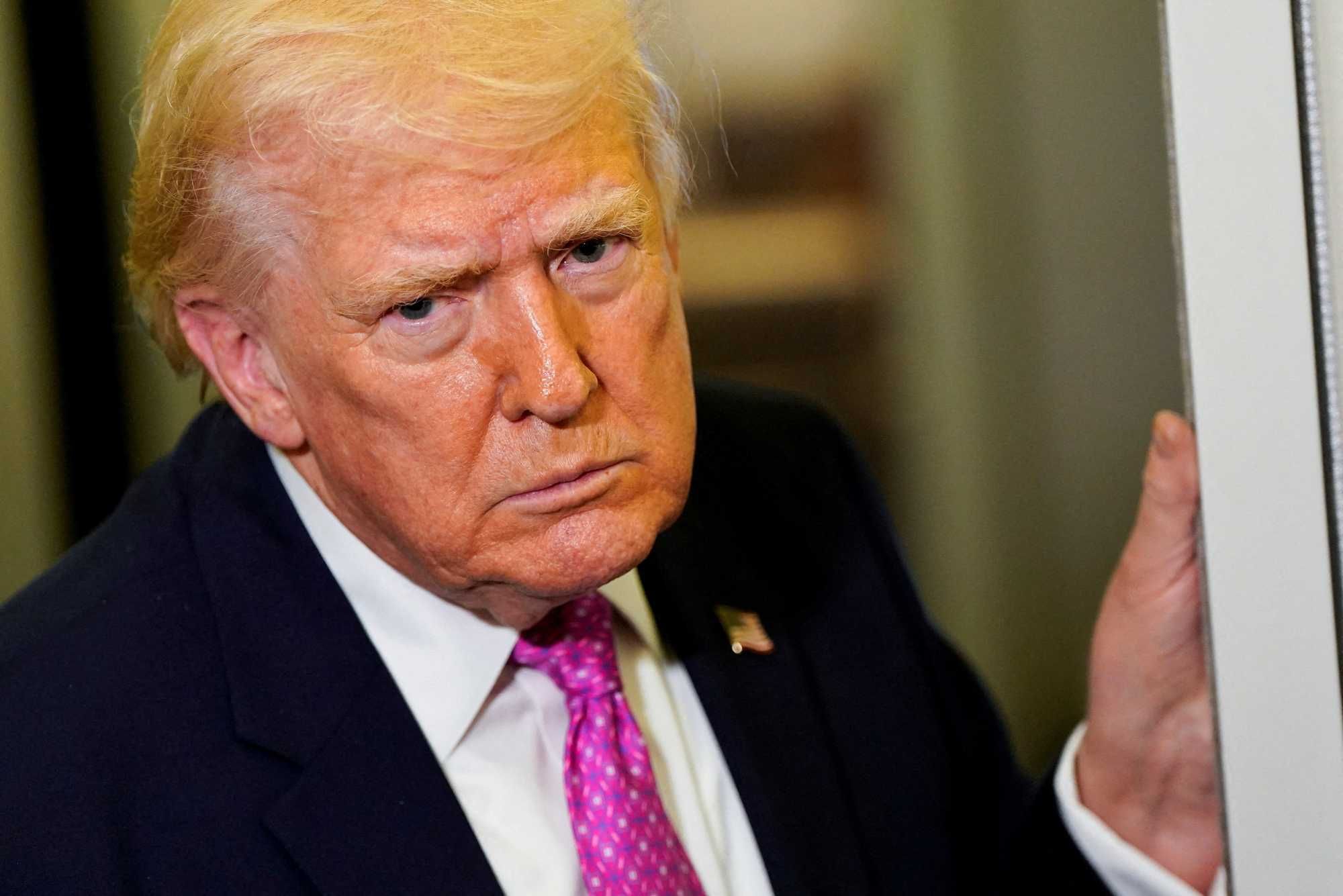
U.S. President Donald Trump looks on as he speaks to members of the media aboard Air Force One en route to Joint Base Andrews, Maryland, U.S., March 29, 2026. REUTERS Elizabeth Frantz
The announcement that the DOJ intends to create a $1.8 billion “anti-weaponization fund” drew bipartisan condemnation over accusations that it would reward convicted J6 rioters, as did a somewhat lesser discussed clause in the agreement, which banned the IRS from auditing President Donald Trump, his family, or organization “forever.” According to CNN, the settlement is about more than mere taxes, and is part of Trump’s concerted effort to undermine presidential checks and balances and insulate himself from future prosecution.
“Trump isdismantling post-Watergate transparency mandates, attacking Congress’ power of the purse, rewarding loyalists accused of committing crimes that support his causes, and assaulting independent agencies and executive branch watchdogs,” writes CNN. According to former government attorneys and constitutional scholars who spoke with the outlet, “Trump has done so by capitalizing on and accelerating an expansion of presidential power embraced by the conservative Supreme Court, and by blowing through norms and political gravity that reined in other presidents.”
Many of the constraints he’s ignoring were set in place by Congress in the wake of Richard Nixon’s abuses. At the time, the goal was to restrict presidential power. But Trump has “barreled through the post-Watergate reforms,” firing inspectors general tasked with investigating fraud and abuse and side-stepping transparency efforts set in place by the Presidential Records Act.
“What we’ve now seen is this dramatic pendulum swing in favor of just more executive power that’s consolidated within the president himself, that’s no longer dispersed,” said University of Southern California Gould School of Law Professor Adam Zimmerman.
Trump’s latest effort involves the IRS settlement, which “is more sweeping inits protections for the president than initially reported. Its language could shield Trump from more than just tax-related probes… but any government claims related to Trump pre-settlement conduct that fits under the agreement’s conception of lawfare’ or ‘weaponization.’”
While those terms are legally meaningless, another part of the agreement defines them in “extremely broad terms,” so effectively, “the deal seeks to forbid all sorts of federal enforcement actions or reviews that could be aimed at past conduct by Trump, his family or his businesses.”
And as CNN reports, Trump’s efforts to shield himself from prosecution extend far beyond the settlement.
“When Trump returned to the White House in January 2025, he did so with the benefit of a sweeping 2023 presidential immunity precedent from the Supreme Court that wasn’t on the books for his first term,” notes CNN. “That Supreme Court case dealt with Trump’s immunity in criminal prosecutions of conduct that could be connected to official presidential acts. But the Justice Department is also now pushing back against the civil lawsuits against the president related to the January 6 assault on the US Capitol. Meanwhile, DOJ is working on regulations that would sideline investigations by state bar associations into department lawyers for attorney disciplinary proceedings.”
This, say critics, results in an atmosphere in which pro-Trump lawyers will be encouraged to break ethical rules on behalf of the president, such as those who fought for his efforts to overturn the 2020 election.
What’s more, “the broad criteria for whom could benefit from the nearly $1.8 billion fund could incentivize individuals to not comply with congressional investigations into the president.” Trump has already leveraged the Justice Department to attack and punish those who supported investigations into his conduct, while erasing legal threats to his allies. As CNN detailed, “Capitol riot prosecutors and DOJ employees involved in former special counsel Jack Smith’s investigations were fired. The Justice Department dismissed the contempt-of-Congress case against former Trump adviser Steve Bannon, for his defiance of a House January 6 probe subpoena. Former FBI Director James Comey and New York Attorney General Letitia James — both the faces of high-profile investigations into Trump — have been targeted with criminal charges.”
And in regard to his allies, “Trump granted clemency to everyone charged or convicted in the Capitol attack, and now top administration officials are not ruling out those defendants — including those convicted of assaulting law enforcement — receiving payouts from the new fund.”
“He’s sending the signal louder every day, that if you commit a crime on his behalf, you have nothing to worry about. In fact, you’ll be celebrated, and perhaps rewarded financially,” said Gregg Nunziata, who previously served as a lawyer in several Republican Senate offices.
“It is a completely fair concern that this could be part of a significant set of incentives for people not to potentially participate in future government investigations, or even the legislative hearings that, we might imagine, would take place if the Democrats took the House or the Senate,” warned Zimmerman.
According to former longtime DOJ attorney Doug Letter, “It takes a certain amount of honorable conduct for our government to work,” and Trump’s goes “so far beyond what anybody thought when putting together the Constitution and our system of government, I am not sure what the real check is, other than impeachment.”