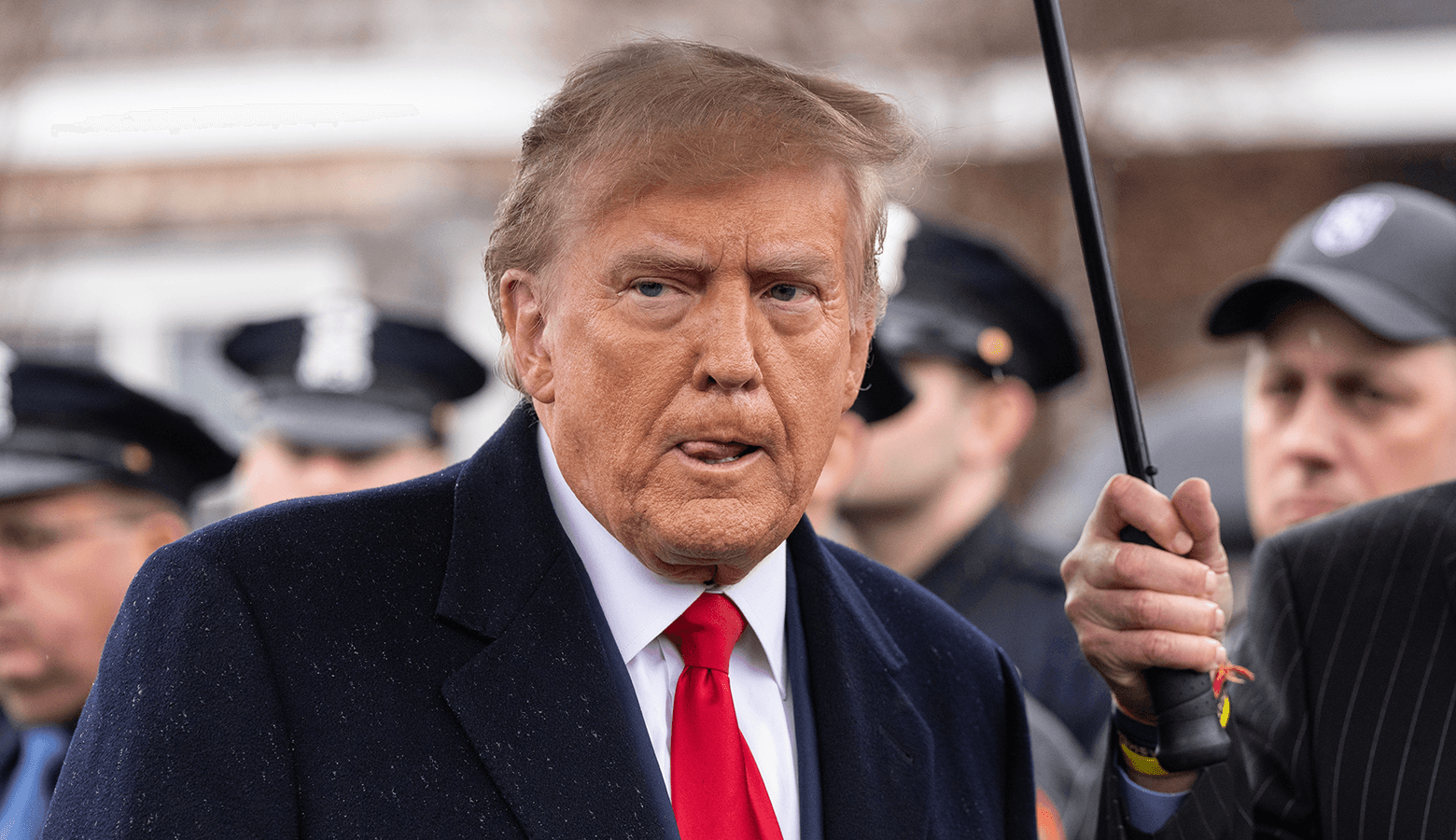
President Donald Trump speaks to the press after attending a wake for an NYPD officer at Massapequa Funeral Home in Massapequa Park, NY, on March 28, 2024, Image via Shutterstock.
The executive-dominated political landscape in which President Donald Trump has reigned in the White House is a far cry from how the Founding Fathers envisioned the U.S. running, and according to a new breakdown from The i Paper, he will soon face a harsh lesson about who is really supposed to run the country.
On Sunday, veteran D.C. correspondent Nick Bryant published a new piece explaining how warped the structure of the U.S. government has become, culminating in Trump's ruthless second-term power grabs.
"This is not how the Founding Fathers intended the power dynamics of Washington to work," Bryant wrote. "Knowing George Washington would be the first incumbent, they granted the president significant authority – greater prerogatives, paradoxically, than those wielded by King George III in Britain. Congress, however, was supposed to be the dominant branch of government. The drafters of the US Constitution gave lawmakers on Capitol Hill the power of the purse, the authority to raise taxes, to advise and consent on international treaties, to approve presidential nominees, to conduct investigations, to impeach and remove a president and even to decide the outcome of a disputed presidential election."
He added: "The power ranking was clear. Congress would be first, the presidency would be second and the Supreme Court a distant third. Now, we have witnessed an upending. The executive is the most powerful branch. The Supreme Court, with its present six-to-three conservative majority, is second. Congress trails a distant third."
Bryant noted that the U.S. being engaged in a near-constant state of military conflict since 9/11 has made the concentration of power with the president even worse. The overwhelming obstructionism of Republicans during Barack Obama's presidency also worsened things, pushing him to exercise greater executive authority in order to get anything done at all.
Trump, though, has been the worst offender by a mile, engaging in wars, approving destructive new building projects and upending decades of federal policy on a whim, all without any attempt to get congressional approval.
Now, however, with Democrats poised to retake the House, and even possibly the Senate, in the midterms, Trump could soon face a tough lesson in the real power structures in Washington.
"All this could change, of course, if the Democrats win back the control of the House of Representatives, which seems likely, and the Senate, which now seems possible," Bryant wrote. "They would use the subpoena powers of Congress to investigate alleged corruption in the Trump administration. They could block new Trump Cabinet appointees, and haul existing administration officials more regularly before congressional committees. With a majority in the House, they could even impeach Trump for a third time, although the chances of removing him from office at the conclusion of a Senate trial, where Senators serve as jurors, is next to impossible. That needs a two-thirds majority vote, and would require Republicans to turn on the President."
He concluded: "Democrats are not only battling for control of Congress. Something larger is at stake. They are fighting to reassert this embattled institution’s constitutional relevance."