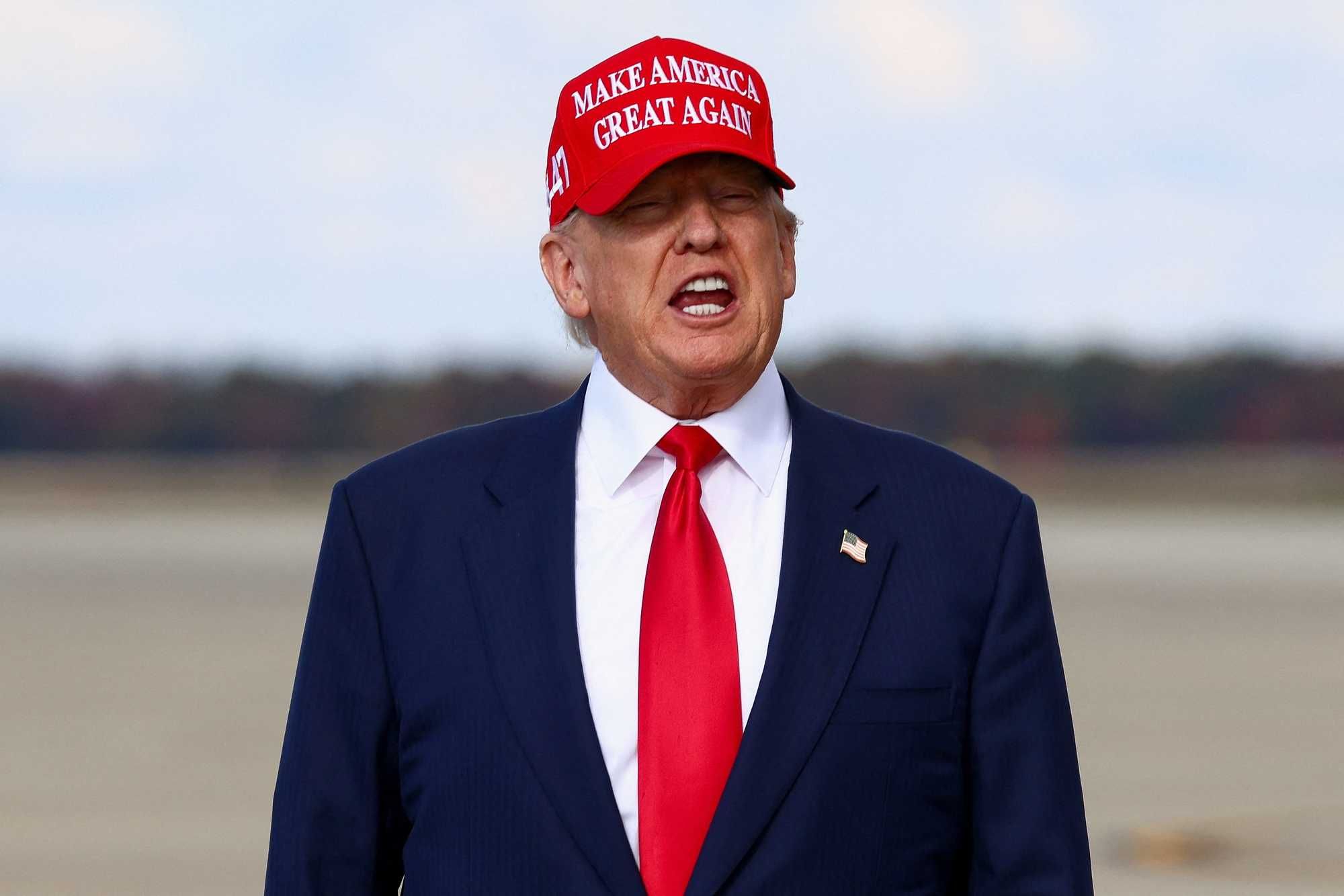
U.S. President Donald Trump speaks, while wearing a Make America Great Again cap, after disembarking Air Force One, as he returns from his Asia trip, at Joint Base Andrews, Maryland, U.S., October 30, 2025. REUTERSEvelyn
Especially in these dark times, it’s important to salute courageous individuals who stand up to Trump’s tyranny.
My latest Joseph Welch Award (named after the courageous attorney who stood up to Joseph McCarthy in the 1954 Army-McCarthy hearings) goes to the 21 Indiana Senate Republicans who stood up to Trump last Thursday.
Indiana’s GOP-controlled state Senate rejected 31 to 19 the map that would have gerrymandered two more safe red seats. The vote may have imperiled the Republican Party’s chances of holding control of Congress next November, but it strengthened American democracy.
The failed vote was the culmination of a no-holds-barred, four-month pressure campaign from Trump and his White House on recalcitrant Indiana Republicans. The pressure included private meetings and public shaming from Trump, along with Trump’s threats to primary them next time they’re up for election (“They … should DO THEIR JOB, AND DO IT NOW!” Trump posted. “If not, let’s get them out of office.”).
The pressure also included multiple visits to the Hoosier State from JD Vance, whip calls from Speaker Mike Johnson, and veiled threats from Washington to withhold federal funds from the state. Republican legislators were also subjected to pipe bomb threats, unsolicited pizza deliveries to their home addresses, and swatting of their homes.
Turning Point Action, the organization founded by Charlie Kirk, pledged to spend tens of millions of dollars to primary any Republican who voted against the redistricting map.
Chris LaCivita, Trump’s 2024 campaign manager and adviser to Fair Maps Indiana, a dark-money group that blitzed the state with ads in recent weeks, also threatened retribution. “If you don’t defend a political movement from those that stand in the way — then it’s not a movement at all — a handful of politicians in Indiana will now know what standing in the way really means.”
Heritage Action, the political arm of the Heritage Foundation, made explicit in an X post Thursday that Indiana would risk all its federal funding if the Indiana Senate didn’t vote for the new map. “Roads will not be paved. Guard bases will close. Major projects will stop. These are the stakes and every NO vote will be to blame.”
Yet — a majority of Indiana’s Senate Republicans voted against the map. How to explain this?
Mitch Daniels, who served as governor of Indiana from 2005 to 2013, blamed Trump’s bullying tactics: “Washington-based enforcers demand maximum, sacrificial loyalty or else. In this case, each of those so threatened has a constituency of friends and supporters. It’s an odd way to build a winning party.”
Daniels also noted that the in-your-face partisanship of Trump’s effort was “not likely to improve the party’s standing with independents, or to inspire its own adherents to turn out next year.”
But there was something else that gave Indiana Republicans the courage to reject Trump’s map. This factor is profoundly important to the future of America. Let me explain.
American politics today is divided between two groups — fanatics who view politics as a form of warfare, and institutionalists who view politics as a means of implementing democracy.
To fanatics, winning is everything. To institutionalists, democracy is everything.
This divide is becoming more significant than the old political divides — conservative versus liberal, right versus left, or Republican versus Democrat. Both warfare fanatics and institutionalists can be found among Democrats, as well as Trump Republicans.
Trump and the people around him are extreme fanatics. To them, America is already engaged in a civil war. They view those who oppose them, including many who call themselves Republicans, as their sworn enemies — against whom scorched-earth tactics are entirely justified.
“We have a huge problem,” said Trump’s former chief strategist Steve Bannon, who simulcasted his “War Room” show live from a suburban Indianapolis hotel just before the vote. “We’ve got a net five to 10 seats [in the House of Representatives]. If we don’t get a net 10 pickup in the redistricting wars, it’s going to be enormously hard, if not impossible, to hold the House.”
But institutionalists don’t view politics as a form of warfare. They see it as a form of service — part of a civic tradition that’s older and more honorable than the win-at-any-cost fanaticism we’re now seeing.
Indiana is a deep-red state, to be sure. But it also has a strong tradition of political responsibility and civic integrity. And last Thursday, Indiana’s civic tradition won out.
Indiana state Senator Spencer Deery, a Republican who opposed the redrawn map, put it clearly: “The power to draw election maps is a sacred responsibility directly tied to the integrity of our elections and the people’s faith in our constitutional system.”
State Senator Greg Goode, another Republican, contrasted that civic tradition with the warfare fanaticism threatening it. In his floor speech before voting against the gerrymandered map, Goode said:
“The forces that define [the] vitriolic political affairs in places outside of Indiana have been gradually and now very blatantly infiltrat[ing] the political affairs in Indiana. Misinformation. Cruel social media posts, over-the-top pressure from within the state house and outside, threats of primaries, threats of violence, acts of violence. Friends, we’re better than this.”
When Goode said “we’re better than this,” he was referring to Indiana’s civic tradition.
Indiana is not alone. A similar civic tradition can be found all over America. It exists in direct contrast to Trump and his warfare fanaticism. I believe America’s civic tradition will prove more powerful than fanatic political warfare.
That Indiana’s Republican senators had the courage last Thursday to stand up to the bully-in-chief is hugely encouraging for the nation. They deserve the Joseph Welch Award.
Robert Reich is a professor at Berkeley and was secretary of labor under Bill Clinton. You can find his writing at https://robertreich.substack.com/.