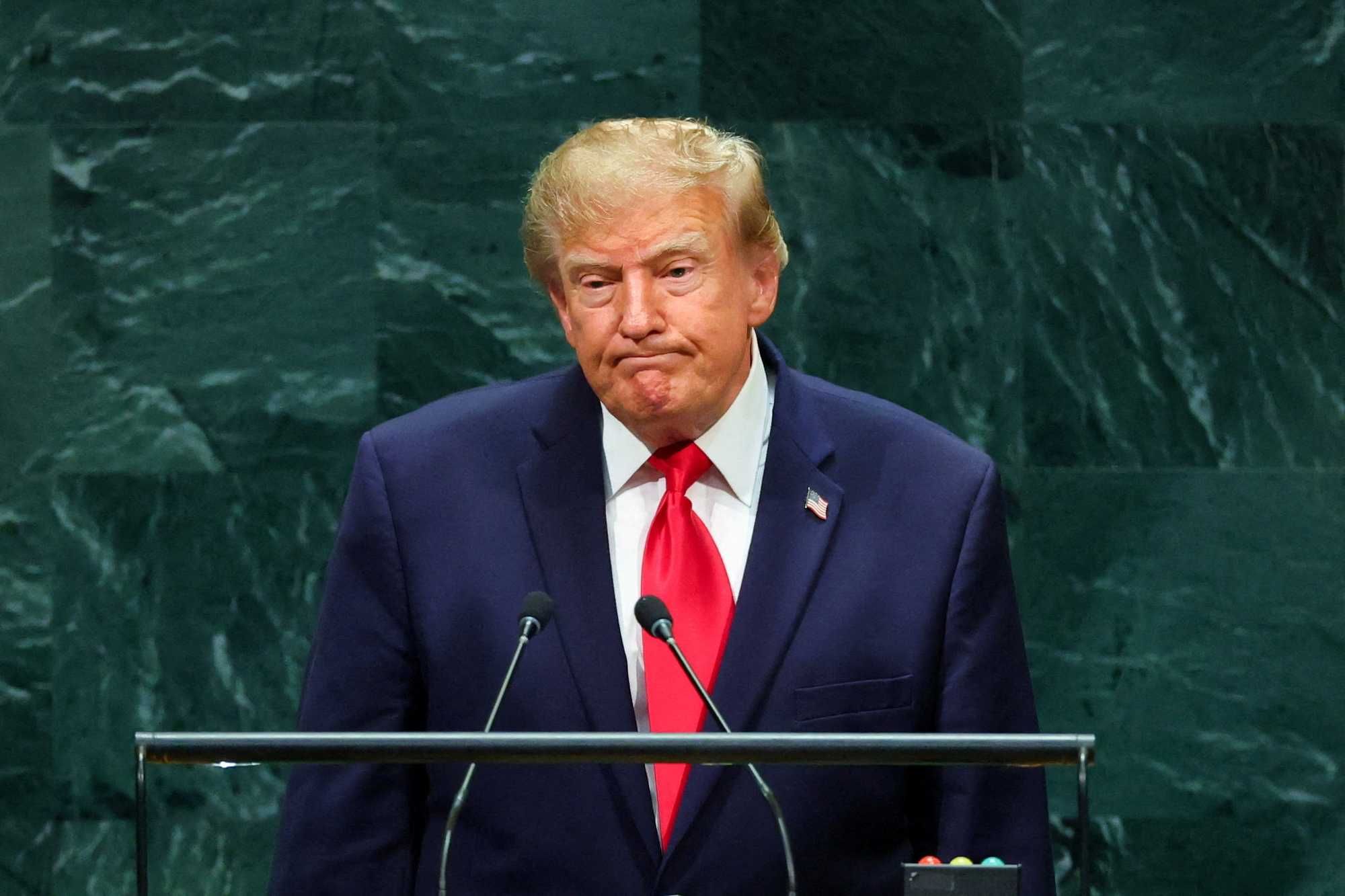
President Donald Trump addresses the 81st United Nations General Assembly at UN headquarters in New York City, NY, September 22, 2026. REUTERS/MIKE SEGAR
President Donald Trump's evident decline has had numerous visible impacts on his abilities, with one body language expert exposing the new ways in which it is causing him to struggle to "project power."
Dr. John Paul Garrison is a clinical and forensic psychologist, as well as an expert in interpreting body language. He also produces numerous videos using his professional expertise to shed light on the behaviors of public figures and what they reveal. This has included many videos about Trump and his signs of failing health, with Garrison theorizing that the president is experiencing accelerated decline, often consistent with the symptoms of a recent stroke.
In his latest video about Trump, Garrison explored the body language cues present during the president's recent visit from Chinese leader Xi Jinping. While the discussion centered on "power dynamics," Garrison stressed that this was all happening amid a context of Trump's seeming decline, noting that "his behavior and body language are actually different than they used to be." Early on, he noted that the president continued to struggle with involuntary spasms during the visit, and explained that this put him on the back foot with Xi, as he would be "focused on trying to control his body rather than anything else."
Garrison highlighted the times when Trump paused his speech so it could be translated into Chinese, during which he lifted his chin higher into the air. This, he explained, is a common tactic people use when trying to assert strength, as it exposes the neck and communicates that you are not concerned about a weakness being targeted. Trump also struggled to keep still during these moments, with Garrison suggesting that other world leaders would see it "as a sign of discomfort or a sign of not feeling at ease."
Garrison then transitioned to an examination of Xi's body language for contrast.
"So, what you're observing so far is that he has what I would describe as a normal reaction that you would expect from a world leader. He appears attentive while President Trump is speaking," he explained. "He's nodding while he's listening to the translation. Everything you're observing right now is essentially what you would expect from a situation like this. And the reason I'm even showing you this now is that President Trump's reaction, when we're going to look at President Xi speaking, is quite different."
He continued: "As you can see, he looks around a little bit. He doesn't have an intense gaze, just staring at President Trump. Nor is he looking away or looking uninterested. As I said, it's basically what you would anticipate in a situation like this. Seeing President Trump and President Xi back-to-back really makes it stand out how uncomfortable President Trump often times looks when he's been speaking lately. President Xi appears very calm. You're not really seeing any emotion on his face. He certainly isn't moving around a lot. Basically, everything is as you would expect from someone who has a very disciplined and controlled way to provide speeches."
Garrison later concluded that Xi consistently showed "a very calm, measured approach to basically everything," while Trump appeared "much more distractible."
"[Trump] seems to be struggling more with attention than he ever has," Garrison explained. "And it seems that he was very excited towards President Xi, particularly as the second day wore on. Now, one big difference between the two is that President Xi seems somewhat ambivalent, at least in my opinion, about whether or not President Trump likes him. The body language doesn't suggest that he has any particular interest or cares whether or not President Trump likes him. Whereas President Trump is sort of the opposite. It seems like he really wants to be liked by Shei. He seems excited by him. And it seems like what he wants is some acknowledgement."