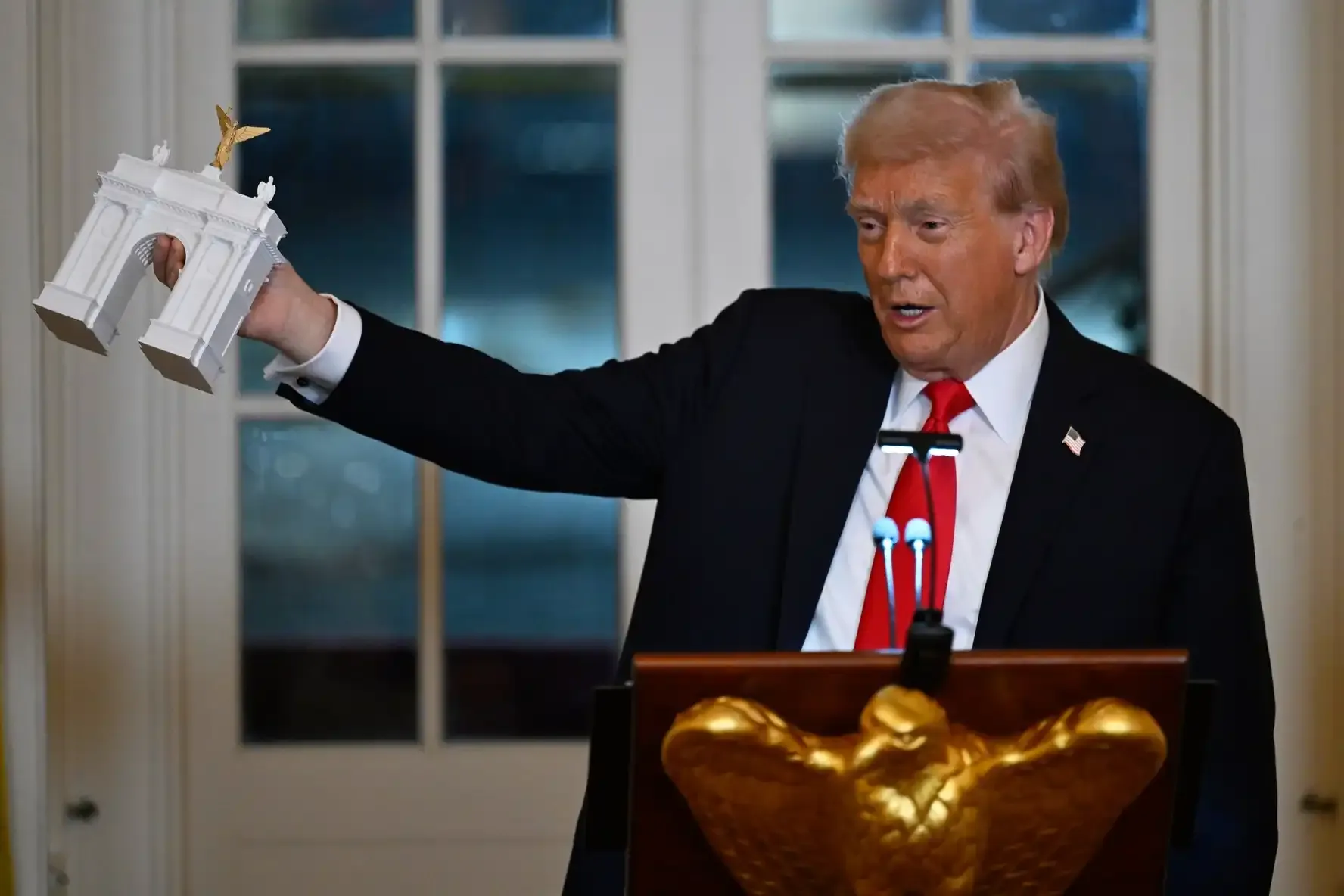
President Donald Trump addresses a dinner for donors who have contributed to build the new ballroom at the White House, Wednesday, Oct. 15, 2025, in Washington
After months of public debate, a federal commission has approved the designs for President Donald Trump’s enormous triumphal arch to be constructed in Washington, D.C. The commission — selected by the White House — made some suggestions for improving upon the plans, but largely ignored widespread concerns that the structure would disrupt the city’s landscape and obstruct existing landmarks.
“We had just under 1,000 commenters,” admitted Commission Secretary Thomas Luebke. “100 percent of the comments were against the project.”
While Interior Secretary Doug Burgum claimed the arch would “strengthen the city’s symbolic architectural vocabulary,” opponents argue that that its 250-foot tall, 165-foot wide design would “be profoundly out of scale with its surroundings” and “appears to disregard established norms that prioritize harmony with existing structures, preservation of sight lines and respect for the symbolic hierarchy of the capitals and landmarks.”
Zachary Burt of the DC Preservation League expressed “serious concerns and strong opposition” to the arch, arguing that its proposed location would threaten the “solemn vista” between the Lincoln Memorial and the Arlington National Cemetery.
Other commenters argued that the arch is "a waste of money and misuse of funds” that will “obstruct historic views and disrupt the landscape,” deeming the design “gaudy” and “oversized.”
For Trump, that’s the point. Modeled after the Arc de Triomphe in Paris, the president wants it to be the largest triumphal arch in the world.
“This is personal for the president,” said commission Chairman Rodney Mims Cook Jr.
Even one of the commission members selected by Trump, Vice Chair James McCrery, expressed reservations about aspects of the design. In the proposed plans, lion statues sit at the base of the arch, which McCrery argues are “not of this continent.” He also wants architects to "open these arches and air them out" to prevent the obstruction of other monuments, and calls a planned 250-foot underground pathway for visitors to access the arch “unfortunate.”
"Sometimes it's absolutely necessary," McCrery said of the underground passage. "Here, I think it's not absolutely necessary at all."
He also acknowledged concerns about the height, suggesting that a 60-foot statue proposed for the top could be eliminated. But that, he said, could be decided at a later date.
“I think everyone is against architectural excess,” McCrery said. “It will be determined later whether that is an accurate characterization of this design.”
The White House has yet to share a proposed budget for the project. While Trump has claimed donors would pay for the arch, the National Endowment for the Humanities has already set aside $15 million for it, though the actual cost is expected to be significantly higher.
A group of Vietnam War veterans has sued to stop the project, arguing that it blocks the view of Arlington National Cemetery.
“The cemetery is supposed to be doing the speaking,” said retired senior architectural historian for the Virginia Department of Historic Resources Calder Loth, a plaintiff in the suit. “This arch is just a rude interruption. No matter what you may think of it aesthetically, it just is the wrong place for it. It’s too gaudy with too much gold ornament on it, but that’s the style of the current administration.”