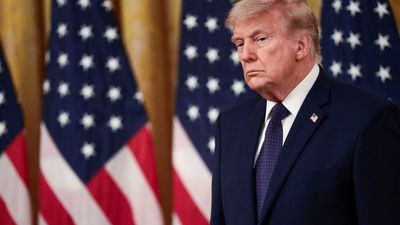
U.S. President Donald Trump in the White House in Washington, D.C., U.S., May 22, 2026.
By now we’ve almost taken for granted that federal district court judges will probably stop — or at least pause — the worst of Trump’s authoritarian moves. We owe them a huge debt of gratitude.
Case in point: U.S. District Judge Indira Talwani, who on August 27 effectively stopped Trump’s plan to use the U.S. Postal Service to restrict mail-in voting.
In issuing a temporary restraining order blocking its enforcement, Judge Talwani used the standard two criteria for such a judicial pause: that (1) the plaintiffs are likely to succeed on their claims when the case goes to trial, and (2) they face irreparable harm in the meantime if the order is implemented.
Judge Talwani found that plaintiffs — a group of blue states and voting rights groups — were likely to succeed in their claims that Trump’s and the U.S. Postal Service’s plan is unconstitutional because it interferes with states’ authority to administer their own elections and risks disenfranchising eligible voters, and that the Postal Service lacks authority to do it. Furthermore, she found an “overwhelming risk” to Americans who need access to mail ballots to vote, and that if the plan were implemented, they wouldn’t be able to.
Her temporary restraining order blocked enforcement of the plan in the 23 states that had sued to stop it. The Trump regime immediately appealed her ruling. Days later, the U.S. Court of Appeals for the First Circuit affirmed her order, rejecting the Trump regime’s appeal.
Trump has now gone to the Supreme Court, which has not as yet issued a final decision. For now, the Postal Service is expected to handle election mail as usual. North Carolina and parts of Wisconsin have already started sending out absentee ballots for the general election.
Let me pause here for a moment to praise Judge Talwani for her principled courage. Like many district court judges who have stopped Trump, she’s undoubtedly received a great deal of criticism — some possibly in the form of violent threats — but has not received the public honor she deserves.
Talwani’s decision in this case is an example of what’s been happening across the nation, especially over the last dreadful 19 months.
The sequence has been this: (1) Trump issues a patently unconstitutional order, (2) attorneys general of blue states and various other groups go to a district court seeking to pause it until there’s a full trial on the issue, (3) a district court judge issues a temporary restraining order that pauses Trump’s, (4) Trump’s Justice Department appeals the pause, (5) an appellate court more often than not agrees with the district court judge, and (6) the Justice Department then seeks Supreme Court review.
The regime has mounted efforts in nearly all 50 states to obtain their complete voter rolls containing sensitive information about registered voters in their states, with the Justice Department arguing that the information is needed to ensure states have programs in place for maintaining accurate voter rolls.
Most have declined to provide complete lists. In response, the Justice Department has filed lawsuits against 30 states and the District of Columbia in an effort to force them to hand over the voter data.
But district court judges across the nation have held the line. (Some of these judges were appointed by Trump.) So far, the Department of Justice has lost all 23 trial-level and initial decisions. It’s an astounding record. The DOJ has appealed most of them.
This sounds like a cold-blooded process, but every step entails human beings making ethical decisions about what to do next.
Many of us have become inured to the cowardice and complicity of the people inside the regime who are acting without regard to the ethical consequences of what they’re doing — people such as those advising Trump about whether and how to draft his unconstitutional executive orders, lawyers in the Justice Department willing to defend these orders and appeal decisions that pause or stop them, and officials in other departments and agencies, such as the United States Postal Service, willing to implement them.
And most of us have become so accustomed to the courage and conviction of people outside the regime who are trying to stop these unconstitutional orders — especially district court and appellate judges — that we no longer recognize their heroism.
I’m making Judge Talwani recipient of this week’s Joseph N. Welch Award, which I give to people who — like Welch, when he confronted Senator Joseph McCarthy in 1954 — stand up to authoritarian bullies who threaten our freedoms, and who thereby protect us all.
The award really goes to all district court judges who have been holding the line against Trump. These judges deserve the appreciation of all Americans — just as those who have enabled and collaborated with the regime deserve our condemnation.
All of these people are making moral choices, whether or not they recognize them as such. Democracy is a moral choice.
Robert Reich is a professor of public policy at Berkeley and former secretary of labor. His writings can be found at https://robertreich.substack.com/.