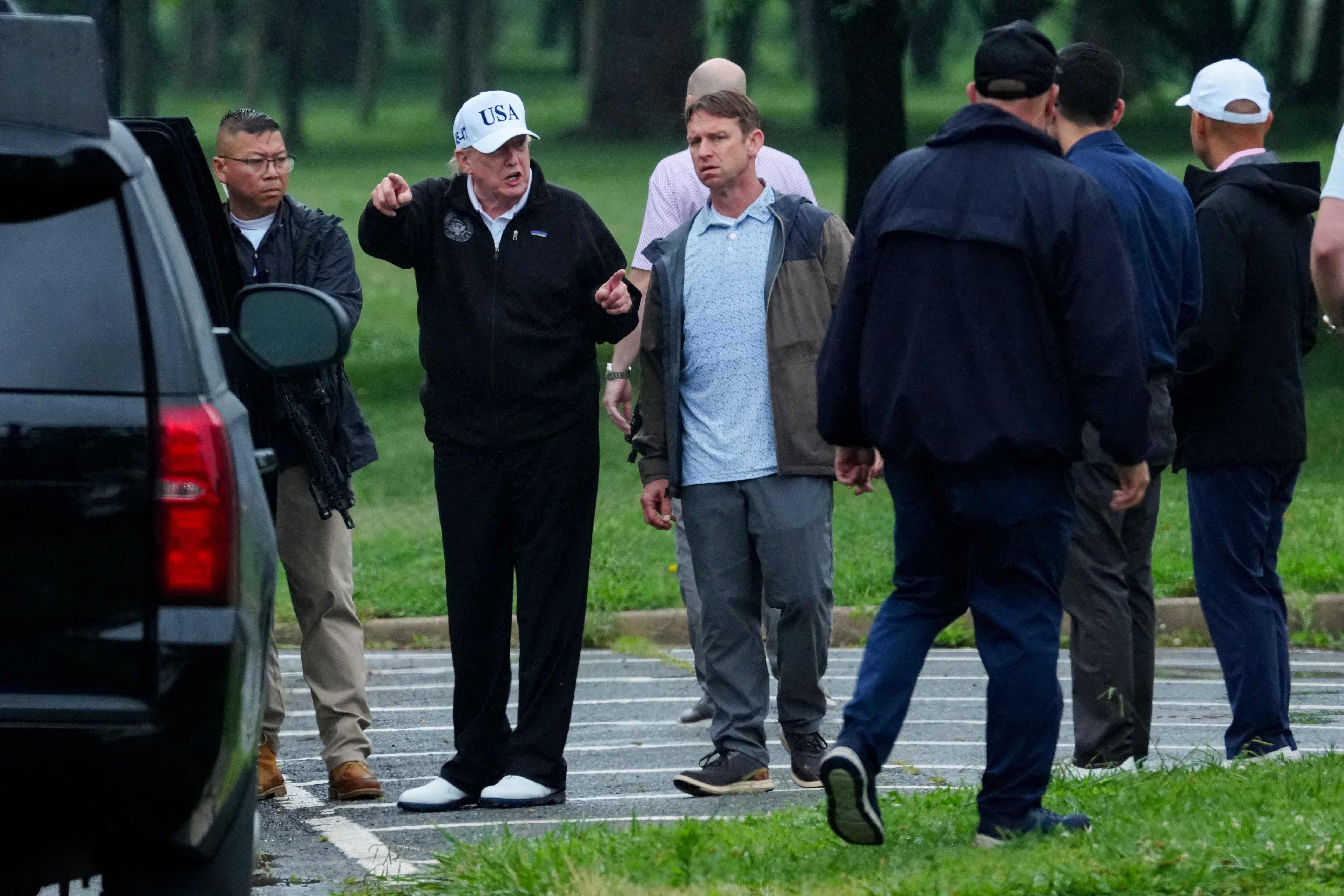
U.S. President Donald Trump visiting a golf course in Washington, D.C., U.S., June 28, 2026. REUTERS/Ken Cedeno
President Donald Trump’s latest power grab under the Constitution’s supremacy clause has already hit a courtroom setback, and a federal ruling threatens to derail his election strategy to force Democratic-led states and cities into line.
Writing in The New Republic on Wednesday, Matt Ford looks at the way the administration has made use of that little-talked-about provision in its immigration and voting disputes, only to be blocked by constitutional boundaries it cannot ignore.
The supremacy clause is meant to give valid federal law priority over state law in the event of a conflict. Ford contends that Trump has seen it as an avenue to assert powers the federal government lacks.
A case in point is New York. U.S. District Judge Ramón Reyes dismissed a Justice Department suit challenging New York City's sanctuary policies, which limit local officials' cooperation with federal immigration.
The administration argued that the city’s restrictions were no match for federal immigration law.
“Even if the United States has standing – and it does not – its preemption claims fail,” he wrote in a ruling on October 15. He noted that under the Tenth Amendment, Washington is not free to conscript state and local resources for immigration enforcement.
“The United States’ preemption arguments are nothing more than a backdoor around the Tenth Amendment,” the judge wrote.
Then there is the matter of California, where the administration is in court to stop the counting of ballots from some 20,000 people it deems likely noncitizens. Because California already bans noncitizen voting in federal elections, Ford sees the administration’s reliance on the supremacy clause as particularly tenuous; no state law needs to be overridden.
Ford pointed to the ruling in Florida earlier this month concerning a Jamaican-born woman who unlawfully registered to vote, who argued that the Section 611 provision invoked by DOJ in the California lawsuit was unconstitutional as applied to her, and the federal judge in the case agreed with her.
In dismissing the prosecution on Oct. 1, U.S. District Judge David Leibowitz said: “Congress has no power to say who can vote or who cannot vote in federal elections – that foundational power is reserved for the States, and limits Congress,” Leibowitz wrote.
While the ruling does not set aside the statute across the country or put an end to the California suit, it is yet another legal hurdle for the administration to overcome.
Ford wrote, “The Trump administration is treating the supremacy clause as a nearly limitless source of power, apparently hoping a federal judge will infer it from the clause’s name instead of its substance.”