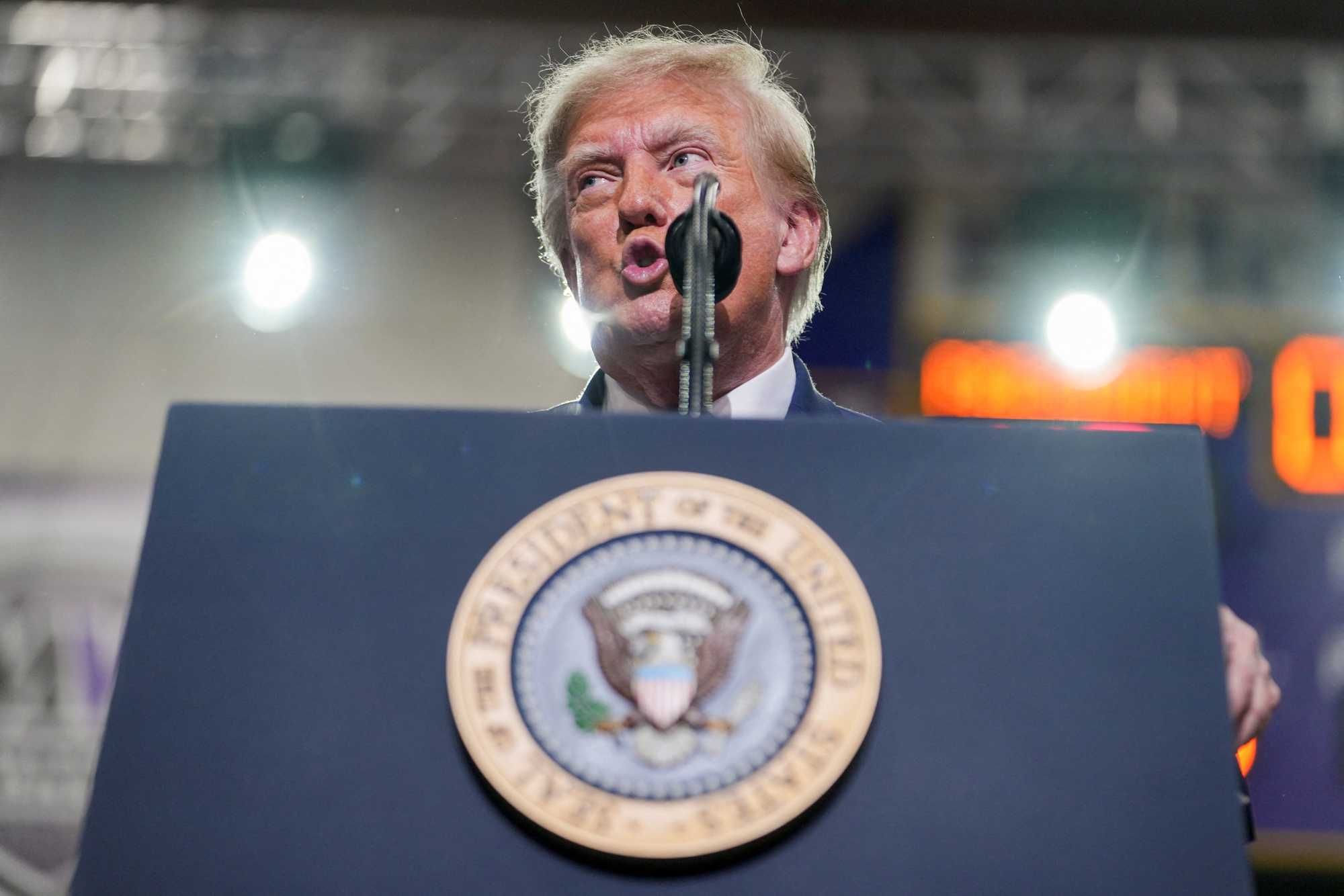
US President Donald Trump speaks during a rally at Butler High School in Vandalia, Ohio, US, October 3, 2026. REUTERS/Nathan Howard
On Monday, a former Department of Homeland Security official revealed the “forbidden” measures President Donald Trump is using to meddle with the midterms. According to Paul Rosenzweig – who served in DHS under President George W. Bush – Trump is “violating the principle of executive neutrality” as he uses the power of government in an attempt to rig the election.
“The principle that government ought to be administered for the benefit of all citizens, not on behalf of one political party, lies at the core of America’s democratic enterprise,” writes Rosenzweig in the Atlantic. “The Trump administration couldn’t care less: It appears to see the federal government not as something to steward on behalf of all Americans, but as an opportunity — a set of levers it can pull on to protect its reign.” He notes that during his tenure under Bush, “the idea that the secretaries of defense or homeland security or the attorney general would have ever appeared at a political rally was unimaginable” as “their roles were too important to national security to risk being perceived as partisan operatives. Not so in the Trump administration. Its members are willing to use the public power at their disposal to do what they can to give Republicans an edge in this fall’s elections.”
Rosenzweig offers a host of examples, writing that Trump and his officials campaign for candidates from their public pulpits, push broadcast-news coverage in a more favorable direction, try to strong-arm the U.S. Postal Service into regulating mail-in balloting into oblivion, threaten withholding FEMA relief funds from those states that don’t elect Republican candidates, release pro–Donald Trump propaganda funded by taxpayer dollars and “the most crass offense,” offer $5,000 checks to voters if Republicans win. According to Rosenzweig, “Some of these tactics are in a legal gray area; others are plainly forbidden. But all of them are violations of the precept that the party in power should not tilt the electoral scales toward itself.” According to Rosenzweig, “The most egregious area of activity has been the total disregard administration officials have shown for the Hatch Act. The law, passed in 1939, imposes limits on certain government employees to ensure that these officials in their executive functions are above partisan political activity. Federal employees may not use their official authority to influence an election,” and “may not ‘take an active part’ in any political campaign.”
But Trump himself and his officials – including Attorney General Todd Blanche, Defense Secretary Pete Hegseth, Secretary of Transportation Sean Duffy – have been traveling around the country campaigning for Republicans in tight races. “Who is supposed to do anything about any of this?” writes Rosenzweig. “That responsibility falls to the Office of Special Counsel, whose head Trump fired early in his second term. He then nominated as his replacement a host of a far-right podcast, whose past behavior and qualifications were so poor that even the Senate Republicans could not support him. Despite not having a permanent leader, the OSC has managed to launch a Hatch Act investigation of one person of great interest to the president: former Special Counsel Jack Smith. The investigation is in response to a complaint that Smith sought quick criminal-trial dates for Trump as a means of influencing the 2024 election.”
Rosenzweig highlights other examples of the administration using government power in its electoral schemes. FCC Chairman Brendan Carr has waged a war on media outlets, attacking late-night hosts like Jimmy Kimmel and Stephen Colbert, and networks accused of running anti-Trump programming. He also points to Trump’s attempts to federalize control of mail-in voting, asserting that the scheme was an effort “to convert the USPS’s neutrality into a political cudgel.” All of this, warns Rosenzweig, could do lasting harm to the U.S. democracy. As he concludes, “When politicians repurpose government action to help themselves maintain power, they are breaking a fundamental promise of governmental impartiality in providing services and benefits. Trump’s assault on this principle of executive neutrality has not yet taken root in American culture. If it does, we will lose far more than control of the House or the Senate; we will lose the possibility that the will of the people can prevail.”