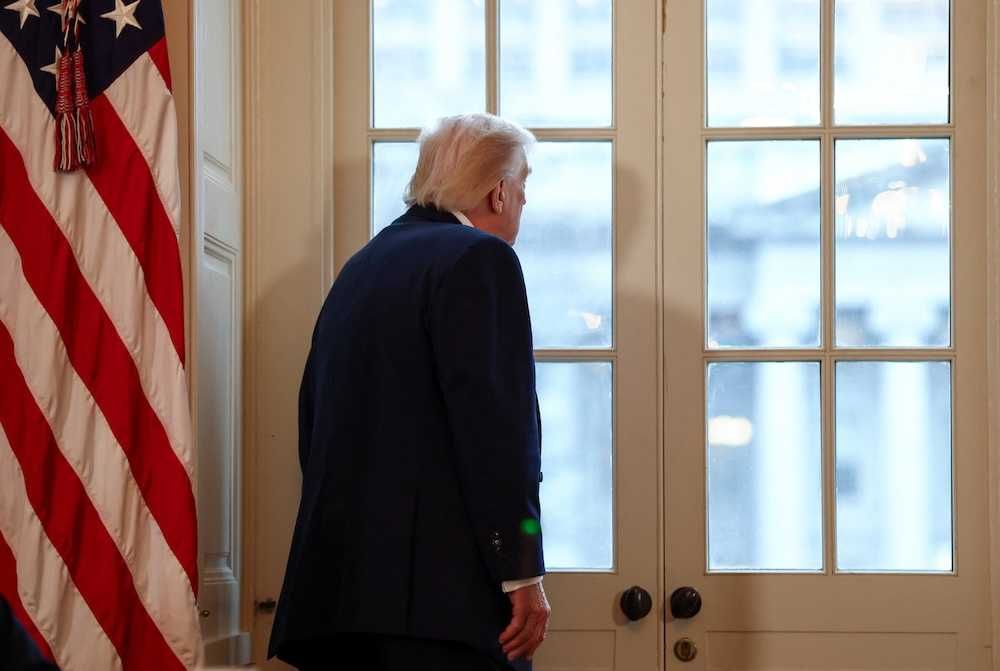
President Donald Trump looks towards the demolished East Wing of the White House, the future site of his ballroom at the White House in Washington, D.C., January 9, 2026. REUTERS/Kevin Lamarque
President Donald Trump's dubious claims about his actions in the aftermath of the 9/11 attacks show that he is fully "trapped in a fictional world," analyst Thomas B. Edsall wrote for the New York Times, and it has made him a danger to the entire world for the remainder of his term.
Edsall published his latest piece for the Times on Tuesday morning, breaking down the fallout of Trump's tall tales across several days surrounding the 25th anniversary of the 9/11 attacks, as he attempted to make the occasion all about himself, instead of the heroic first responders.
"Last Tuesday, President Trump demonstrated for the few who remain in doubt that his mind is trapped in a fictional world where he is the heroic savior of the nation, if not all mankind," Edsall wrote. "Speaking at a Tunnel to Towers Foundation event honoring police officers, firefighters and other first responders, Trump recounted his memory of 9/11 and the days that followed. It has to be read in full to be truly reckoned with."
"I was building a big building in New York, and I took the whole crew down there right after this happened," Trump said. "And they were — they had no hesitation. Everybody went down with me. We went down as a big group of people. Wasn’t too much we could do. I’ll be honest. It was, it was raw... The United States Steel Building was creaking, really creaking, and we thought it was going to fall down. The truth is, it creaked a lot. It creaked. It still creaks, but it never came down. And I’ll never forget two firemen. We thought it was coming down on top of us, and two firemen, big strong guys. And I’m not the smallest guy in the world. They grabbed me under the arm, said, 'Got to get out of here!' And they literally lifted me up. This is not easy to do. I’m big. They lifted me up and they started running with me. I said, 'Fellas, I can run myself.' But they were amazing. But they thought it was coming down. It didn’t come down."
As Edsall explained further, "the words were barely out of Trump’s mouth" when the fact-checks began to pour in. CNN's fact-checker, Daniel Dale, wrote that "It’s possible there are elements of truth in Trump’s latest story, versions of which he has told before, but he hasn’t provided any evidence for it." Nia Prater and Chas Danner of New York magazine said Trump was repeating "a questionable anecdote about his whereabouts and actions in the aftermath of the tragedy and later defended his recollection as questions arose."
Attempting to defend himself, Trump later claimed on Truth Social that his story "was exactly accurate," though he also later said that he was not at Ground Zero the day of the attacks, but only "as soon as the Law allowed." Edsall highlighted the now-infamous call Trump made to WWOR-TV as the attacks unfolded on September 11, 2001, in which he wrongly claimed that one of his buildings was now the tallest in downtown Manhattan.
In light of these new claims, Edsall highlighted the statement from "36 prominent medical specialists questioning Trump’s mental fitness for office," entered into the congressional record by Sens. Sheldon Whitehouse and Jack Reed.
"We are compelled to warn of a president of the United States who is increasingly a danger to the public," the statement read. "Severely impaired judgment and impulse control, reflected in reckless threats of violence, advocacy of lethal force against civilians, encouragement of extrajudicial actions by armed supporters, repeated threats and often actions — judicial, prosecutorial, police, military and by invoking emergency power — against political opponents and others who disagree with him. Significant loss of self-control (disinhibition) and getting stuck on the same thoughts or actions, unable to let go or move on (perseveration), including seemingly compulsive, manic-like late-night communications — e.g., 150 social media posts in one night — fixation on perceived enemies, persecutory ideas and prolonged, disproportionate attacks on specific individuals and institutions."
"The reality, however, is that no action to remove Trump from the White House will happen until he does something so threatening and damaging that drumming him out of the White House becomes an inescapable necessity — no small comfort for a nation looking forward to 28 more months of an unstable man holding the presidency," Edsall concluded.