Royalty-free stock photo ID: 735158137
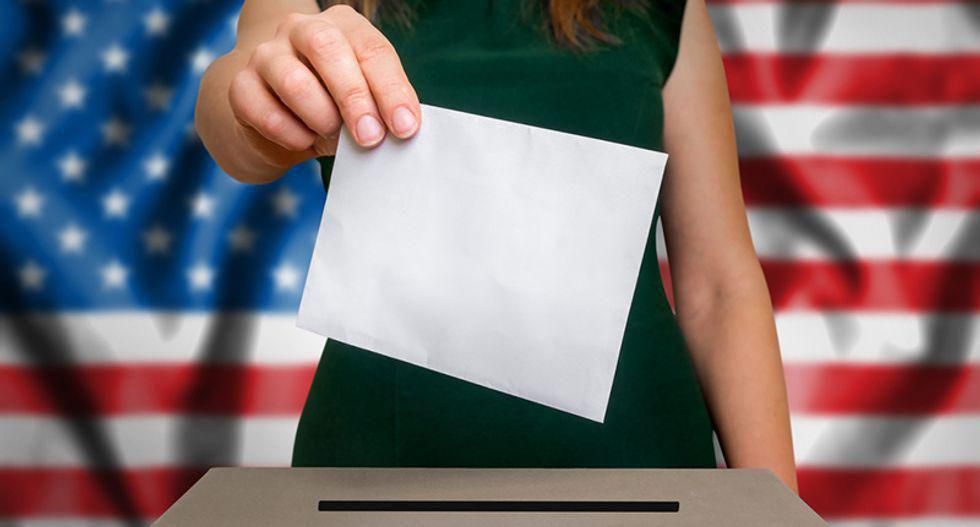
Election in United States of America - voting at the ballot box. The hand of woman putting her vote in the ballot box. Flag of USA on background.
Royalty-free stock photo ID: 735158137
Election in United States of America - voting at the ballot box. The hand of woman putting her vote in the ballot box. Flag of USA on background.
The Atlantic’s David Frum sat down with Michael Waldman, president of the Brennan Center at New York University, to discuss how President Donald Trump and his administration might try to undermine the 2026 midterm elections, and what is in place that could prevent them from succeeding.
“What can a president and a party that is still in control of Congress do to bend things their way?” Frum asked.
“Well,” Waldman replied, “there is much they can do to try to undermine the way the system works, but there are limits as well.”
“I want to stress that,” he added, “in each of these areas, there are things that can be attempted, and there are potentially effective pushbacks that can make sure that the election actually does happen, as we would hope it happens, where the voters, however they choose, get the last word.”
But Waldman also warned Frum that “for the first time, I think, in American history, the federal government and the Trump administration are actively waging an effort to undermine the 2026 elections.”
“One thing that President Trump has tried to do already,” Waldman noted, “is to take personal control of the election system.”
Frum and Waldman discussed several activities Trump and his administration have tried, could try, or are trying, including issuing an executive order requiring passports as ID to vote — which the courts blocked. Similar legislation, requiring a passport or birth certificate to vote, passed the House but stalled in the Senate (the SAVE Act).
There is also the purging of federal election security experts, the weaponization of law enforcement, the use of federal agents — including, for instance, ICE and CBP near polling locations — and the use of the courts.
“When Congress blocked the SAVE Act,” Waldman noted, “the president put out another, rather, another post on social media saying, ‘I’m going to do an executive order ending vote by mail.'” Paraphrasing the president, he suggested that Trump claimed, “I’m gonna do this, and, by the way, the state election officials are merely agents who work for the president, and their job is merely to count the votes as agents for the president.”
“They are threatening to use the tools of law enforcement to scare off people in the election machinery,” Waldman explained.
Frum warned that National Guard troops, for example, operating near polling locations, could “detain” people for a few hours, “at least until after the polls close.”
“Those are known as ‘Kavanaugh stops,'” Waldman interjected, referring to the U.S. Supreme Court justice.
There is also the use of gerrymandering and the possibility that the U.S. Supreme Court will further gut the Voting Rights Act, they noted.
On gerrymandering, Waldman explained, “sometimes, if the voters have what’s called a wave election, where people are all rushing to the polls to vote, you know, their opposition to the current party in power, it can actually not only not have the desired impact, it can actually create more victories for the other party. That is, in technical terms, called a ‘dummymander.'”
Waldman noted that the Trump administration may be trying many different things to sow doubt about free and fair elections.
He said, “ultimately … they are trying to stir doubt, and create a cloud of suspicion, to make it easier, should there be, you know, the opportunity to push election officials and others to cave.”