The Supreme Court’s 'cry wolf' defense explodes after new Trump ruling
02 September
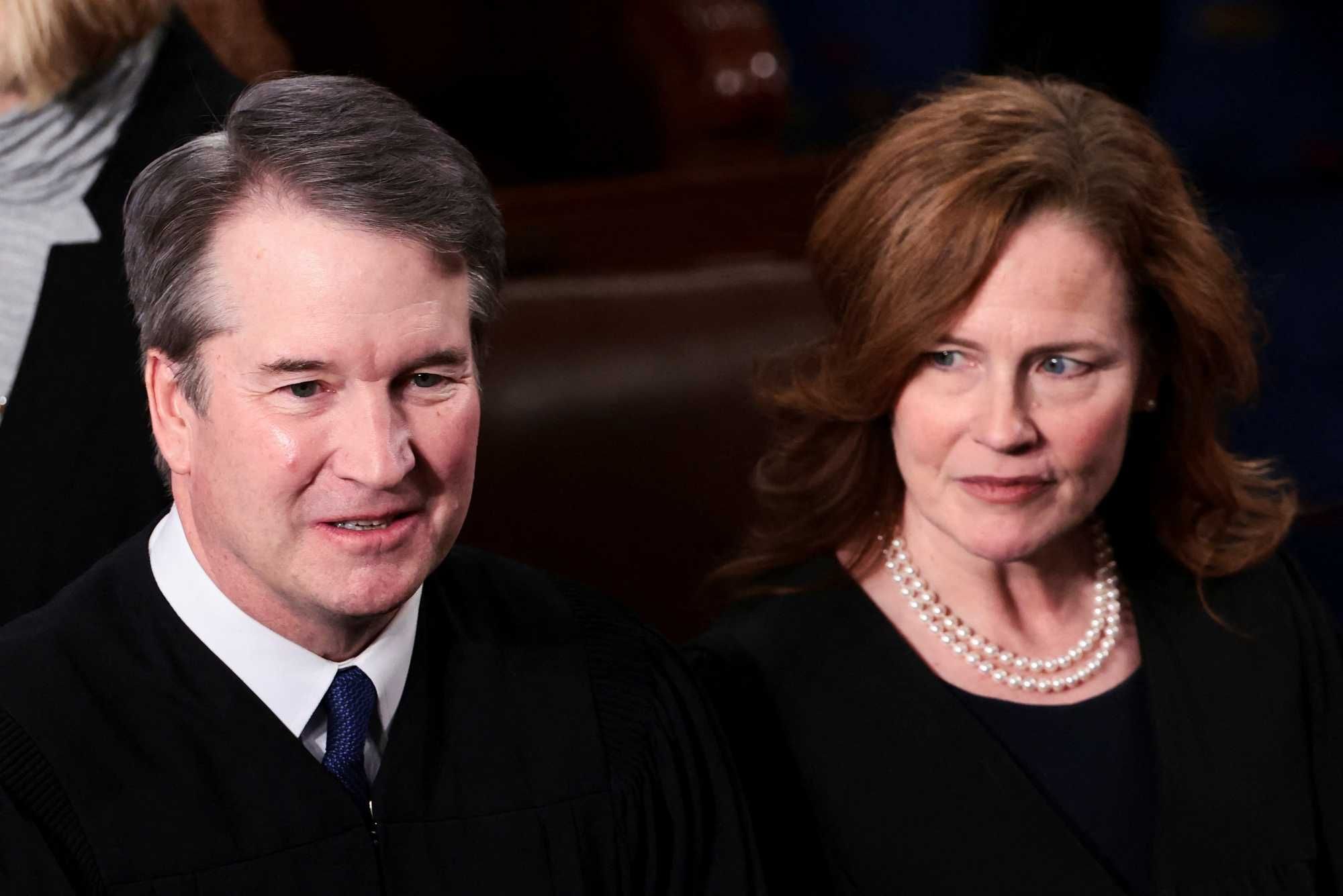
U.S. Supreme Court Justices Brett M. Kavanaugh and Justice Amy Coney Barrett during President Donald Trump's State of the Union address, February 24, 2026.
Supreme Court justices have gone on the road in recent months to defend their decision-making as strict obedience to law rather than to politics.
But their actions continue to show a heavy political tilt when Donald Trump is involved.
The decision on Monday to allow construction of Trump’s gilded ballroom complex on the wreckage of the destroyed White House East Wing is a good example. A bare majority of the court hung their approval on a finding that the National Trust for Historic Preservation, a nonprofit chartered by Congress to guard public buildings, lacked “standing” to claim injury.
Simply put, the majority made a technical ruling and refused to look at the legality of the project, the balance-of-powers concerns underscoring the case, or the diffidence of Trump’s stop-me-if-you-can approach. In fact, Chief Justice John G. Roberts Jr. joined with liberal justices in a dissent that specifically said the building activity is “likely unlawful,” a finding unpersuasive to the right-leaning justices who made up the majority.
Neither a federal district court nor an appeals court had trouble with “standing.” Who has standing is Congress, which, of course, cannot decide on such matters as whether daylight savings time ought to be permanent, never mind a constitutional question about their own powers.
This technical ruling rejecting an injunction on continuing construction rather than on the broader issues was just an available out to avoid crossing Trump, whose powers this court continues to expand. Since the majority did not even bother to explain its ruling, we don’t know if a unilateral presidential decision to tear down the entire White House to massage the Trump ego is a problem.
What happened to judges as “officers of the law” to act on illegality when they see it? What happened to a court that sees Constitutional issues in all direction unless they involve Trump? What happened to bringing a supposedly narrow issue before the court only to find that justices wanted to widen it to question the historical justifications or the original meaning of Founding Fathers who granted authority over such questions to Congress?
What happened to the idea that construction promised to be based on private donations alone is now socking taxpayers with a billion-dollar bill with no congressional authorization?
Apparently, Trump is right. With few exceptions, he can do whatever he wants by this court majority. No wonder we’re in for a mighty debate if there is a new majority after November about the makeup of the court’s justices.
The first ruling of this court last week on Trump interference with delivery of mail ballot applications also hung on a technical point – that the lawsuit challenging the executive order was too early. Now the Trump Justice Department is arguing that the next one is too late. The court decided to ignore the actual underlying issue. Now a whistleblower within the administrator is saying the administration is flaunting judicial orders to stand down. Where is the Supreme Court to tell Trump to follow the rules?
The cry-wolf plaints of Supreme Court justices stung by public criticism that they are acting in blatantly political ways won’t disappear until this court decides to enforce the laws as they touch Trump.
Terry H. Schwadron retired as a senior editor at The New York Times, Deputy Managing Editor at The Los Angeles Times and leadership jobs at The Providence (RI) Journal-Bulletin. He was part of a Pulitzer Gold Medal team in Los Angeles, and his team part of several Pulitzers in New York.