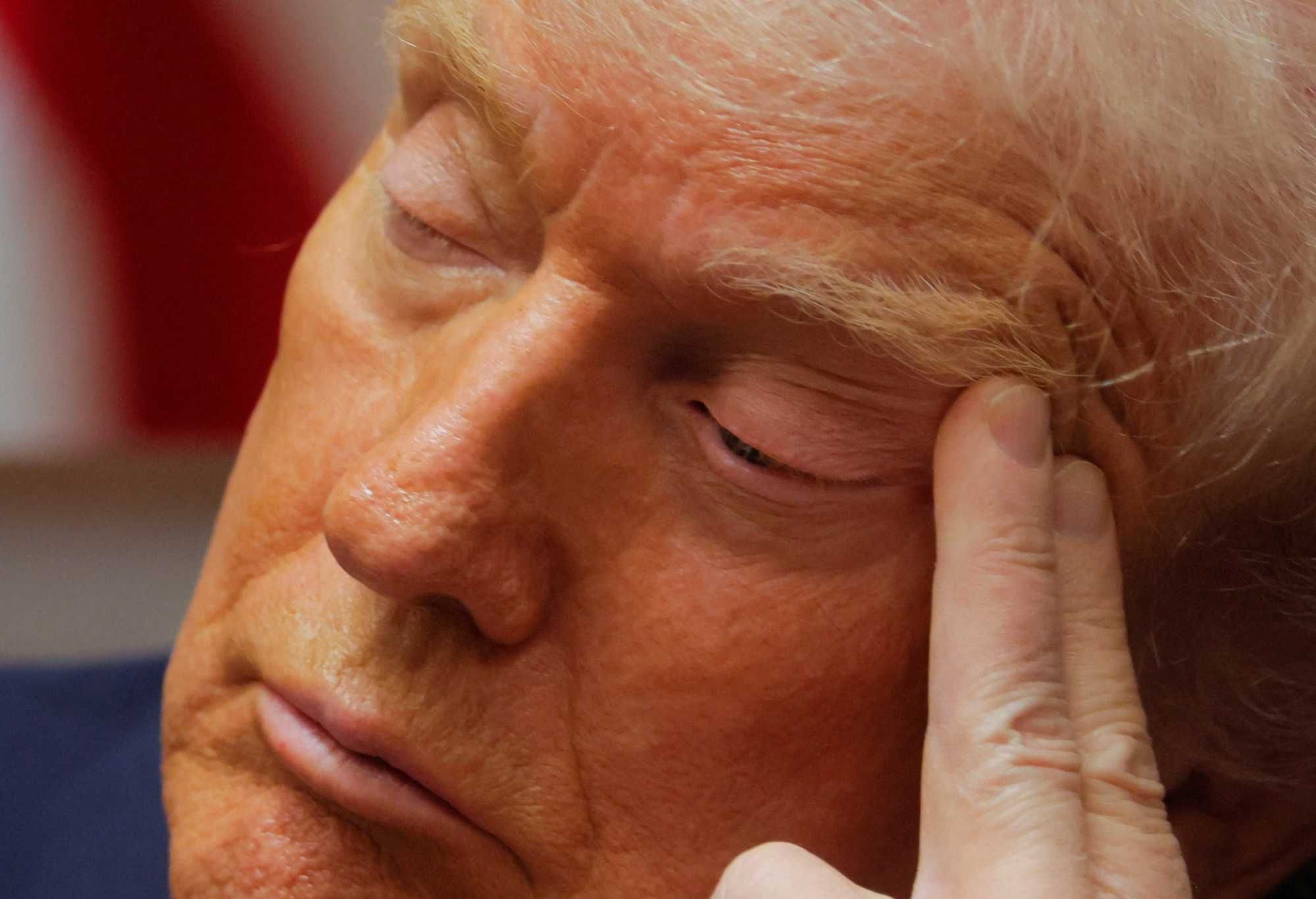
U.S. President Donald Trump attends a cabinet meeting at the White House in Washington DC, 2025. (REUTERS)
President Donald Trump made it very clear that he would not allow Americans to turn Congress against him.
He tried to nationalize the elections by purging voters from state rolls (the courts wouldn't let him), sending monitors to intimidate voters (they didn't care) and filing frivolous lawsuits to stop people from voting (except for the Supreme Court, this usually didn't work either). He even had the world's richest man, billionaire Elon Musk, spend $445 million so Trump's Republicans would retain control of Congress.
It was all for naught. From the Iran War to the floundering economy, Trump's America proved too unacceptable to voters for them to keep Republicans in charge. Democrats have decisively won both the Senate and the House, so much so that Trump cannot contest the results because the so-called "blue tsunami" was too overwhelming. At the time of this writing, Democrats will win the Senate by 52-54 to 44-46 and the House by 231-153, with more than 50 races yet to be called. Democrats only needed 51 Senate seats and 218 House seats to reclaim power.
To understand why Trump seems to have quit his attempts at election rigging (at least for now) after Election Night 2026, AlterNet spoke with two experts from Democracy Defenders Fund, a nonprofit that focuses on fighting election sabotage and protecting democratic institutions. The experts were Beauregard Patterson, Election and Voting Rights Counsel, Democracy Defenders Fund and Jacki Anderson, also an Election and Voting Rights Counsel, Democracy Defenders Fund.
The following transcript has been lightly edited for clarity, context and length.
Matthew Rozsa: For the past two years, journalists and voting rights activists have fretted that President Trump would try to overturn the 2026 midterms. To be fair to those people, myself included, Trump himself made it clear that he wanted to overturn the election results if he lost. He tried to get access to state voter rolls. He tried to intimidate people by sending monitors. He threatened to declare a national emergency or send the National Guard. He intimated that he might try to overturn results through litigation. And of course, we all remember that after he lost the 2020 presidential election, he attempted to overturn it, first through frivolous litigation and then through an actual coup attempt. Why did none of these worst fears materialize?
Beauregard Patterson: I can go ahead, Jacki, if that’s okay. One of the things that I would point to as to why these worst-case scenarios didn’t materialize is that, unlike the 2020 election, which was a presidential election, in a midterm year each state is responsible not only for managing its election procedures, which it does in any election, but for choosing its representatives and senators and sending them to Congress. And so one of the challenges here is that, in order to actually overturn this election, the Trump administration would have had to successfully overturn the results in several states simultaneously. And look at the past year and a half of litigation efforts to challenge election procedures and to federalize elections, particularly, if you’ll recall, the attempt to use USPS as a federal mechanism for whether ballots are rejected or accepted. Because of the failure of all those dozens of legal challenges and attempts at subversion by the Trump administration, they were left with few tools at this point to meaningfully try to take over and overturn the election results.
Jacki Anderson: I agree with Bo. I think that the courts really have pushed back on the Trump administration’s efforts to interfere with elections. Matthew, as you said, the courts rejected DOJ’s unprecedented efforts to access confidential voter information. As Bo said, the courts blocked Trump’s executive order regarding mail ballots, and also the proof of citizenship executive order. The courts also stopped DOJ’s attempt to segregate and then not count certain ballots. And as of today, a district court dismissed DOJ’s lawsuit trying to prevent Alaska from certifying the election, even though I know that’s now on appeal. So I think the administration has not had the level of success in the courts that it perhaps thought it would, and the courts are largely standing up for the rule of law and protecting our elections.
Matthew Rozsa: In short, it sounds like it’s a combination of the fact that the Constitution mandates that these elections be controlled by the states and the fact that the courts were strong enough to uphold that aspect of the Constitution. Am I summarizing what you’re saying correctly?
Beauregard Patterson: Absolutely. I think that’s an accurate summarization. I’d also add an additional point, which is that because of the fears of subversion that were reasonably created after January 6th, we as coalitions of 501(c)(3) organizations that are pro-democracy have also had, I think, an incredible ground game. We were prepared, we were ready, we had action plans in place. We ensured that we had people on the ground in every location where we were afraid that subversion could occur. And so I think it’s a combination of constitutional precedent and the courts’ willingness to uphold that precedent and defy the Trump administration, along with efforts from organizations such as ours to ensure that if something were to happen, we were there and ready.
Jacki Anderson: I would also add that I think election officials really prepared more than they ever have for this election. I know that in many jurisdictions, they did tabletop exercises going over what to do in case any of these unprecedented threats arose. So I think the level of preparation by election officials also really contributed to a smooth election yesterday.
Matthew Rozsa: What lessons exist for American democracy going forward as a result of all of the preparations that had to be made to protect elections in this cycle?
Jacki Anderson: I think American democracy is strong. I think we’ve stood strong since our founding and will continue to stand strong. And as we face challenges, I think that American democracy is flexible and adaptable and learns how to overcome them. We’re just becoming stronger and better and more innovative in handling these challenges.
Beauregard Patterson: I would add that the foundation of American democracy is the power of the people. And I think that this election, if it shows us any particular lesson, demonstrates that when you engage in coalition and work together, like Jacki was saying, we have the power to resist unconstitutional acts. When candidates engage voters, they show up. And when people are tuned in, that is more powerful than the money that comes from special interest groups and billionaires.
Patterson later followed up by email to add that Americans should "1. Seek a restoration of the traditional voting protections of the federal Voting Rights Act of 1965 with strengthened laws against voter intimidation, and expand federal voting protections through the John Lewis Voting Rights Advancement Act; 2. Advance state Voting Rights Acts across the country so that voters have more than just federal protections to rely on; and 3. Restore and formalize the independence of the Department of Justice and rebuild its Civil Rights Division and Voting Rights Section so that it returns to being an enforcer of federal voting rights law and is immunized from partisan gamesmanship."