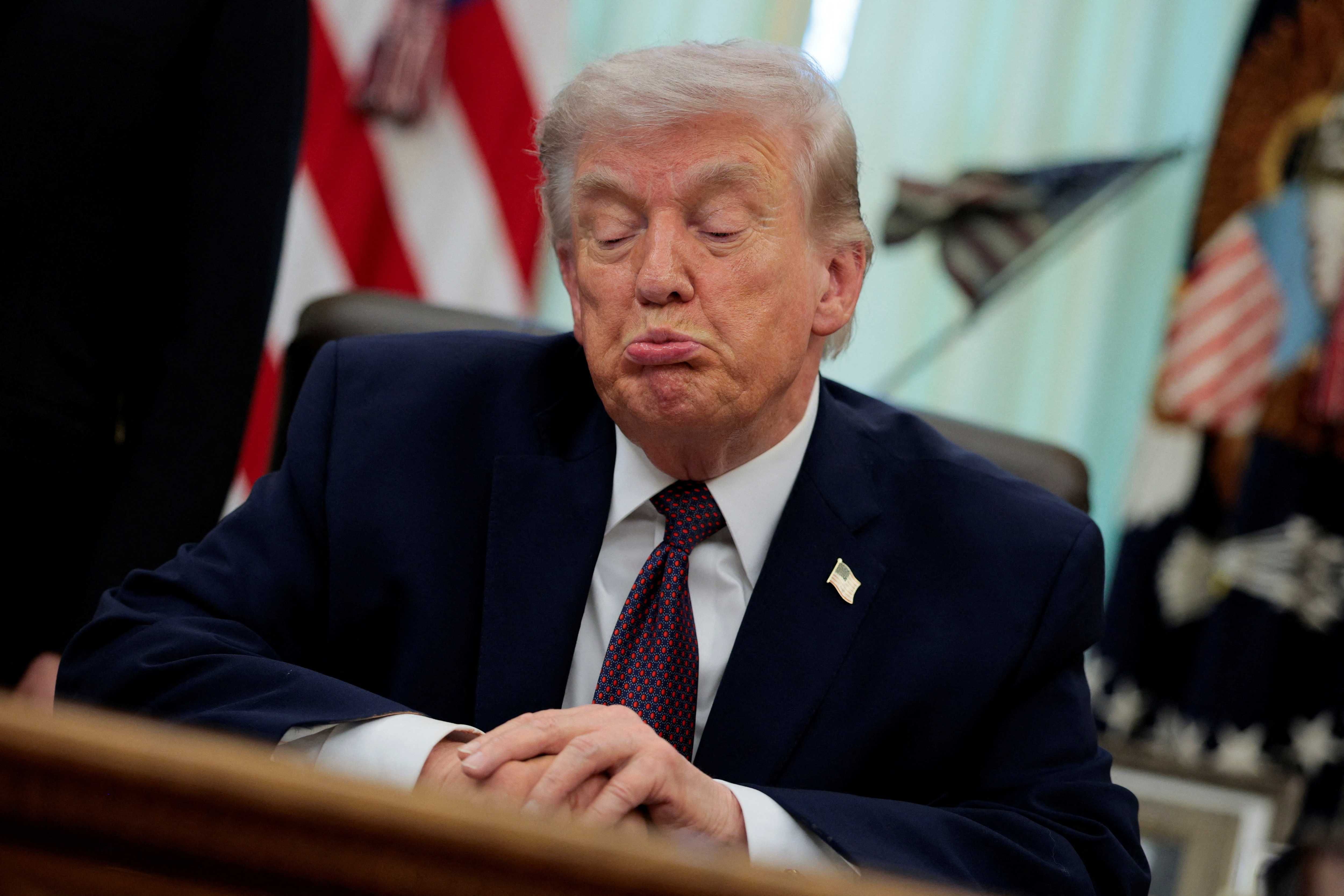
U.S. President Donald Trump reacts as he speaks during the signing ceremony for an executive order on mail ballots, in the Oval Office of the White House in Washington, D.C., March 31, 2026. REUTERS Evan Vucci
Among President Donald Trump’s most touted achievements is his One Big Beautiful Bill Act, which Republicans championed as a means of addressing the cost-of-living crisis by lowering taxes. “The problem is that,” explain two acclaimed conservative economists, “although the government is putting money back into taxpayers’ pockets on the one hand via tax refunds, it is taking more money out via tariff-driven price increases, leaving Americans worse off financially.”
Writing in the Wall Street Journal, former chairman of the Senate Banking Committee Phil Gramm and senior fellow at the Hudson Institute Michael Solon assert that Trump’s “obsession” with tariffs has destroyed any hope of the “golden age” he promised on the campaign trail. While Trump “insists that other countries are eating the cost of tariffs,” Gramm and Solon point out that this is a “myth.” Instead, a Federal Reserve Bank of New York analysis finds that “there is 100 percent pass-through from tariffs to import prices, and therefore on U.S. consumers and firms.” And the majority is paid by individuals, as the Congressional Budget Office “estimates that businesses are absorbing 30 percent of the tariffs’ cost while consumers are paying 70 percent.”
The result is that American consumers ended up paying roughly $195 billion in new tariffs, versus the $188 billion reduction in federal tax liability they received from Trump’s tax cuts. In other words, the tariffs cost more than the tax cuts relieve.
“Things will get worse in 2026,” Gramm and Solon warn. “The Congressional Budget Office projects that Mr. Trump’s tariffs will generate $331 billion this year, while the CBO estimates the new tax cuts will save taxpayers $230 billion. Families and businesses will be worse off on net.”
And, they note, this will likely come into play during the November midterms. By October, Americans will have spent $443 billion on Trump’s tariffs, while the tax cuts will have provided them with $379 billion. “If the president successfully restores his tariffs to the levels where they were before the Supreme Court’s decision in February, the tariff tax in 2026 will be 44% larger than the new tax cuts contained in the Big Beautiful Bill.”
Trump came into his second term under the belief that his idea of using tariffs to replace income taxes would be popular. But, write the economists, “If he studied the history of tariffs…he would know that Americans have always hated them. From Britain’s Townshend Acts of 1767, which helped fuel the American Revolution, to the Smoot-Hawley Tariff of 1930, which deepened the Great Depression, tariffs have proved politically toxic.”
Their conclusion is simple: “Voters don’t reward politicians for enacting tariffs.” And in a midterm year when the GOP is already projected to take major losses, the tariff-to-tax ratio adds up to bad math for Republicans.