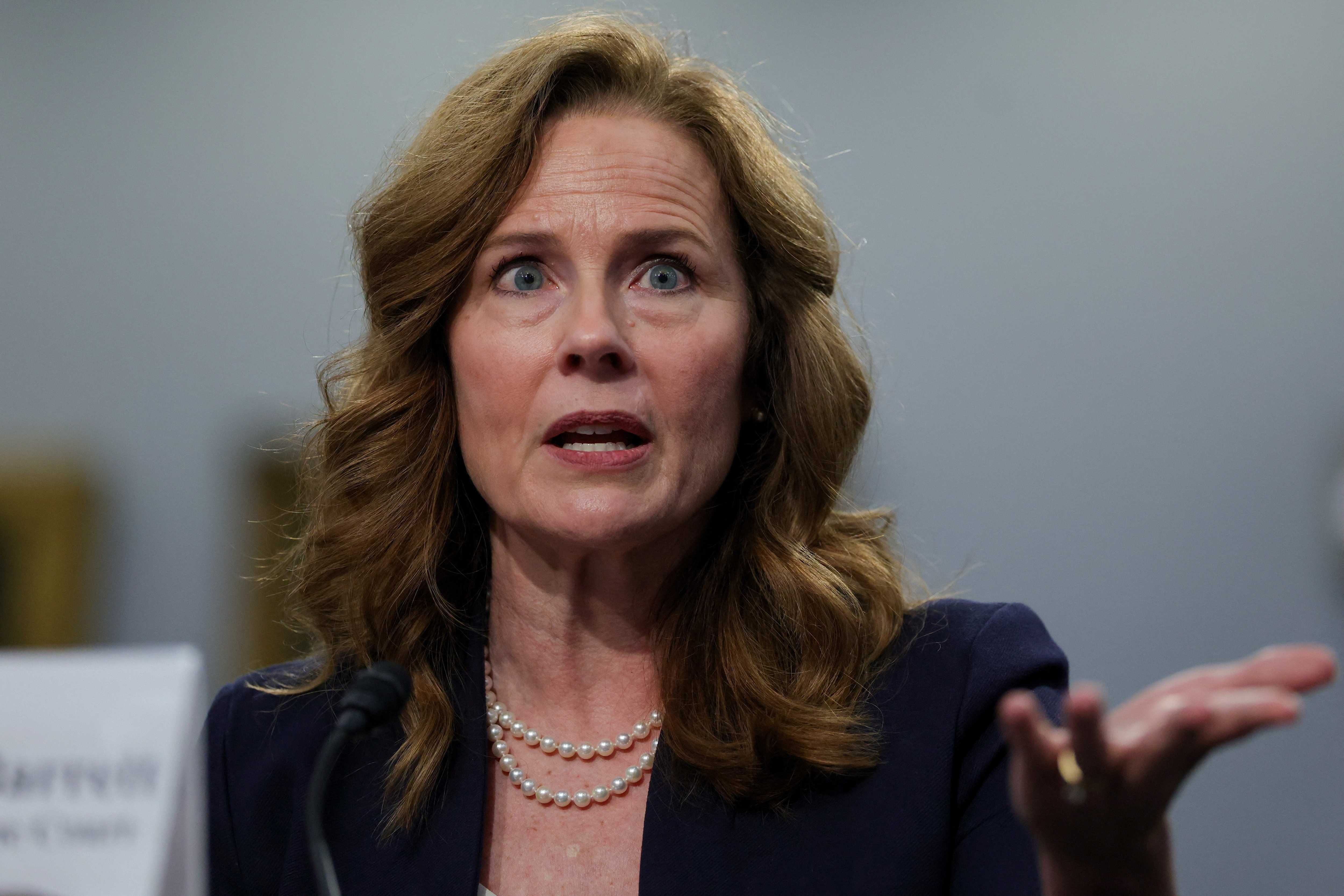
U.S. Supreme Court Justice Amy Coney Barrett on Capitol Hill in Washington, D.C., U.S., July 14, 2026. REUTERS/Evelyn Hockstein
The Supreme Court has become notorious for either overturning longtime legal precedent to do President Donald Trump's bidding — such as gutting the Voting Rights Act and making it easier for him to impede mail-in voting — or coming perilously close to doing so, such as when four judges voted to overturn the 14th Amendment's birthright citizenship clause. Speaking for the podcast Politicon on Thursday, a legal expert agreed with a political strategist and a journalist in describing the status quo as "crazy."
The conversation began with how Trump's administration will make bizarre legal arguments to the Supreme Court, which nevertheless treats those statements as potentially valid instead of self-evidently absurd.
"It's amazing the stuff they'll say," former top Justice Department official Pam Karlan said. "I don't know if you've taken a look at the Postal Service's 95-page explanation of its final order, but there's this moment in there where they say, 'Well, of course we can tell you how to do your ballot envelopes, because we've got this stuff that tells people how to send human remains through the mail.'"
"... Which is crazy talk," Karlan added.
Journalist Albert Hunt singled out one judge, Justice Amy Coney Barrett, who centrists attempted to reassure liberals and moderates would not move to the far right despite being jammed through by President Donald Trump before the 2020 presidential election. Four years earlier, when a vacancy appeared shortly before the 2016 presidential election, Senate Republicans refused to confirm President Barack Obama's nominee Merrick Garland on the grounds that they needed to wait until the election's outcome.
"Everyone knew she would be very conservative on social issues, abortion and the like, but there was a sense that maybe she would be more of a swing vote on other issues," Hunt said. "The New York Times even did a front-page piece on that. That doesn't appear to be the case. She seems to be pretty much in lockstep on most of these issues with the rest of the Republicans."
Political consultant James Carville, who helped elect Bill Clinton in the 1992 presidential election, described the Supreme Court as a "pack of fools."
"The birthright citizenship case, okay, I've read the 14th Amendment," he explained, adding that he had done so "20 times." "How clear could the language be?" The birthright citizenship clause of the 14th Amendment states, "All persons born or naturalized in the United States, and subject to the jurisdiction thereof, are citizens of the United States and of the State wherein they reside."
"The language is clear," Karlan said. "And until five or six years ago, this would've been a nine-zero case at the Supreme Court, and it's just a sign of what people sometimes call the Overton window, that crazy ideas move the court to crazy places over time. And that's really troubling. But yeah, you're absolutely right. If you read that language, it's clear."
Carville offered a cynical observation about the Supreme Court's motives.
"Even Justice [Clarence] Thomas admits that the 14th Amendment does mean that the Bill of Rights applies to the states," Carvile said. "He just thinks it's not through the due process clause, he thinks it's through the privileges and immunities clause. Now, the one effect that that would have, which really gets back to your point about birthright citizenship, is then the provisions of the Bill of Rights would only apply to citizens and not to other people because the Privileges and Immunities Clause is only about citizens. I mean, down the road, we could see some crazy stuff. I mean, we're already seeing crazy stuff, so..."
He concluded, "Yeah. I don't know why I say down the road."