Scalia panic sparked a secret Supreme Court plot to hide its history: NYT
01 September
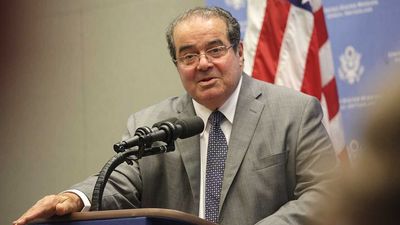
U.S. Supreme Court Justice Antonin Scalia on July 13, 2011 (U.S. Mission Photo: Eric Bridiers/Flickr)
U.S. Supreme Court Justice Antonin Scalia on July 13, 2011 (U.S. Mission Photo: Eric Bridiers/Flickr)
The death of U.S. Supreme Court Justice Antonin Scalia in 2016 is mainly remembered for then-Senate Majority Leader Mitch McConnell (R-Kentucky) blocking then-President Barack Obama's nomination of Judge Merrick Garland for the seat — and keeping the seat open until Obama left office. But according to the New York Times' Jodi Kantor, there was another significant event at the High Court that year: a plot to hide part of SCOTUS' history.
Kantor, the Times, explains, "In early 2016, Justice Antonin Scalia died suddenly of a heart attack on a Texas ranch, sending his Supreme Court colleagues into a period of grief and uncertainty. Behind closed doors, they had to contend with another piece of unsettling news. Justice Scalia, the leading light of the conservative legal movement, had left no plans for his working papers, according to five people aware of the situation. For a Supreme Court justice, this was the equivalent of dying without a will. With no instructions for creating an archive or opening it to the public, the definitive inside account of his work — and the Court's — could be lost or emerge with uncomfortable speed."
According to Kantor, Scalia's colleagues "entered into private negotiations to try to head off any such situation in the future."
"In a series of memos and conference meetings," Kantor reporters, "Chief Justice John G. Roberts Jr. led the surviving justices in discussions about imposing a more uniform seal for their own papers, according to several people with knowledge of the process.
The absence of instructions from Justice Scalia and ensuing confidential conversations, which have not previously been reported, help explain why the nation's highest court can be so difficult to understand. The ultimate record of the Court's work is considered the personal property of each justice, to dispose of or share as he or she chooses. And many of the justices have valued confidentiality over transparency and chosen to postpone scrutiny of their work for years to come."
Kantor notes that unlike the U.S. government's executive branch, the judicial branch has "no laws to determine what the justices save, shred, burn or reveal, or when."
"People familiar with the episode after Justice Scalia's death, who spoke to The New York Times on the condition of anonymity because of the Court's sensitivity over disclosure of internal workings, recalled that a consensus was reached, but had differing memories of its terms and how solid or lasting it was," according to Kantor. "Still, the death of Justice Ruth Bader Ginsburg, just a few years later, provides a clue: Her Supreme Court papers went, at her direction, to the Library of Congress on the condition that no case file would be opened until every justice involved in the matter had died, a restriction that could lock away many documents for decades."