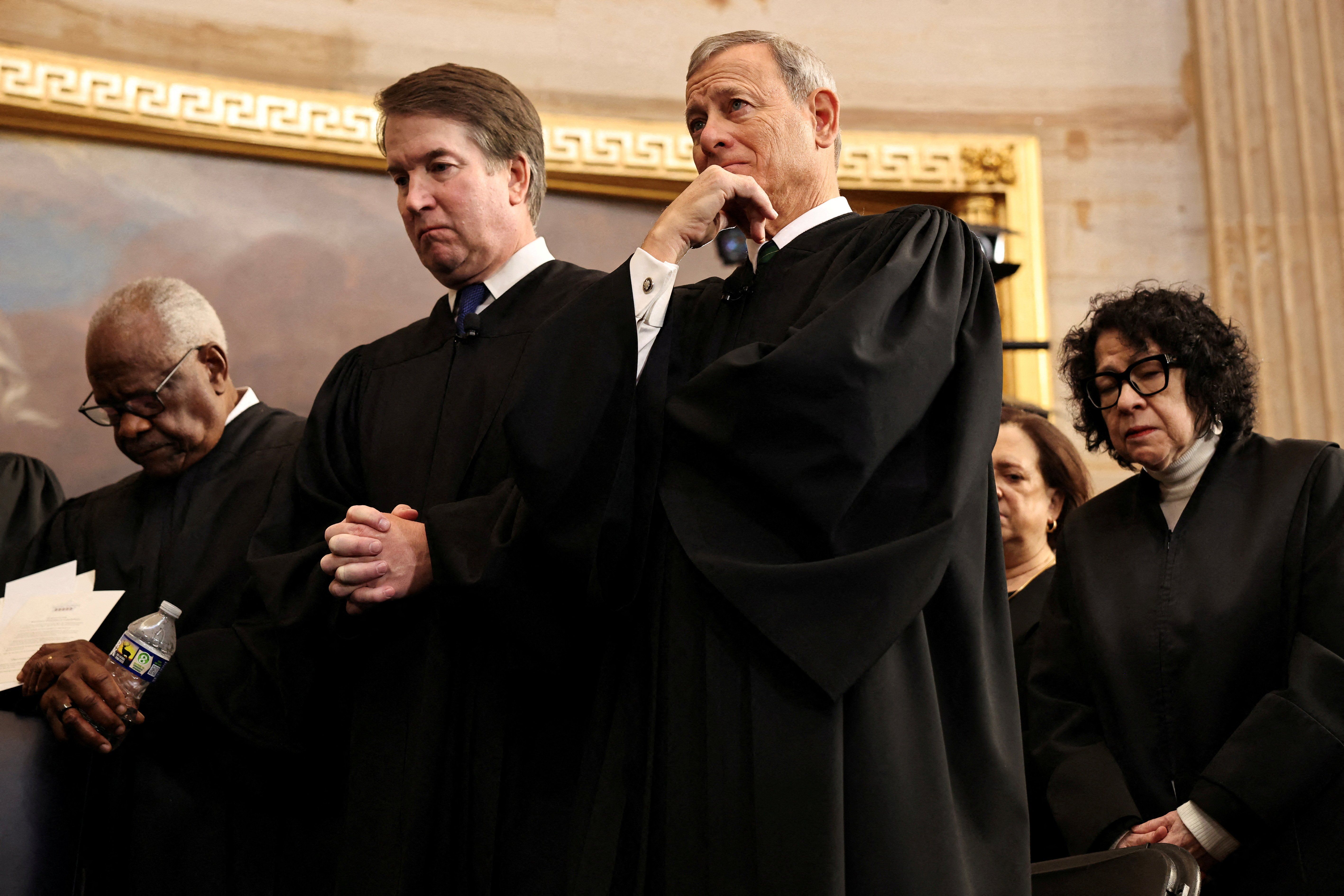
The Supreme Court seems poised to hand Donald Trump a victory in one of his most substantial power grabs yet, but according to the New York Times, the justices appear uncertain how to do so while protecting one key agency: the Federal Reserve.
The Court on Monday began hearing arguments in the case of Trump v. Slaughter, which stems from the president's attempt to fire Rebecca Kelly Slaughter, a Democratic member of the Federal Trade Commission. The law requires that Trump give a sufficient reason for such removals from independent agencies, but he has argued that the Constitution grants him the authority to fire officials like Slaughter for "any reason or no reason at all," the Times explained.
Justices appeared willing to accept the president's argument, which would grant him sweeping new authorities to reshape government agencies meant to stay insulated from presidential interference. They did, however, express concern that giving Trump this authority might also give him those new authorities over the Federal Reserve as well. Instability at the Fed brought on by potential Trump interference could result in serious damage to the economy and markets.
Trump-appointed Justice Brett Kavanaugh posed the question to Solicitor General D. John Sauer.
“General Sauer, can I ask you about the Federal Reserve?” Justice Kavanaugh said. “The other side says that your position would undermine the independence of the Federal Reserve and they have concerns about that, and I share those concerns. So, how would you distinguish the Federal Reserve from agencies such as the Federal Trade Commission?”
In response, Sauer said that a prior opinion from the Supreme Court sufficiently set the Fed aside as a government entity separate from those Trump has been attempting to exert control over, though he did not explain precisely why this was.
“The Federal Reserve is a uniquely structured, quasi-private entity that follows in the distinct historical tradition of the First and Second Banks of the United States,” the opinion cited by Sauer argued.
The Times' report noted that the opinion cited by Sauer "was not notable for its clarity." Lev Menand, a law professor at Columbia, also cast doubt on the solicitor general's argument in a statement to the outlet.
“Neither the government nor the justices have worked out a way to do this consistent with the constitutional theory advanced by the president,” Menand said.
Trump has previously expressed a desire to fire Fed Chair Jerome Powell, on account of his unwillingness to shift interest rates in a manner that would benefit the president's economy. Powell's term as chair will end in May, and Trump is widely expected to put forward National Economic Council Director Kevin Hassett as the nominee to replace him.