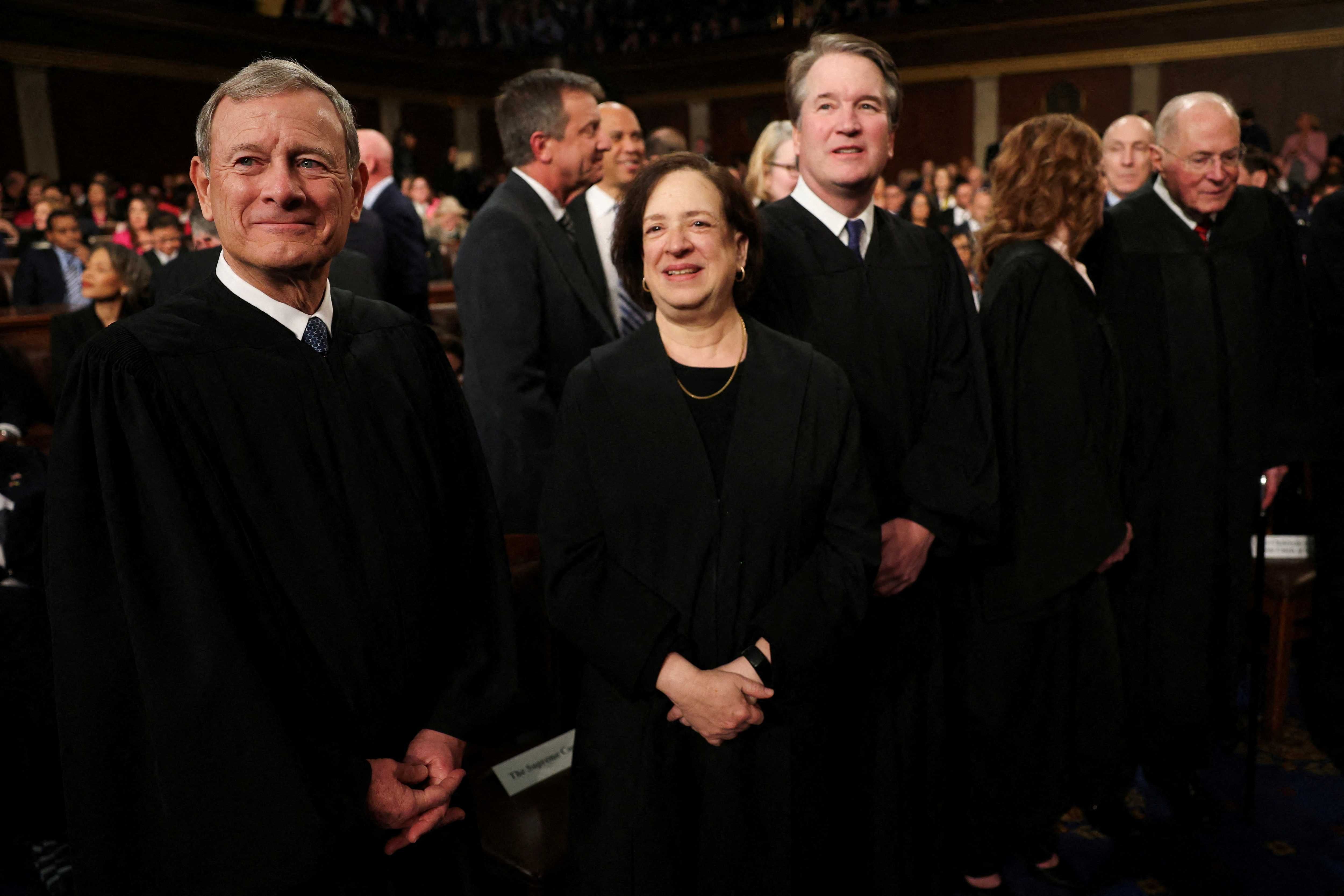
Chief Justice of the Supreme Court John Roberts, Justice Elena Kagan, Justice Brett Kavanaugh, Justice Amy Coney Barrett, and retired Justice Anthony Kennedy on March 04, 2025 in Washington, DC. Win McNamee/Pool via REUTERS
In an unsigned shadow-docket order on Tuesday night, June 2 in the case Allen v. Milligan, the U.S. Supreme Court upheld a congressional map in Alabama that eliminates a largely Black district. This decision follows the High Court's controversial 6-3 ruling in Louisiana v. Callais, decided on April 29. And Slate legal analysts Dahlia Lithwick and Mark Joseph Stern believe that the June 2 order makes Callais even worse.
Justice Sonia Sotomayor, in her dissent, was highly critical of the Alabama order — which, she argued, "disregards both democratic values and the rule of law." Lower federal court judges found the Alabama congressional map to be racially discriminatory, but the High Court's right-wing supermajority disagreed.
"Although the supermajority described its handiwork as a straightforward application of April's decision in Louisiana v. Callais," Lithwick and Stern explain in Slate, "Tuesday's decision dramatically expands the scope of that ruling. It is not a mere aftershock from Callais, but a separate earthquake of the same or perhaps even greater magnitude. Following years of twists and turns in the legal system, this case has become the vehicle by which the Court's conservative supermajority not only applies its own brand-new 'updates' to Section 2 of the storied Voting Rights Act of 1965, but also, sweeps what remains of constitutional protections against discriminatory voting practices out the back door."
The legal analysts continue, "It commits these crimes in an unsigned, blithely dismissive order that lacks any substantive reasoning, as it pretends to be honoring some jurisprudential lodestar it celebrates as 'our colorblind Constitution.'"
The June 2 order on Alabama, according to Lithwick and Stern, expands "Callais' jury-rigged standards."
The Callais ruling inspired plenty of heated debates. While some conservatives and libertarians saw Callais as a victory for fairness, quite a few liberals and progressives countered that it decimated the Voting Rights Act of 1965 and gave the green light to racial discrimination.
NAACP President Derrick Johnson is among the critics of Callais and the June 2 Supreme Court order that followed it. Appearing on MS NOW, Johnson told host Ana Cabrera, "It seems the Supreme Court is endorsing racially discriminatory behavior by the state of Alabama."
Similarly, Lithwick and Stern view the High Court's Alabama order as a victory for "blatantly racist gerrymanders."
"In reality, the Alabama map was determined, over many years and many pages of fact-finding, to have been a product of intentional discrimination," the Slate legal analysts write. "For instance, the state admitted that it had tried to keep residents with 'European heritage' — that is, white people — in the same district while aggressively slicing up non-white communities into different districts. Under the new regime, the Roberts Court's conservatives don't care. In fact, Tuesday's order expressly approved of the state's desire to keep those white voters together while divvying up Black voters to prevent the latter group from electing their preferred representative. It is now open season on minority voters in any state that seeks to crowd them out of their voting booths."