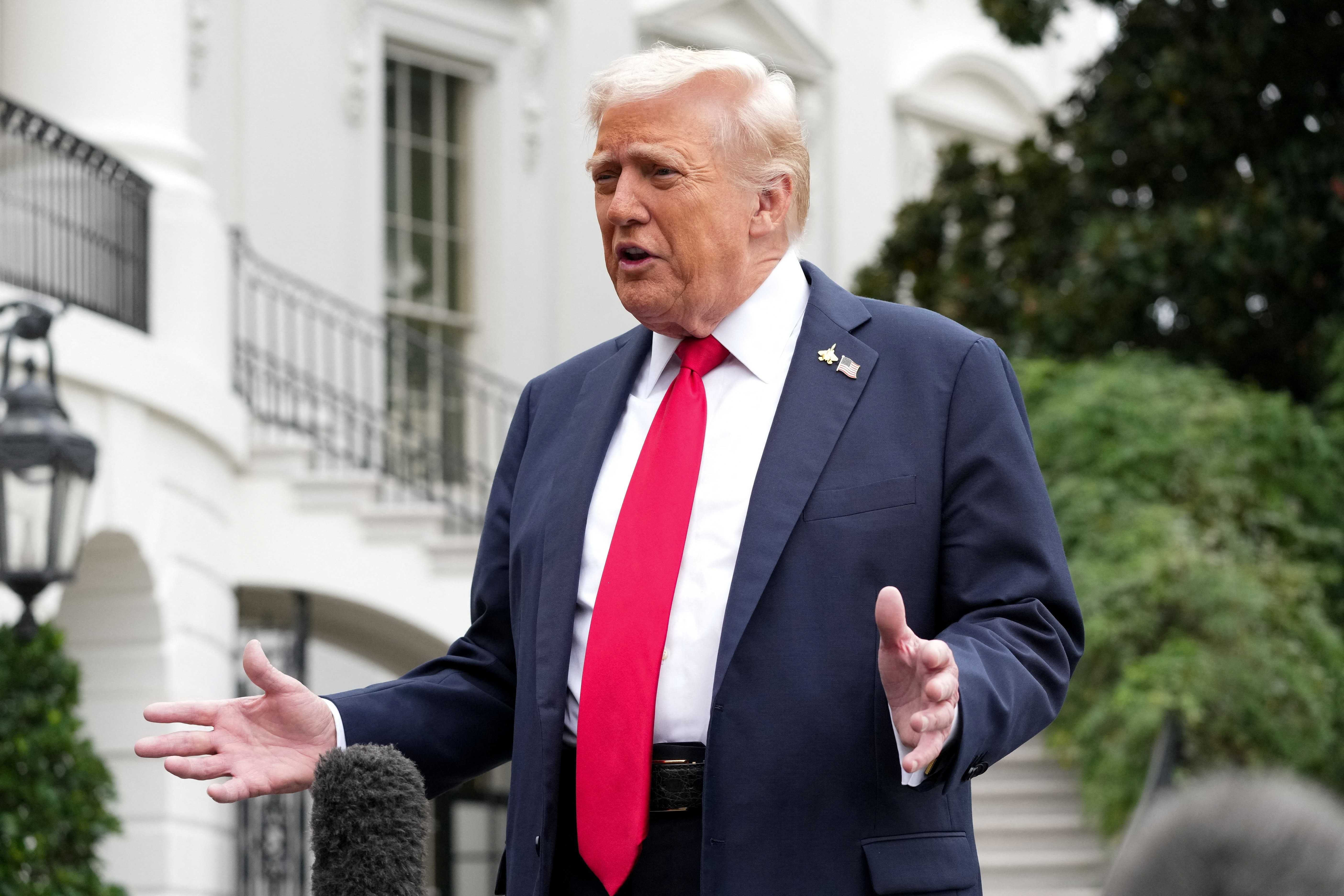
U.S. President Donald Trump speaks to the press before boarding Marine One to depart for Quantico, Virginia, from the South Lawn at the White House in Washington, D.C., U.S., September 30, 2025. REUTERS/Ken Cedeno
Despite promising to protect the program, and ordering its employees to praise him, President Donald Trump has left Social Security with a $169 billion deficit (through his tax laws) and the potential that it will soon be looted (by flirting with privatization). Now a new report exposes how, thanks to Trump's larger $40 trillion debt, the deficit is going to be a major issue for whoever succeeds him in office.
What's more, former officials for President Joe Biden tell AlterNet that Social Security is bound to be a part of that.
“To prevent a 22 percent automatic benefit cut, Congress and the next president will need to agree to some mix of benefit cuts and tax increases or an allocation from the government’s general fund to prop up the program, all contentious and unpalatable options," wrote Axios journalist Neil Irwin on Monday. Speaking with former Biden adviser now at the Economic Security Project Mike Konczal, Irwin was told that "we’ve now moved from a world where there wasn’t enough demand to one where supply is the limiting factor. Moreover, the deficit situation is quite grim in a way I don’t think people appreciate.” Similarly Zachary Liscow, a Yale University law professor and former chief economist at the Office of Management and Budget, told Axios that "the scale of the fiscal challenge is simply too large for GDP expansion to serve as a silver bullet for the ongoing problems of our deficit and debt.”
A third Biden Administration official elaborated on the implications of the views expressed by Konczal and Liscow.
"We have come to the end of 50 years of Reaganomics," former Social Security Commissioner Martin O'Malley told AlterNet on Monday, referring to the economic policies of former President Ronald Reagan. "The warped notion of supply side economics that has told all of us that if we just let the super wealthy of America pay less and less in taxes, that that will somehow create a cloud burst of excess capital that will rain down in terms of jobs and opportunity for the rest of us. The only thing that it created, predictably, was a flood of debt for the United States. And you saw that in gross and obscene proportions during the second Trump administration. They are borrowing money to give the wealthiest of Americans, people like the Trump family and Elon Mosk, huge windfalls of cash."
He added, "And they’re borrowing on our country’s future and our children’s future in order to give it to themselves. So if we only returned to the income tax rates that applied to the highest earners in the first term of George W. Bush, we would bend that trend line in a very positive way for the foreseeable future."
Regarding Liscow's comment on economic growth alone being insufficient to solve the debt crisis, O'Malley said it is "absolutely true. In fact, that’s what many Republican presidents had told us every time they borrowed more money to give tax cuts to the wealthiest of Americans. And it didn’t happen. They were like magicians telling you not to look at what they have in their right hand, just look at this future GDP growth in their left hand. And it’s never happened. It’s not true. It’s mathematically untrue. And math is a stubborn thing. The solution is to require that the wealthiest of Americans return to paying the same tax rates that they did in the [former President George H. W.] Bush administration, and probably also to reexamine capital gains."
He later added, "Social Security is a valuable part of the nation’s economy. Huge driver of not only consumer confidence, but of consumption. And Social Security throughout its 90-year history has always ranged in terms of GDP in the neighborhood of about three and a half, 4 percent. So I don’t think that analysis really has much to do with Social Security as it does to the self-inflicted revenue hit that we shifted to borrowing, because we used the borrowed money to reign buckets of cash on the wealthiest of Americans with no appreciable benefit for the national economy."
While O'Malley shared the views of his fellow Biden Administration alumni, at one point he disagreed with Irwin's framing of the debt issue.
"To that I would say no, they don’t need to do a mix of those three solutions," O'Malley said, referring to Irwin arguing that to save Social Security from large cuts Americans would need to “agree to some mix of benefit cuts and tax increases or an allocation from the government’s general fund to prop up the program, all contentious and unpalatable options."
"They need only require that the wealthiest 4 percent of Americans pay the same social security tax rate on their earnings that the rest of us do," O'Malley told AlterNet. "Not only is that very politically palatable, that is very politically popular. Most Americans think that it’s unfair, unjust and not right, that billionaires and people like the Trump family and Elon Musk should pay no more into Social Security than a family making $185,000 a year."