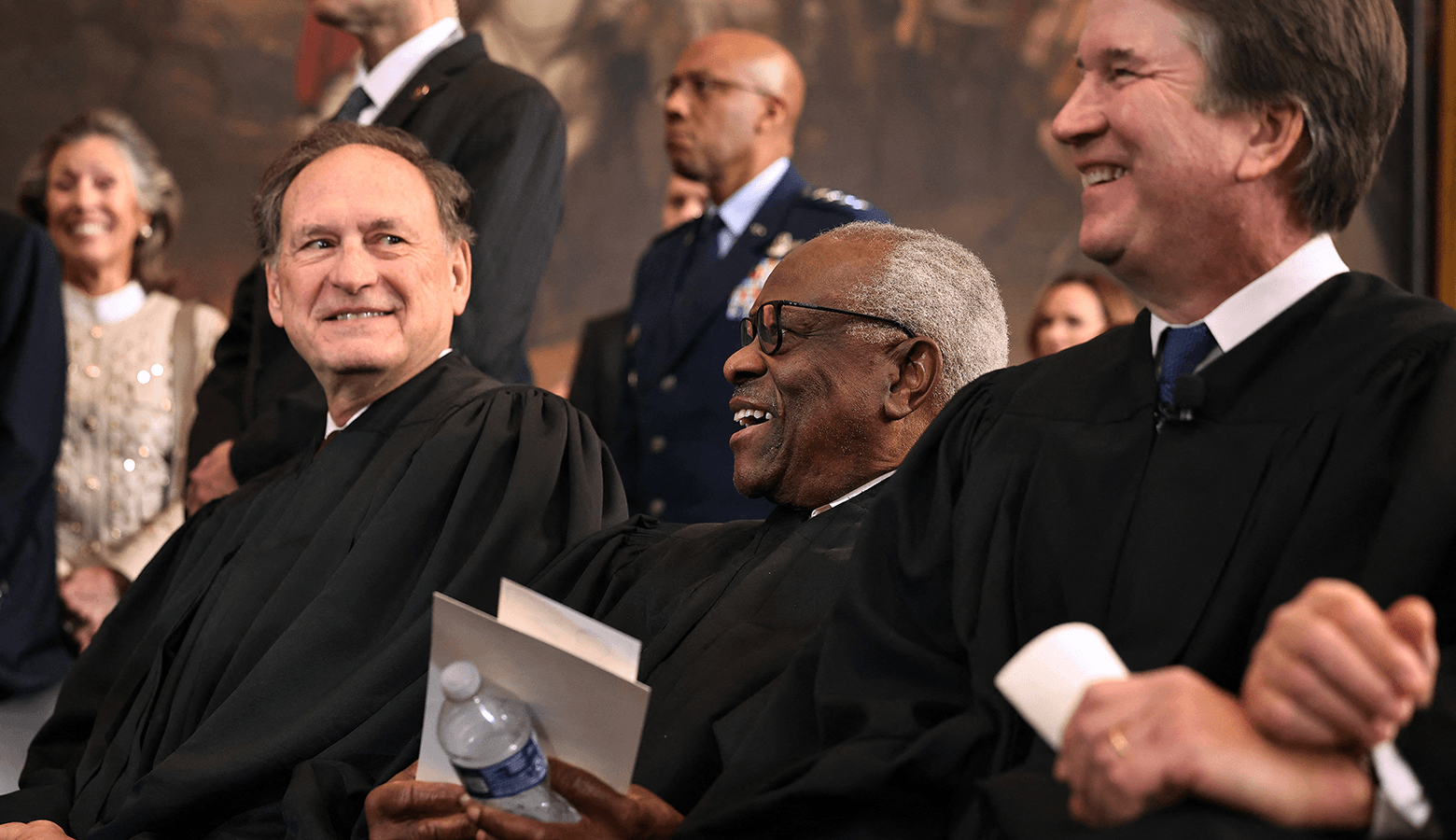
Supreme Court Justices
President Donald Trump has benefited enormously from the heavily far right Supreme Court, one that repeatedly throws its weight behind their fellow Republican even when doing so seemingly requires them to avoid explaining their reasoning. Yet according to two of the Supreme Court's non-Republican judges, the bench's GOP faction is starting to back off on its tendency to use the so-called "shadow docket" to avoid accountability for its decisions.
"The Supreme Court’s liberal justices keep dissenting, but they also are seeing some progress on one front as the Trump administration floods the court with emergency appeals," reported The Hill's Zach Schonfeld on Sunday.
Schonfeld added, "During recent talks to judges and law students, Justices Elena Kagan and Ketanji Brown Jackson both welcomed their colleagues’ increasing willingness to pen opinions publicly explaining their fast-track decisions."
Jackson was quoted as saying, "I think it is a good and positive development," then adding later that "because now, the public and also lower courts, who are charged with responsibility of understanding what the court is doing and applying to a certain degree the court’s principles in future cases, really need some way to go about doing that.”
She concluded, “And it was not possible before in a world in which the court was not providing any explanation.”
Kagan affirmed Jackson's stance, as Kagan herself has previously expressed criticism for the Supreme Court issuing landmark decisions without explaining their reasoning. She has also, however, shied away from referring to this as a "shadow docket," arguing that they have improved in the recent past compared to the early months of Trump's second term in explaining their reasoning behind controversial rulings.
Speaking before Congress in the summer, Kagan also slammed the Trump administration and its followers for using language that often seems designed to intimidate judges. That rhetoric has, in turn, led to quite real threats to the safety and lives of the justices themselves.
“He talked about how criticism is fair game... but intimidation is a different thing entirely, and when political figures of any stripe are trying to intimidate judges and justices to do things that they like rather than the things that they don’t, that’s where we really have crossed the line,” Kagan explained.
In addition to concealing their reasoning behind pro-Trump decisions, the Supreme Court is being blasted for contradicting its reasoning from decision to decision — flip-flopping on matters like the appropriate extent of executive power, for example — in order to guarantee Trump gets the outcome he wants.
Justice Ketanji Brown Jackson, in a dissent over the Supreme Court allowing Trump to unilaterally cut funding to the National Institutes for Health, said that it is “Calvinball jurisprudence with a twist. Calvinball has only one rule: There are no fixed rules. We seem to have two: that one, and this Administration always wins.”