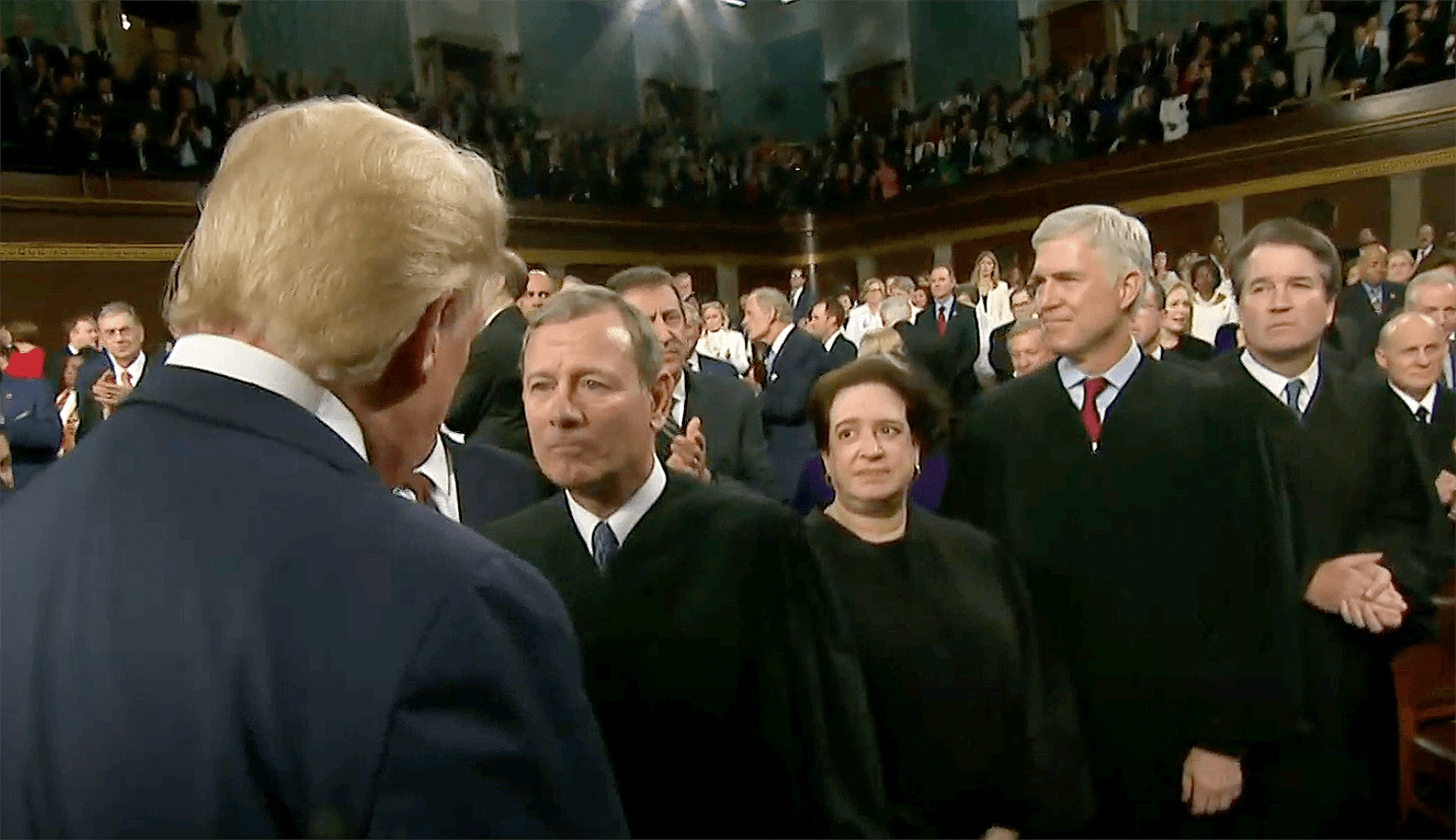
President Donald Trump an justices of the Supreme Court, Image via Screengrab / NBC.
The Supreme Court has seen tempestuous times during President Donald Trump’s second term. From needing to decide whether Trump can build his White House ballroom to ruling against him on key cases involving the midterm elections, tariffs, the Federal Reserve and birthright citizenship, America’s most powerful bench has frequently defied the Republican leader, even as on many other occasions — such as in allowing him to fire vast sections of the federal workforce, overturn civil rights laws and act with unilateral authority — they prove quite deferential to him.
Now Democrats are trying to rein in the court’s overall power.
“One bill proposes increasing the number of Supreme Court justices from nine to 13,” reported The Washington Post's Julian Mark on Sunday. “Another would cut their lifetime terms to 18 years. Others would create an enforceable ethics code and place standards on how the court rules from its relatively opaque ‘shadow docket.’”
Mark added, “The latest wave of proposals to overhaul the Supreme Court have reached something of a fever pitch over the past few months, as Democrats grow increasingly frustrated with the court’s rightward turn. While the court blocked several of President Donald Trump’s key initiatives this past term, it also delivered significant conservative victories that pared back the 1965 Voting Rights Act, loosened campaign finance rules and increased presidential power.”
Even though liberals are not likely to implement those reforms without regaining control of the Senate and eliminating the filibuster, they still have hope these things could be achieved, as indicated by Sen. Sheldon Whitehouse (D-RI).
“Last month, Whitehouse and other Senate Democrats proposed a law that would limit justices’ terms to 18 years,” Mark wrote. “Under that system, a president would nominate a justice every other year — a design intended maintain a measure of ideological balance on the bench.”
The journalist added, “Some advocates say specified terms also would lower the stakes of Supreme Court confirmation battles, since they would not be for lifetime appointments. These battles in recent years have become all-out, nasty and often personal.”
As Whitehouse told The Washington Post, “Even in a Congress like this one, where these bills have no chance of passage, it’s really important to file them and to stand by them, because they reassure people that there is in fact a mechanism by which the court could be restored to some degree of better order.”
Similarly James Talarico, the Democratic nominee for Senate in Texas, recently said in a public statement that “Black Texans, Black Americans, have been ringing the alarm about the Supreme Court, and I think it’s time for all of us to realize the crisis that we face on the highest court in this country.”