How a radical far-right doctrine triumphed at the Supreme Court: legal scholar
01 July
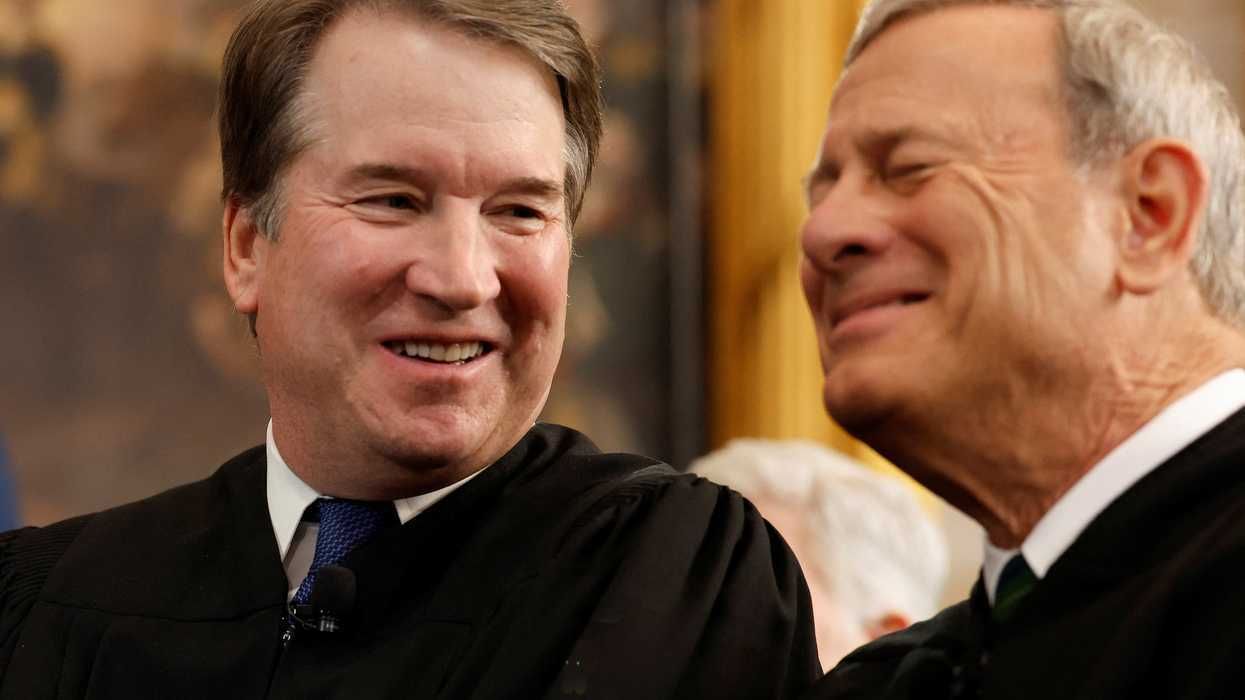
U.S. Supreme Court Chief Justice John Roberts with Justice Brett Kavanaugh. Chip Somodevilla/Pool via REUTERS
In its 6-3 Trump v. Slaughter ruling released on Monday, June 29, the U.S. Supreme Court's GOP-appointed supermajority decided that President Donald Trump enjoys considerable power when it comes to his ability to fire members of independent regulatory agencies. The ruling rejected the High Court's Humphrey's Executor v. United States precedent of 1935, and Peter M. Shane — a scholar at the New York University School of Law — views Trump v. Slaughter as a major "triumph" for a "radical" far-right doctrine known as the "unitary executive theory."
The unitary executive theory, promoted by many MAGA Republicans, favors a very powerful executive branch for the federal government. But critics of the theory, including conservative New York Times columnist David French, see it as unconstitutional and anti-checks and balances.
The "Slaughter" in Trump v. Slaughter was Rebecca Slaughter, who Trump fired from the Federal Trade Commission (FTC). The High Court ruled that Trump was well within her right to fire her.
Shane is highly critical of the Robert Court's Trump v. Slaughter ruling, which he sees as a recipe for presidential overreach.
"In the words of Chief Justice John Roberts, who wrote for the majority, the FTC 'unquestionably exercises executive power, and must therefore be controlled by the Chief Executive, in whom such power is vested,'" Shane explains. "As a result, he said, Rebecca Slaughter 'served as the President's subordinate at the FTC — and that the President was entitled to cut her tenure short.' In so concluding, the Court explicitly overruled the unanimous 1935 decision Humphrey’s Executor v. United States, which held exactly the opposite with regard to the same agency…. The Court's decision extends to all independent regulatory agencies, not just the FTC. Its central premise is that the president is constitutionally entitled to control all exercises of executive power — the 'unitary executive theory.'"
Shane continues, "Roberts defined 'executive power' as broadly as is possible: 'When an agency executes a congressional mandate against private parties,' he wrote, 'it exercises executive power — no ifs, ands, or quasis about it.' Because all of the regulatory agencies created by Congress issue rules and orders that affect private parties, they all would appear to exercise executive power within the Roberts definition."
Justice Sonia Sotomayor, a Barack Obama appointee, was among the three dissenters in Trump v. Slaughter — and Shane shares her concerns.
"It is not hard to imagine how a creative president could use his newfound control over all agencies," Shane writes. "As (Justice Neil) Gorsuch points out, giving presidents unfettered control over the specialized agencies allows a retributive chief executive to launch attacks on his opponents from multiple directions…. A Court tilted against regulation has positioned itself as the ultimate, nondeferential arbiter of when legal challenges to the president are even permissible and whether those challenges have merit. The Court can also tell Congress if measures the legislative branch thought 'necessary and proper' to constrain the executive went too far."
Shane continues, "Justice Sonia Sotomayor is certainly correct in stating that 'the result' of Slaughter 'is a President who emerges with far greater power than ever before.' One might, however, say the same about the Roberts Court itself."