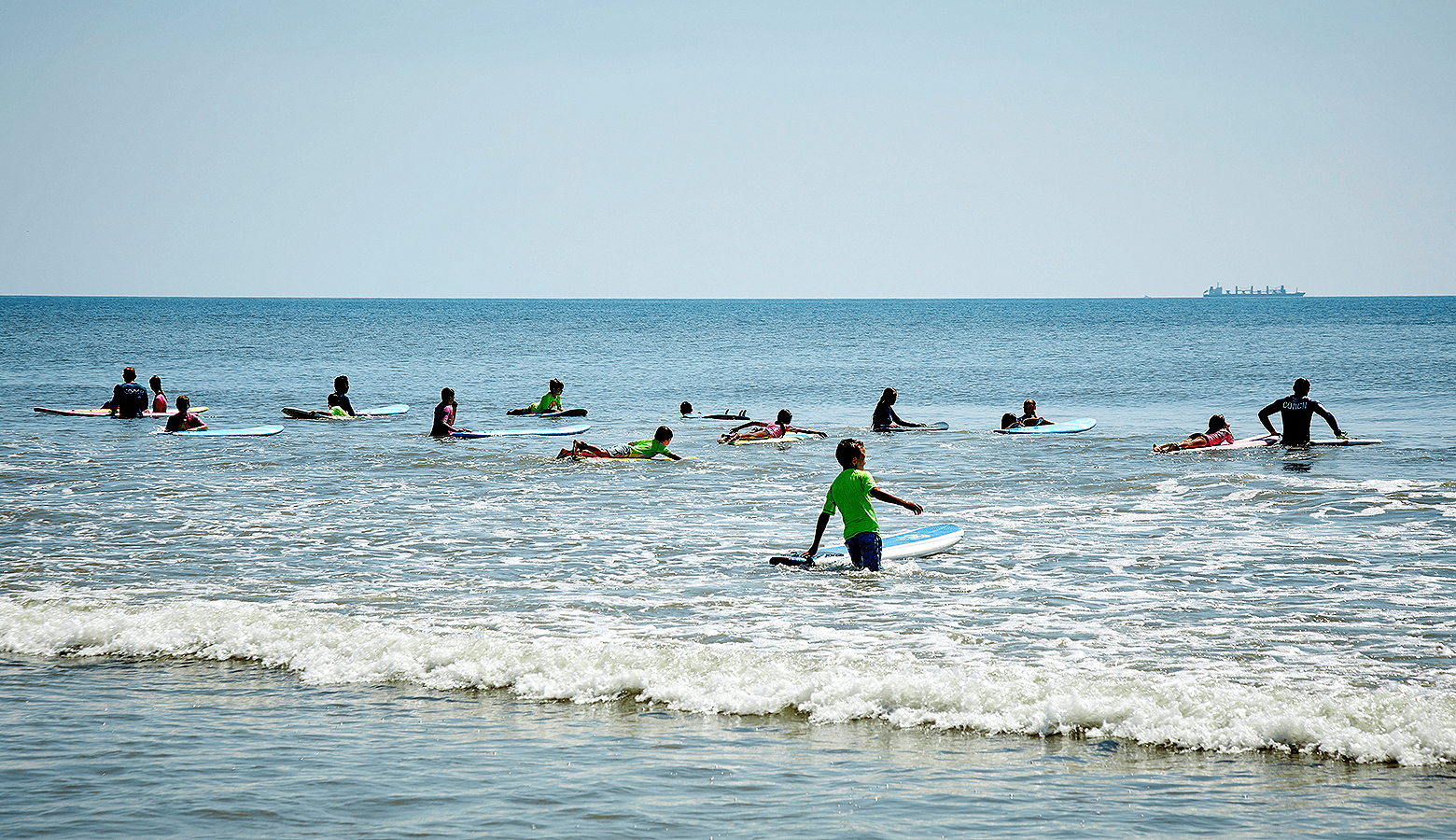
Cocoa Beach, Florida, United States July 30 2025 Children in the sea having fun while taking surf lessons at Cocoa Beach on a beautiful sunny summer day, Image via Shutterstock.
The beaches of Florida have become swamped with huge quantities of sargassum seaweed, with the majority of its Atlantic and eastern Gulf coasts seeing accumulations ranging from elevated to significantly above normal. State meteorologists say that while it’s a tourism industry “killer,” Florida politicians are doing little to address the crisis.
“Sargassum seaweed coverage has been brutal recently across parts of the Florida coast,” posted meteorologist Matt Devitt on Thursday. “Happens every year, but still can be quite annoying.”
Reports have been emerging of a “tsunami” of seaweed, which has been accumulating and rotting in massive piles, not only making beaches inaccessible but in many cases causing a wretched stench. While news outlets have noted beachgoers’ annoyance at the issue, some have asserted that what begins as annoying could develop into a full-blown economic crisis.
“I've lived in South Florida since I was a kid, & there's nothing normal about the breadth, depth and duration of sargassum weed choking beaches in recent years,” posted White House correspondent Marc Caputo, noting that the issue has also been plaguing the shores of Mexico. “It's an economy killer for the tourism industry. Politicians aren't talking about it enough.”
Sargassum is a dense, spongy seaweed that grows in large blooms that break free and drift atop the ocean, often accumulating in massive floating islands. When these islands of algae wash up on shore and amass, they begin to decay in the sun, releasing hydrogen sulfide gas, which smells much like rotten eggs. Beyond its stinky annoyance, another risk researchers have raised is the potential for the festering seaweed to act as a substrate for dangerous bacteria, such as “vibrio,” which cause roughly 80,000 illnesses and 100 deaths in the U.S. each year.
While sargassum provides a vital habitat for marine life when on the open ocean, as it piles ashore, it not only hurts tourism, but can cost coastal communities millions of dollars as they try to clean it up. Experts say that the unusually large sargassum blooms are the result of rising ocean temperatures and the presence of more nutrients in the water, and the seaweed has become a growing problem for tourist-oriented beaches around the world. Currently, for example, 50 percent of the beaches near Cancun, Mexico, are on sargassum alert as massive islands of the stuff have marred shores.
Meanwhile in Florida, as communities race to bury or rake the sargassum back into the sea — which is practically the only solution — the mess is accumulating faster than they can remove it.
According to Pompano Beach Commissioner Audrey Fesik, it is a "never-ending task of trying to stay ahead of mounting seaweed.” He noted that within "12 hours it's all back.”