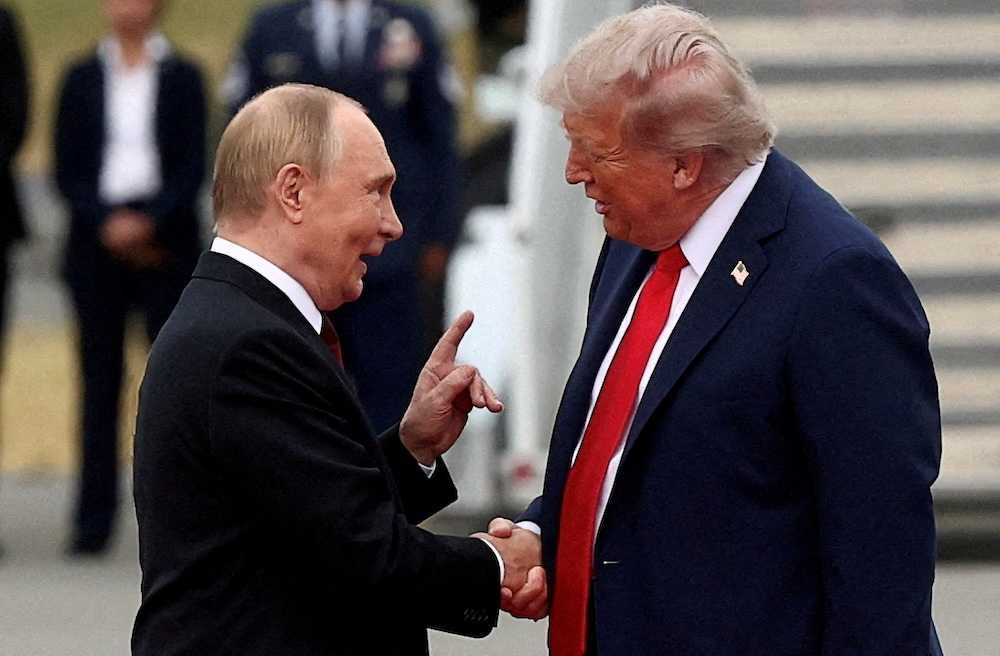
Vladamir Putin and Donald Trump
The New York Times reports signs are emerging that Russia and other foreign governments are once again seeking to influence American voters — in favor of Trump and Republicans.
An online influence operation backed by the Russian government has been ramping up efforts to use Israel as a political wedge and sow division among U.S., according to a new study by an independent company that tracks digital threats and foreign propaganda campaigns.
The “Doppelgänger” influence operation created a flood of social media posts amplifying perceptions that Democrats have retreated from supporting Israel.
“In appearing to target Democrats with negative content, the Doppelgänger push is just the latest effort by Russia to harm the party and support President Trump since his first run for office in 2016,” reported the Times. “… Doppelgänger is run by Russia’s Social Design Agency, a public relations firm. Both the U.S. government and the European Union have imposed punitive sanctions upon it.”
Sources speaking with the Times said U.S. intelligence officials tried to provide a classified briefing to state officials on the midterm election threats on Thursday—the first of its kind in more than two years. However, Trump administration officials were unable to establish a secure virtual connection to the election personnel, said the sources.
On Wednesday, social media platform X announced it banned 13,000 accounts linked to Iran, Russia and China, said the Times. But, nothing stops Russian and Chinese-backed trolls and software from simply opening new accounts from which to sow division and animosity among voters.
The Times reports international operations have “grown more difficult to track” thanks to a broad pullback by many social media firms. That reversal of fake site subversion happened after condemnation and outcry from conservatives and MAGA elements, who accused the companies of collaborating with the U.S. government to stifle free expression.
Lisa Kaplan, the founder of Alethea, told the Times that the volume of posts in the current campaign, and replies under postings that had high engagement, “indicated that the messaging was likely getting in front of people.”
The campaign included more than 50 fake personas, posing as Israeli women, that posted in “synchronized waves” beginning on Oct. 7, the three-year anniversary of the Hamas attack on Israel. The Ties reports a separate network of more than 1,000 accounts then inserted those posts into high-traffic conversations, creating an estimated stack of 150,000 posts.
The Times added that U.S. intelligence findings and numerous reviews have “consistently found that President Vladimir V. Putin of Russia has favored Trump over Democrats, most of whom are more sympathetic to Ukraine as it battles Russia’s invasion.”
In September, for example, a network linked to Kremlin trolls posted a series of AI slop social media videos churning out baseless claims against Democrats running in closely contested Senate races.
The campaigns “give us a glimpse of what their objectives are,” said Jean le Roux, a senior researcher at Graphika. “They’re not targeting Republican candidates in the same way.”