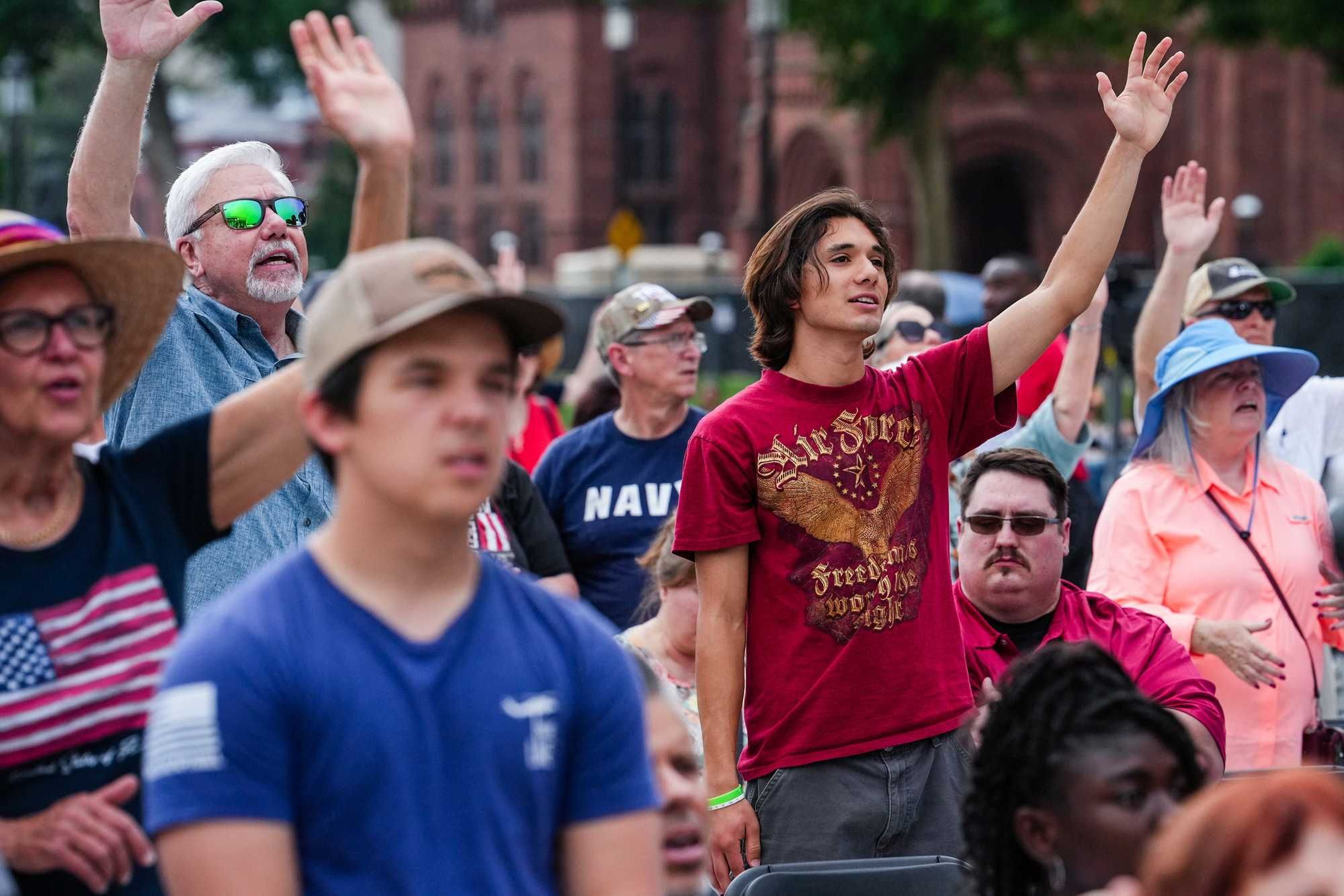
Trump supporters
The separation of church and state is the principle that government and religious institutions should remain independent of one another. However, a new analysis from Deseret News unpacks the intersectionality of politics and religion, suggesting that religion is becoming increasingly intertwined with politics, resulting in Americans distancing themselves from organized religion.
If people are turning away from their faith because they increasingly associate religion with political agendas, it raises a larger question about the future of church and state in America: Is the growing politicization of religion threatening the very principle designed to keep government and religious institutions separate?
In the analysis, researchers argue that political views are increasingly influencing which religious communities people join. Furthermore, some are choosing not to associate with religion at all. Pew Research Center data show that white evangelical Protestant and white Catholic voters are the only religious groups favoring Republican candidates for the U.S. House in the 2026 midterm elections. All other religious groups either favor Democrats or are evenly split.
Historically, political candidates have been open about their religious beliefs, often gaining support from voters who share their faith. Religious values have also frequently shaped political policies and arguments. But that relationship appears to be changing. More Americans are becoming critical of candidates they believe use religion to advance their own political agendas rather than express genuine faith.
Churches were once a unifier for most, and according to David Campbell, professor of American democracy at the University of Notre Dame, he told the outlet that churches are becoming more politically divided. “The congregation is increasingly no longer a place where Republicans and Democrats come together,” Campbell asserts. He believes that candidates' religious rhetoric and affiliation have become a turn-off to many. “Historically in the United States, religious leaders have always been involved in politics. That is nothing new. What is different today is that their involvement is so explicitly partisan,” Campbell notes.
Partisan religion may be driving Americans away from faith. David Campbell's research identifies politics as “a leading explanation” for the growing number of Americans who say they have no religious affiliation.
Campbell's research suggests that politics is increasingly pushing Americans away from organized religion. As churches and religious leaders align themselves with political parties or movements, people may begin to see religion as a political statement rather than a personal expression of faith. Those who disagree with their church's political views may feel disconnected from the religious community, even if they still consider themselves spiritual.
The relationship between religion and politics may continue to shift as Americans' political views increasingly shape their religious affiliations. Although some religious groups currently lean Republican while others favor Democratic candidates, Campbell cautions that these political ties can change. “The funny thing about politics is that it’s always a moving target,” he said. “Things never stay the same.”