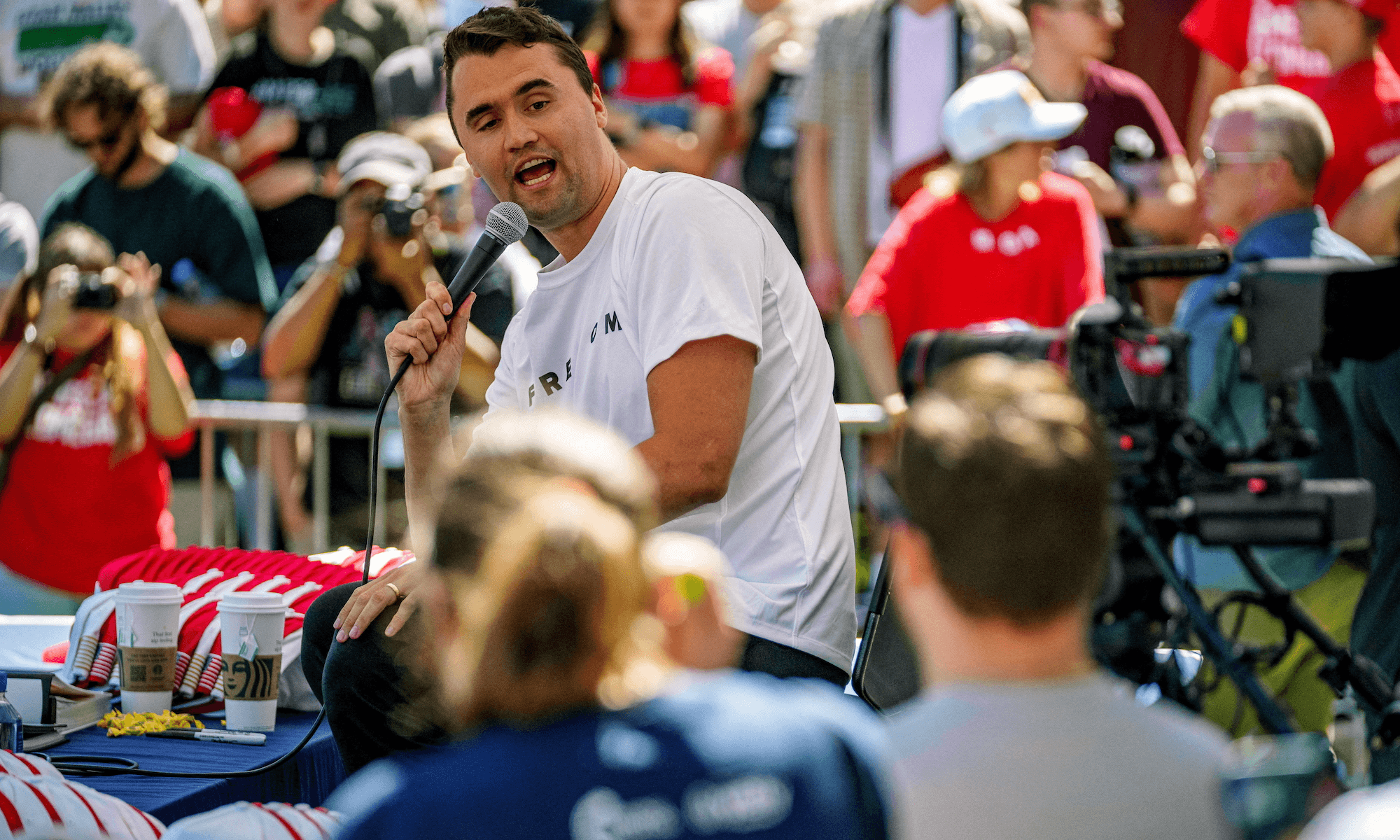
Charlie Kirk appears at Utah Valley University in Orem, Utah in 2025 - Trent Nelson/Reuters
When conservative activist Charlie Kirk was assassinated last year, President Donald Trump and his supporters vowed that his death would change things. In at least one tragic sense, this has been true — politicians are now spending campaign money on personal security.
“Since the assassinations of conservative activist Charlie Kirk and Democratic Minnesota House Speaker Melissa Hortman, more than 15 states have passed laws or approved rule changes allowing lawmakers to access campaign funds for personal security, a sign of growing concern about political violence in America,” Politico’s Natalie Fertig reported on Sunday. Since the start of 2026 Alabama, Nebraska, Oregon, South Dakota and Utah altered their policies so that state lawmakers can use campaign funds for personal security, while states like Tennessee are discussing similar laws.
“The suspect in Hortman’s killing, Vance Boelter, is facing federal murder charges, and authorities said he allegedly confessed in a letter in which he recounted a confusing and convoluted scheme to punish Democratic Minnesota Gov. Tim Walz,” Fertig wrote. “Boelter has pleaded not guilty. In Kirk’s killing, the suspect, Tyler Robinson, allegedly inscribed bullet casings with anti-fascist phrases and meme-culture phrases. A preliminary hearing in his case is scheduled to start this month.”
The newfound vigilance is not limited to politicians; even political activists have to be on their guard. Turning Point USA head Erika Kirk pulled out of a University of Georgia speaking event, where she would have been joined by Vice President JD Vance, because of “serious threats.”
“I take my security team’s recommendations extremely seriously,” Kirk explained in a post on X, with Turning Point USA’s Andrew Kolvet adding the threats against Kirk were “a terrible reflection on the state of reality and the state of our country.”
Trump himself has been accused of inciting violence against politicians who disagree with him. When he accused Walz and Minneapolis Mayor Jacob Frey of “domestic terrorism” for disagreeing with him, former Department of Justice's (DOJ) Civil Rights Division attorney Julia Gegenheimer told Slate legal writer Mark Joseph Stern that Trump’s rhetoric is designed to harm the Minnesota Democrats.
"It is profoundly disturbing. And the reason why this feels different to you is that it is a bit of a different flavor," Gegenheimer said. "It’s pitting the federal government against the states and creating tension where it doesn’t need to be. And frankly, it’s implicitly encouraging acts of political violence against these elected officials by turning them into the enemy." Indeed, Trump has issued subpoenas against Walz, Frey, St. Paul Mayor Kaohly Her and Minnesota Attorney General Keith Ellison.
"We’ve seen this throughout history, even recent history: When you put people in opposition like that — when you portray them as the enemy, when you describe them as kind of threatening a person’s way of life or things that they hold dear — that creates the conditions under which people are more likely to resort to political violence, and it becomes more and more the norm," Gegenheimer explained.
Speaking with this journalist for Salon in 2024, New School for Social Research history department chair and author of "A Brief History of Fascist Lies" Federico Finchelstein explained that Trump and his supporters engage in a "kind of dissonance between what Trump is saying and what is going on. And this has been the case with totalitarians and fascists for decades, that they say stuff that doesn't connect to reality." He described as “shocking” "the idea that the person that has promoted violence through rhetoric, and even sometimes the glorification of that violence, the idea that that person can complain about the 'rhetorical violence' of his enemies.” Finchelstein then added that Trump "does this kind of thing again and again, and that's why he reminds us of [Nazi Germany dictator Adolf] Hitler." The former and possibly future president "follows Hitler's playbook in projecting onto his enemies all his desires, fantasies, and aspirations. This includes, of course, as he said, 'retribution' and violence."
In response to Finchelstein’s comment to Salon, press secretary Karoline Leavitt told Salon that "it's been less 72 hours since the second assassination attempt [by Ryan Wesley Routh] on President Trump's life and the media is already back to comparing President Trump to Hitler. It's disgusting. This is why Americans have zero trust in the liberal mainstream media."