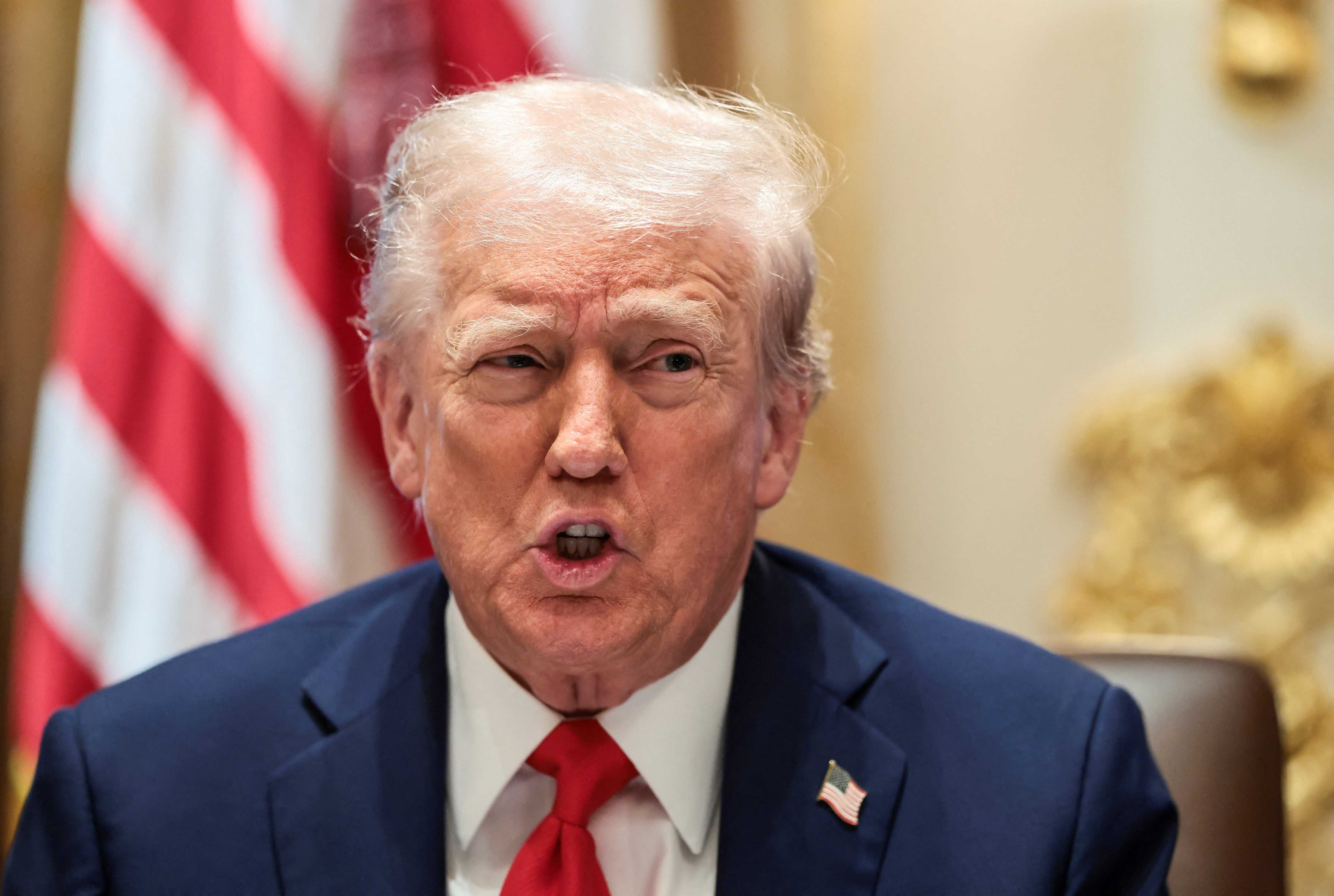
U.S. President Donald Trump speaks during a cabinet meeting at the White House in Washington, D.C., U.S., October 9, 2025. REUTERS Evelyn Hockstein
During the Cold War, the MAD theory — mutually assured destruction — argued that the United States and the Soviet Union had a mutual interest in avoiding a nuclear conflict. And proponents of MAD often argued that the nuclear weapons of the 1970s and 1980s were much more powerful than the nuclear bombs the U.S., under President Harry Truman, used against the Japanese cities Hiroshima and Nagasaki in August 1945.
The Soviet Union ceased to exist in the early 1990s, replaced by the non-communist Russia Federation. But the fear of nuclear confrontations remains.
In an editorial published on February 16, the New York Times' editorial board lays out some reasons why "the world is entering a dangerous new nuclear age" — from the expiration of the NEW Start Treaty to the divide between the United States and longtime North Atlantic Treaty Organization (NATO) allies in Europe.
"This month, the New START treaty between the United States and Russia — the last major restraint on the world's two largest nuclear arsenals — expired," the Times' editorial board explains. "In its place, the Trump Administration is substituting a policy of vague threats and dangerous brinkmanship that portends an unconstrained arms race not seen since the height of the Cold War. President Trump's approach to this new, unbound era is alarming in both its words and its mechanics. Rather than preserving the stability that has held for half a century, the administration is weighing the deployment of more nuclear weapons and, perhaps most recklessly, the resumption of underground nuclear testing…. The administration seems to think that when it comes to nuclear weapons, more is better."
The Times writers add, "With New START gone, the Navy is studying whether to reopen disabled launch tubes on Ohio-class submarines and load additional warheads on its intercontinental ballistic missiles. The moves could more than double today's deployed arsenal."
Trump's "disdain for American allies," according to the Times, has "encouraged them to consider expanding their own nuclear promises."
"European leaders have begun to discuss whether France, which has nuclear weapons, should vow to protect other parts of Western Europe from Russia, given the sudden unreliability of the United States," the editorial board argues. "'As long as bad powers have nuclear weapons,' Prime Minister Ulf Kristersson of Sweden told The Atlantic, 'democracies also need to be able to play.' A larger nuclear umbrella for any country increases the chances that a misunderstanding or mistake will lead to devastation."
The board continues, "Especially disturbing is the (Trump) Administration's signal that it may resume underground nuclear testing…. We must be clear about what this means: The United States has not conducted an explosive nuclear test since 1992…. The president of the United States currently possesses the sole, unchecked authority to launch a nuclear war. In an era of rising tension and decaying treaties, leaving the fate of the world to the judgment of a single person — whoever it is — is a risk no democracy should tolerate."