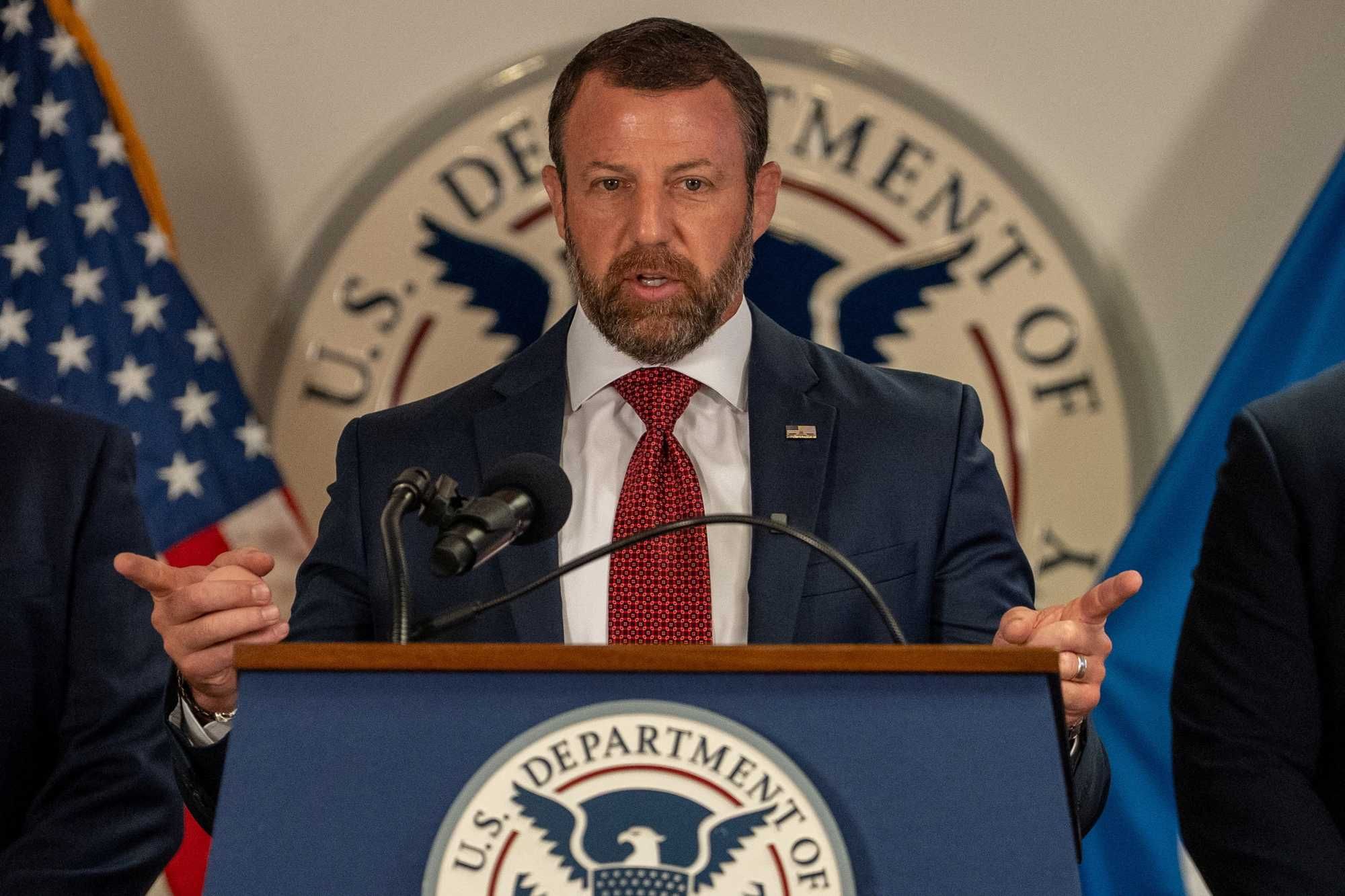
Homeland Security Secretary Markwayne Mullin isn’t one to shy away from a fight.
This article was originally published by Votebeat, a nonprofit news organization covering local election administration and voting access.
The former professional mixed martial arts fighter once challenged the Teamsters president to a brawl in the middle of a Senate hearing and clashed with U.S. officials while unsuccessfully trying to mount his own rescue mission to Afghanistan during the chaotic 2021 American withdrawal.
Now Mullin is stepping to the forefront of the Trump administration’s battle to exert more control over the fast-approaching November elections.
Mullin has threatened to lock up elections officials and withhold federal dollars from states that don’t adopt the election security measures dictated by his agency. He’s suggested that ICE officers might enter polling places on Election Day if they are trying to arrest a suspect. And he’s directed agents to step up voter fraud investigations in nine states.
The cascade of tough talk has propelled Mullin into the heart of the Trump administration’s expansive efforts to remake America’s electoral system in President Donald Trump’s vision.
Justin Levitt, an election law specialist at Loyola Law School in Los Angeles who worked in the White House under President Joe Biden on voting rights issues, said Mullin appeared to be driven by one overriding ambition: “Please the boss.”
“When the fourth grade soccer coach decides that everybody runs to the ball, everybody runs to the ball,” he said. “Regardless of what your actual job is.”
The Department of Homeland Security did not respond to requests for comment.
Mullin took over as secretary in March after the tumultuous 14-month tenure of Kristi Noem, who was forced out by Trump after a series of controversies, notably on immigration enforcement.
“My goal in six months is that we’re not in the lead story every single day,” Mullin said during a confirmation hearing in March that barely touched on election issues.
Mullin emerged as a prominent public face of the Trump administration’s election overhaul in July when the president delivered a primetime address attacking the integrity of the nation’s voting system.
The next day, Mullin held a press conference at the White House complex, where he claimed his agency had found more than 250,000 noncitizen voters on the rolls in four states, challenged the integrity of voting machines, and threatened to jail election officials who didn’t do enough to prevent voter fraud. States have pushed back on those numbers.
Since then, Mullin has shifted more focus onto elections, declaring that “election security is national security.”
Last week, news broke that Mullin had directed hundreds of agents to focus their efforts on hunting down noncitizens on voting rolls across the country, even though there is no evidence of a widespread problem with noncitizens voting in U.S. elections.
Mullin also told reporters that he might send ICE agents into polling places on Election Day if they get reports of undocumented immigrants inside they are trying to arrest. That stirred up renewed concerns that the Trump administration would try to use federal forces to intimidate and deter voters from casting ballots — a federal crime, Levitt and others said.
A Department of Homeland Security spokesperson tried to calm fears by saying that “ICE is not planning operations targeting polling locations,” but that did little to assuage concerns.
“We have to respond in a very calm, collected way” to the Trump administration, said Nevada Secretary of State Francisco Aguilar, who leads the Democratic Association of Secretaries of State. “We cannot respond in a chaotic manner that creates angst among the voters because we already know the administration is creating enough chaos.”
So far, Mullin’s efforts have had a limited impact. The Department of Homeland Security has quietly walked back its claims of 250,000 noncitizens on voter rolls. In Nevada, for instance, the agency scaled back its estimate from 16,000 to 185.
The federal campaign to root out alleged noncitizen voting over the past month has led to the arrest of at least six noncitizens accused of voting.
Mullin has also asked the Justice Department topursue an investigation into some votingequipment.
Levitt said Trump’s biggest leverage is the perception that he might seize ballots or send troops to polling places on Election Day, not that he would actually do so.
“My real fear is that people change their own behavior in response to the noise, rather than taking a breath and looking around and recognizing that the world outside their door doesn’t actually look like the communications world he’s trying to construct,” he said.
Dion Nissenbaum is Votebeat’s senior national reporter and is based in Houston. Contact Dion at dnissenbaum@votebeat.org.
Votebeat is a nonprofit news organization covering local election integrity and voting access. Sign up for their newsletters here.