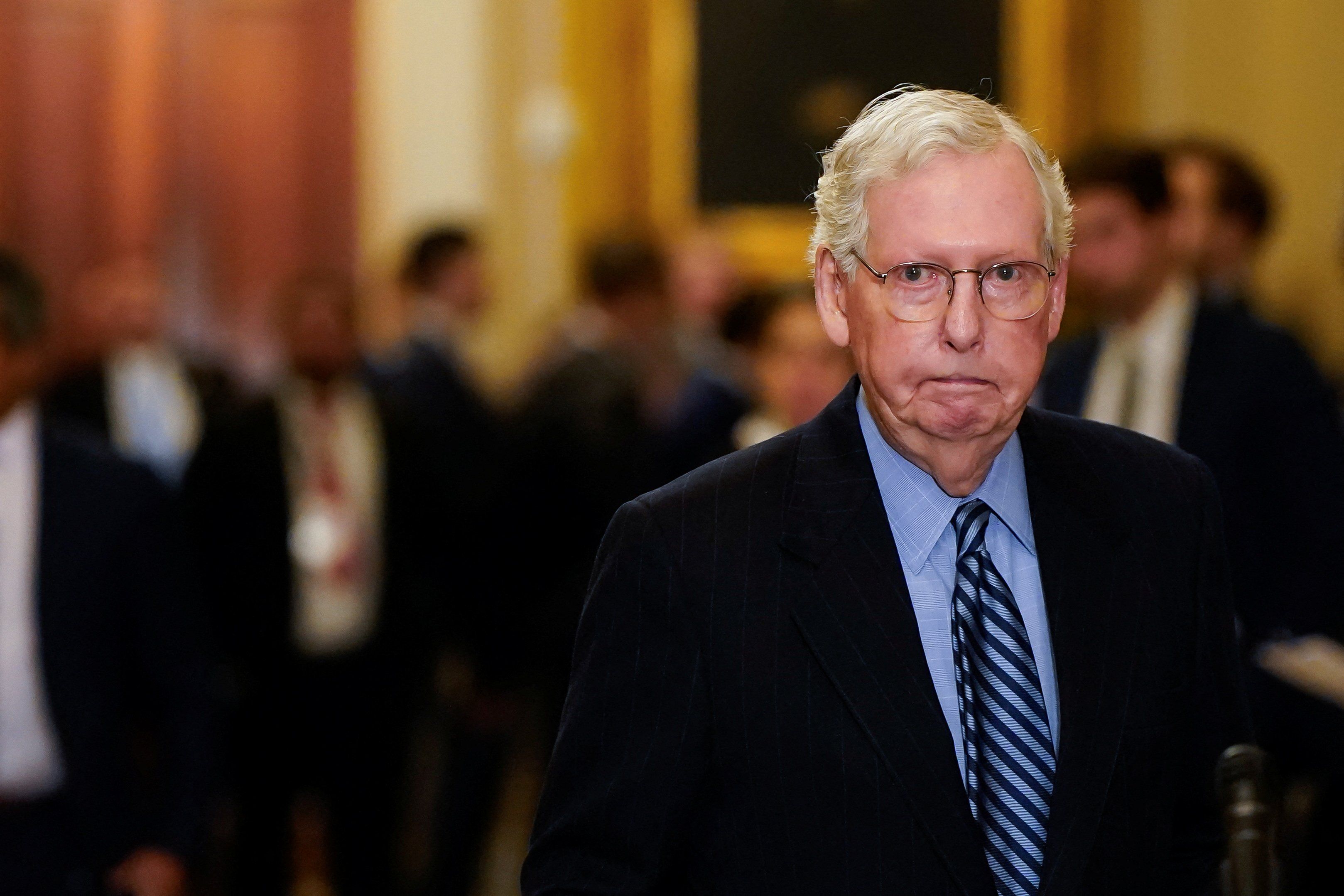
U.S. Senate Minority Leader Mitch McConnell (R-KY) holds a press conference following the Senate Republicans weekly policy lunch at the U.S. Capitol in Washington, U.S., November 19, 2024. REUTERS/Elizabeth Frantz
Sen. Mitch McConnell, R-Ky., used to be the Senate Majority Leader. He was the millstone around the legislative necks of Democratic presidents like Barack Obama and Joe Biden, as well as the wind beneath Presidents George W. Bush and Donald Trump’s parliamentary wings.
That was then, and now it is 2026: In the age of MAGA, many of McConnell’s own past staff opposes him in order to demonstrate fealty to Trump.
The Republican primary to replace McConnell as he prepares to retire is led by three candidates who have distanced themselves from the erstwhile power broker despite two having ties to him, according to a report by Hannah Knowles of The Washington Post.
Former Attorney General Daniel Cameron used to serve as McConnell’s legal counsel and was once regarded as his protégé. Representative Andy Barr runs in the same circles as McConnell by being fellow legislators who share donors (many of McConnell’s ex-backers now support Barr, who is leading the candidates in fundraising).
Businessman Nate Morris, by contrast, has been so emphatically anti-McConnell it has “alienated some Republicans in the state,” reported Knowles. “This is a fight for the future of the Republican Party … Donald Trump’s Republican Party,” Morris, a friend of Vice President JD Vance, explained to The Post. “And certainly, if you’re with Mitch McConnell, you’re not part of that future.” Morris notably was endorsed by both Tesla CEO Elon Musk and the late Charlie Kirk before he was killed in September. Kirk’s Turning Point USA organization continues to support the businessman. Morris “is not going to be beholden to the McConnell machine,” Turning Point USA spokesperson Andrew Kolvet told The Post, adding that McConnell is a “relic.”
Cameron, by contrast, argued that the Republican Senate nominee needed to do more than “just bashing an old man.” Yet that has not stopped Cameron from engaging in some of his own McConnell-bashing during the campaign. “What we saw from Mitch McConnell in voting against Pete Hegseth, Tulsi Gabbard and RFK was just flat-out wrong,” Cameron declared in one campaign video. “You should expect a senator from Kentucky to vote for those nominees to advance the America First agenda.” Even Barr, who once called McConnell a “mentor,” made his allegiance clear when he closed his speech at a recent Republican event with a comment to President Trump, “Thank you for giving me a chance to work with this president to make America great again.”
This is not the first report to document how McConnell has fallen out of favor with the party he once led. CNN’s David Wright reported in September that “Mitch McConnell has become a pariah among the Republicans trying to succeed him.” After summarizing the “insulting” anti-McConnell race between Barr, Cameron and Morris, Wright concluded “it's a reflection of how President Donald Trump has all but extinguished the influence of any challengers within the GOP."
While McConnell is not a Never Trumper by any stretch, The Hill’s Alexander Bolton reported in July that McConnell is “one of the biggest wild cards in the Senate, keeping his Republican colleagues guessing about how he'll vote on elements of President Trump’s agenda." A “crafty veteran,” McConnell is one of the Republican senators (along with Lisa Murkowski of Alaska and Susan Collins of Maine) most likely “to signal when he thinks Trump — and by extension, Trump’s allies in Congress — are moving in the wrong direction. In doing so, he's using his leverage to preserve the values of the traditional GOP establishment in Washington."
Perhaps McConnell has been most unspoken in critiquing Trump’s foreign policy. In July he slammed the president’s handling of Russia’s invasion of Ukraine, describing it as “strategic incoherence” because it involves “underfunding our military and restricting lethal assistance to partners like Ukraine.”
Similarly, in September McConnell drew parallels between Trump’s “America First” movement and the “America First” movement of the 1930s, both of which supported isolationism and protectionism, policies many historians blame respectively for World War II and the Great Depression.
“I think this is the most dangerous period since before World War Two,” McConnell said. “There’s certain similarities right now to the ’30s.”