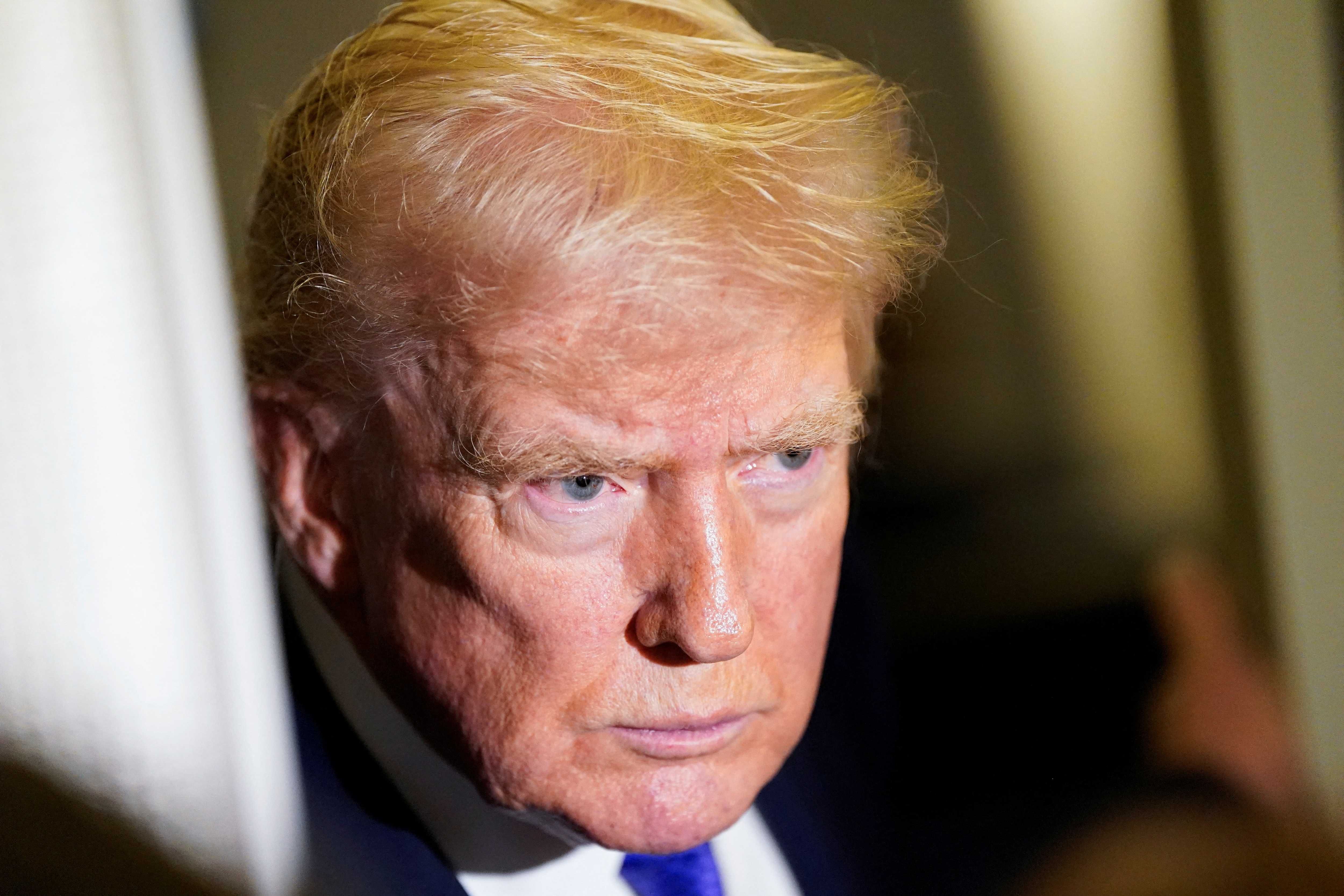
U.S. President Donald Trump on Air Force One, February 16, 2026. REUTERS/Elizabeth Frantz
U.S. President Donald Trump on Air Force One, February 16, 2026. REUTERS/Elizabeth Frantz
When 2026 arrived, President Donald Trump's allies were hoping that his approval ratings would improve. But a little over two and one-half months into 2026, that isn't happening.
A recent Quinnipiac poll found that only 37 percent of registered voters approve of Trump's performance as president. And CNN data analyst Harry Enten, in February 16 post on X, formerly Twitter, examined four polls conducted this year and wrote, "Some talk about Trump's floor of support... I'm not sure he has a floor! His net approval is at a term 2 low across a number of pollsters. Trump's now in worse shape than he was at this point in term 1 or where Biden was at this point in his one term. He's way underwater."
Trump's allies often dismiss such polls as "fake news," insisting that he has never been more popular. And according to legal scholar and former federal prosecutor Harry Enten, Trump has a game plan for undermining the 2026 midterms.
In article published by The New Republic on February 18, Litman lays out four of Trump's election tactics.
"The administration is pressing aggressively to obtain voter rolls and election materials from states across the country, particularly in roughly 15 battleground states, while Trump openly calls on Republicans to 'federalize' the conduct of federal elections," Litman warns. "This is not a theoretical replay of 2020. The effort is operational now through four means: formal Justice Department demands, active litigation, seized election materials, and scheduled federal briefings with state officials.
Trump's push to "federalize" elections, Litman notes, is very much at odds with the U.S. Constitution.
"The Constitution gives the president no operational role in administering elections," the legal scholar explains. "Article 1, Section 4 — the elections clause — assigns authority over the 'Times, Places and Manner' of federal elections to the states, subject to congressional regulation. The executive branch is not part of that structure. As U.S. District Judge Colleen Kollar-Kotelly recently put it when rejecting one of Trump's attempts to reshape election procedures, the Constitution gives 'no role at all to the President' in setting election rules. Yet in recent months — and intensifying in recent weeks — the Justice Department has demanded full, unredacted voter rolls from states nationwide, including sensitive personal data, such as partial Social Security numbers and birth dates…. DOJ is not merely seeking confirmation that states are conducting routine list maintenance. It has demanded expansive voter-roll data, historical election materials, and back-end administrative records far beyond what is necessary to assess statutory compliance — including information that could be used to scrutinize or challenge individual registrations."
According to Litman, voter rolls "in the wrong hands" can "become instruments for advancing allegations of fraud or irregularity."
"The possession of comprehensive voter data enables mass eligibility challenges in targeted counties, cross-referencing registration rolls against other databases to flag supposed inconsistencies, singling out demographic concentrations for public allegations, and launching investigations that generate damaging headlines even if they produce no indictments," Litman notes. "Most such claims might ultimately fail in court. But often, they will not be fully tested because of the ticking clock after an election."
Litman adds, "The objective need not be victory on the merits. It may be delay, uncertainty, and public doubt — especially in close races."