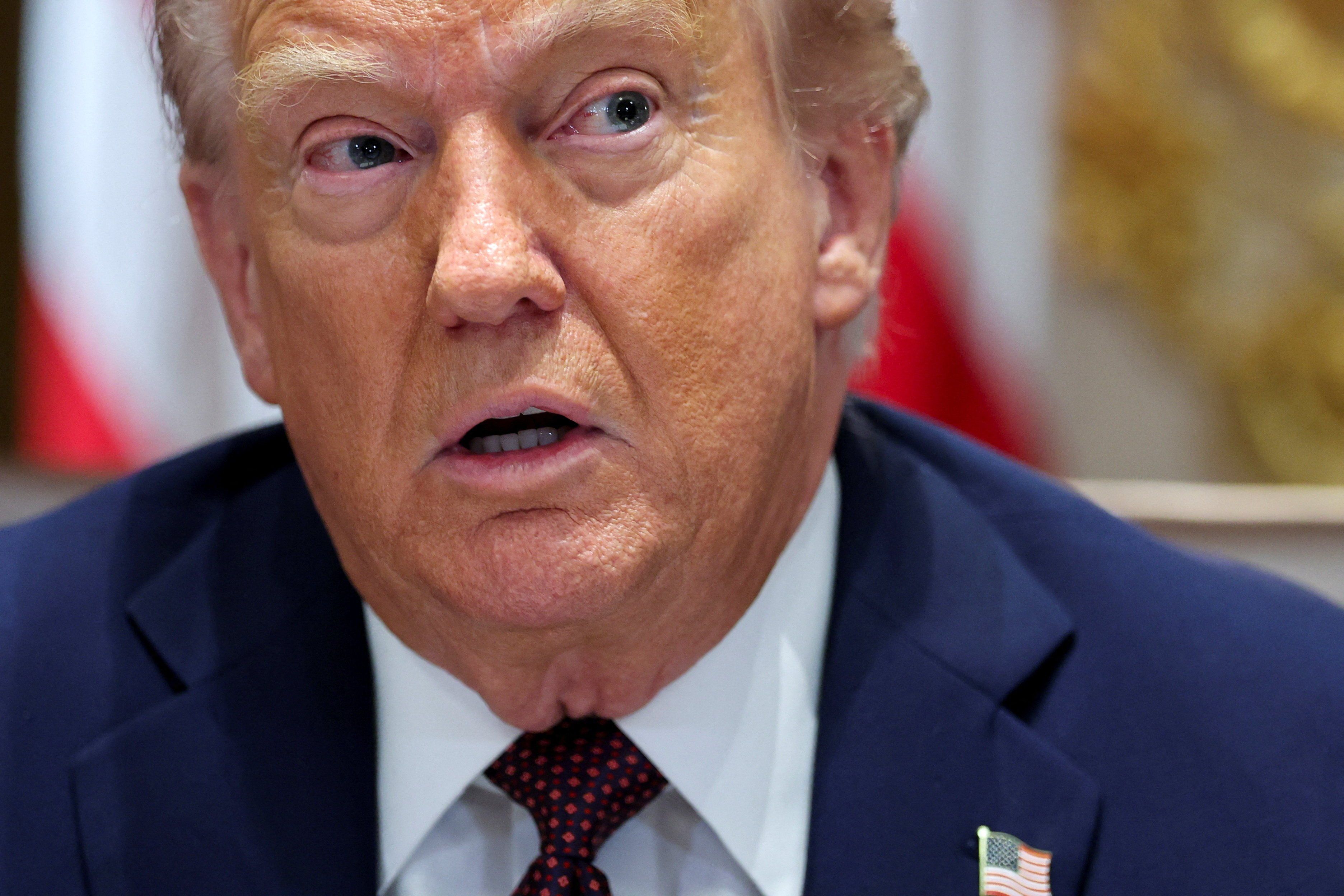
U.S. President Donald Trump attends a cabinet meeting at the White House in Washington, D.C., U.S., August 26, 2025. REUTERS/Jonathan Ernst
A scholar from a right-leaning think tank argued in a Saturday editorial that President Donald Trump’s latest anti-immigrant policy will turn banks into a “citizenship police.”
“President Trump is reportedly considering an order requiring financial institutions to check customers’ citizenship, a curious departure from the administration’s professed concerns about the burden of bureaucracy and debanking,” wrote the Competitive Enterprise Institute’s Solveig Singleton for The Hill. Although they say this is being done to remove people illegally residing in the United States, Singleton said “this policy will only elevate suspicion above free speech, privacy, fairness, and integrity.”
Singleton proceeded to argue that requiring bank customers to verify their citizenship “would taint Americans’ vital relationships with banks and credit unions with mutual mistrust.” Many would likely move their money to informal financial networks provided by their family, community or religious institution, some of which are prone to being used for criminal activities.
Even those customers which continued to use legitimate banking institutions would be vulnerable to criminal activity because “scammers will do their utmost to exploit the opportunity to deluge customers with fake demands. How would baffled seniors be expected to understand that they cannot pay their electric bill from an account they opened decades ago because they have failed to produce documents on time? Must a legal resident applying for citizenship update their financial service providers at every stage of the process?”
The libertarian scholar concluded, “Federal statutes forbid financial service companies from alerting customers when surveillance reports are sent to authorities. But being asked to prove citizenship on everyday occasions is an intrusion people are sure to notice. Perhaps lawmakers will remember that annoyed bank customers are also voters.”
While Trump has doubled down on his anti-immigrant policies, the American public is increasingly rejecting them. In a Washington Post survey of 2,300 people, 39 percent of voters backed Trump while 60 percent opposed him. Of the Americans who disapprove of Trump, 57 percent listed immigration policy as the worst thing he has done as president. This followed by the economy at 33 percent, with 29 percent blaming his tariffs for the ongoing malaise. Respondents specifically blasted Trump for “detaining and deporting immigrants with no criminal background,” endowing “ICE all the power they have,” practicing “Gestapo style of deporting illegal immigrants... even killing at least two U.S. citizens. We are a ‘nation of immigrants’” and basically “everything with ICE, deporting immigrants, etc.”
Similarly earlier in March the United States Conference of Catholic Bishops, a group "representing the Catholic hierarchy in the United States," filed an amicus brief to the Supreme Court arguing Trump’s birthright citizenship executive order is "at its core, this case is not solely a question about citizenship status or the Fourteenth Amendment. It is a question of whether the law will affirm or deny the equal worth of those born within our common community—whether the law will protect the human dignity of all God’s children."
Writing for The New Republic earlier in March, former Washington Post political reporter Greg Sargent identified immigration as one of three core policy areas that could destroy Trump’s second presidency.
“Consider three of the biggest developments in our politics right now,” Greg Sargent wrote for The New Republic. “We just learned that the economy lost 92,000 jobs, a capstone to a terrible year in terms of job creation. President Trump has fired widely despised Homeland Security Secretary Kristi Noem, a key architect of his mass deportations. And reports are indicating that the killing of scores of Iranian schoolchildren might have been the handiwork of the United States.”