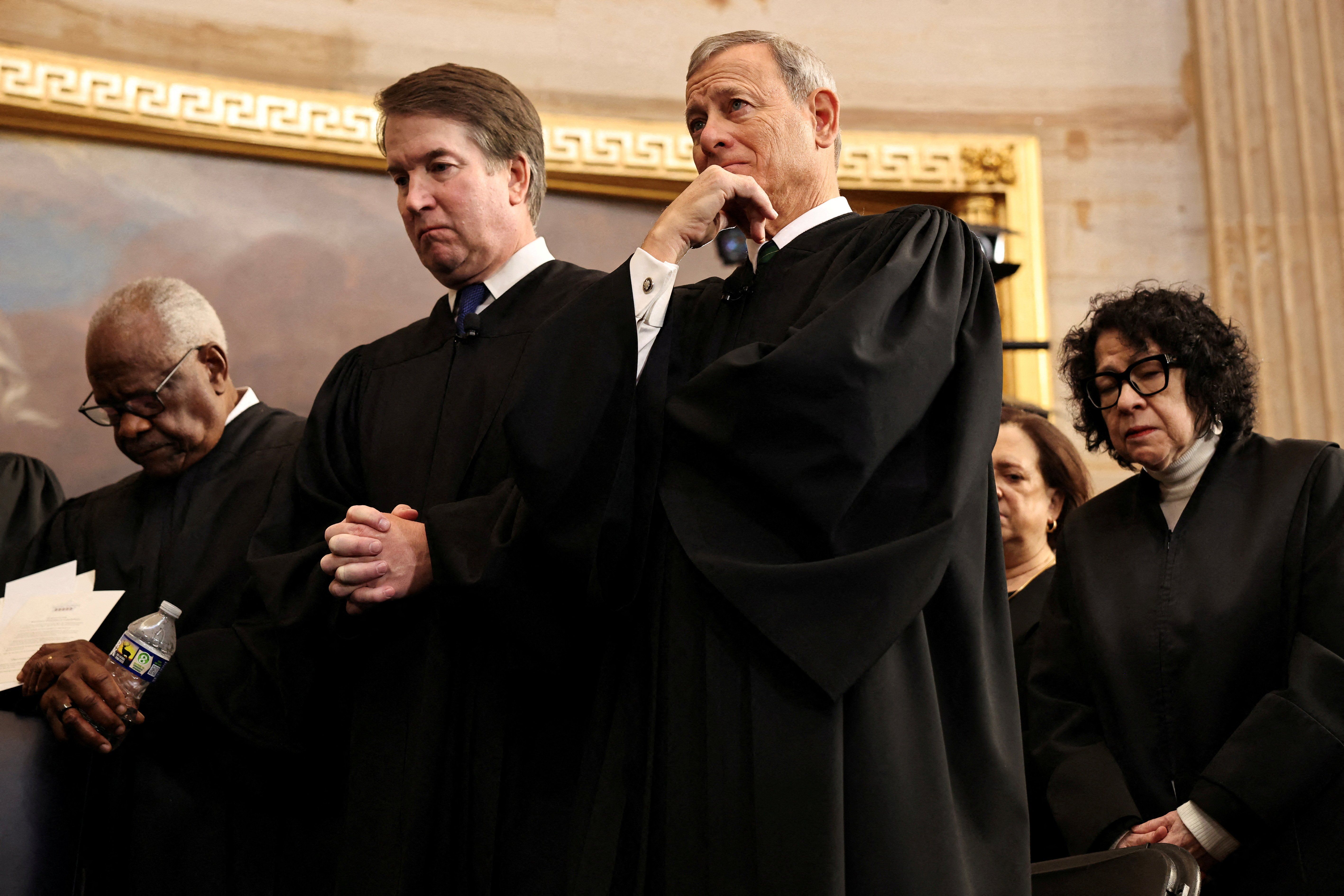
Justice Brett Kavanaugh found himself in an unusual position at the Supreme Court on Monday, standing apart from his conservative colleagues after Justice Samuel Alito unexpectedly recused himself from a major oil-company case.
The court refused to hear the case of Sunoco Inc. v. Cline, and so left intact a class-action judgment of roughly $100 million against the company. One notable point in the short order was that Kavanaugh was the only member of the judiciary who had made a public statement expressing his desire for the court to take the case.
At the same time, Alito did not take part in the decision. The court gave no reason for his recusal, but Newsweek reported that he has a financial interest he has in Sunoco's competitors
The disagreement stems from the allegations that Sunoco did not pay the required interest when payments to the owners of oil wells in Oklahoma were delayed, and the case later developed into a class action suit involving tens of thousands of holders of royalties and interest.
Sunoco contended that the class was far too wide and that a great many of the individuals included in the ruling had never been identified or proven to have suffered an injury that would entitle them to bring a lawsuit.
The federal appeals court dismissed those arguments and maintained the judgment. The Supreme Court's decision not to consider Sunoco's appeal meant that the ruling could stay in place.
By supporting the company's plea for another hearing, Kavanaugh had taken a position that was clearly at odds with that of the other members of the court. On the same day Kavanaugh showed sympathy for another big energy company in a separate case involving Suncor Energy and Exxon Mobil, the development took place.
The disagreement centers on lawsuits initiated by local governments in Colorado against oil companies for damages caused by climate change, and the companies contend that interstate pollution is essentially a matter for the federal government and cannot be dealt with by means of individual state-law claims.
While giving his oral arguments, Kavanaugh referred to a number of earlier Supreme Court rulings which he stated strongly supported the companies' position.
“As I read them together, [these precedents] make crystal clear that interstate air and water pollution are matters for federal law unless Congress specifically preserves state law,” Kavanaugh said. “That is through and through those four cases.”
The two cases involve different companies and legal issues, even though they share similar names: Sunoco and Suncor. Yet on Monday there was a rare opportunity to see Kavanaugh's view on the court, where the six-member conservative majority usually acts in unison.
In the case of the Sunoco dispute, Kavanaugh was prepared to give the company another hearing while none of his colleagues publicly supported him.