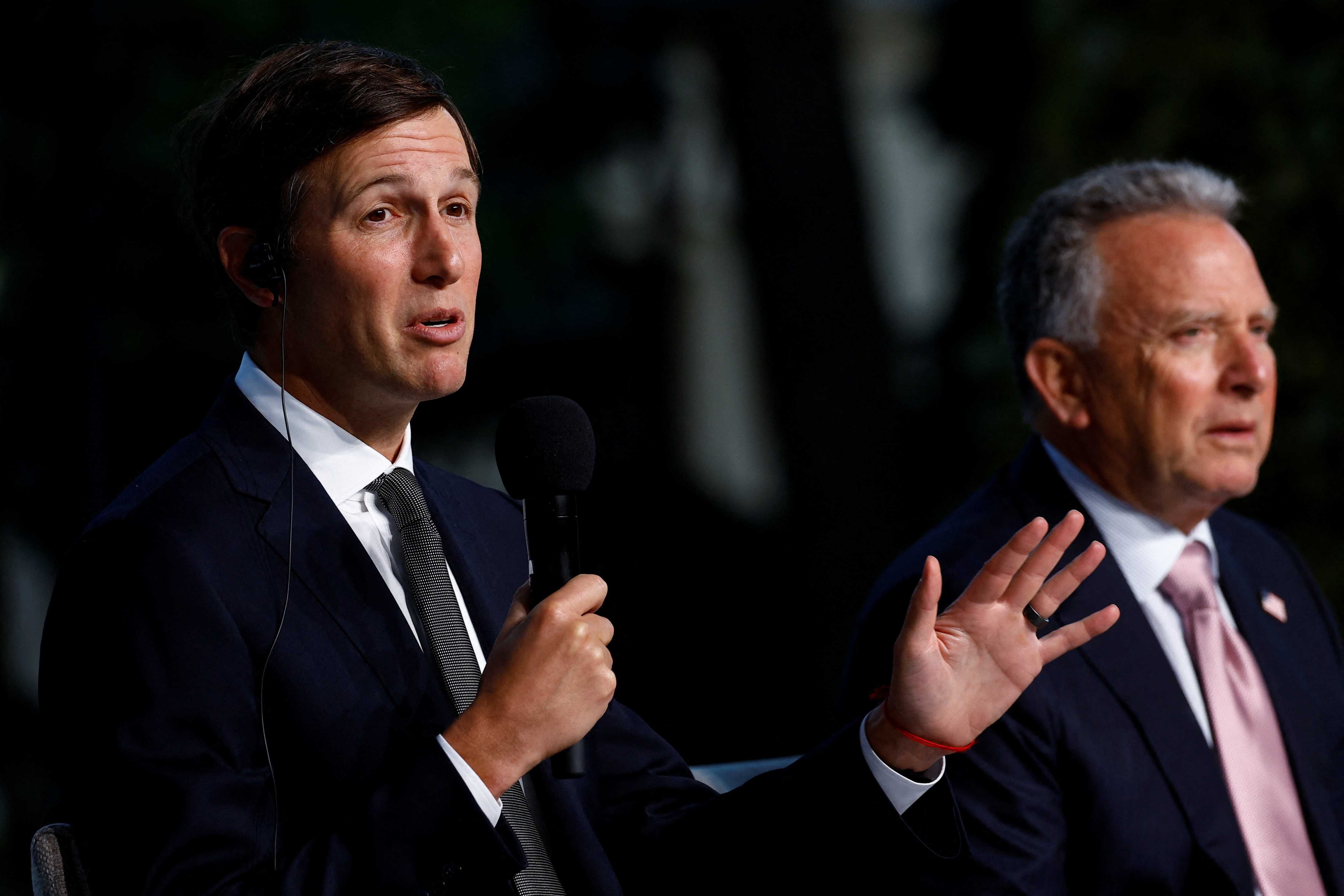
Jared Kushner with U.S. Special Envoy Steve Witkoff in Kyiv, Ukraine September 6, 2026. REUTERS/Valentyn Ogirenko
Vanity Fair recently published an excerpt from longtime investigative reporter Matthew Cole’s new book, Princes and Thieves: Jared Kushner and Mohamed bin Zayed’s Secret Plot to Remake the Middle East.
The excerpt alleged that during President Trump’s first term, Saudi and Emirati leaders secretly put at least $2 billion into bank accounts and gave access to Kushner. At the time, Jared Kushner was serving as senior adviser to President Trump, his father-in-law. He is now Trump’s special envoy. Kushner’s lawyers responded by demanding that Vanity Fair retract the article and threatening legal action against the book publisher, Simon & Schuster.
Jared Kushner denied the report, saying, “The allegations made by this author are completely insane, categorically false, and never happened. We denied every one of these claims on the record, yet the author failed to provide a single shred of evidence to substantiate any of them.” His lawyers say no such bank accounts existed and that the allegations are unsupported by the verifiable evidence.
In an extended interview with Democracy Now!, author Matthew Cole stood by his reporting. “This book is a result of more than 50 sources. There was an enormous amount of fact-checking and legal vetting that went into this book,” says Cole. “There’s plenty of information and reporting in the book that lets us establish and understand that there was … an unholy alliance between Jared Kushner and the leader of the UAE, the leader of Saudi Arabia and, at the time, Benjamin Netanyahu, the prime minister of Israel.”
On Friday, Congressmember Jamie Raskin, the ranking Democrat on the House Judiciary Committee, called on Kushner to recuse himself from Middle East and Ukraine negotiations and to produce a “comprehensive list of bank accounts or other financial instruments” that he had access to during his time in government.
This is a rush transcript. Copy may not be in its final form.
AMY GOODMAN: This is Democracy Now!, democracynow.org. I’m Amy Goodman.
With the midterms a day away, polls show corruption has emerged as one of the top issues for many voters. A new Harris poll for The Guardian found 76% of voters said elected officials care more about enriching themselves than improving the economy for ordinary people.
We turn now to the new book Princes and Thieves: Jared Kushner and Mohamed bin Zayed’s Secret Plot to Remake the Middle East. It’s written by longtime investigative reporter Matthew Cole.
Vanity Fair recently published an excerpt headlined “The Art of the Deal: Jared Kushner’s Hacked Phone Revealed His Secret Negotiations — Including More Than $700 Million in Transfers.” The excerpt alleges that during President Trump’s first term, Saudi and Emirati leaders secretly put at least $2 billion into bank accounts and gave access to Jared Kushner. At the time, he was serving as a senior adviser to President Trump, his father-in-law. Kushner is now Trump’s special envoy.
Jared Kushner’s lawyers responded by demanding Vanity Fair retract the article and threatening legal action against the book publisher, Simon & Schuster.
Jared Kushner denied Cole’s reporting, saying, quote, “The allegations made by this author are completely insane, categorically false, and never happened. We denied every one of these claims on the record, yet the author failed to provide a single shred of evidence to substantiate any of them,” unquote.
Kushner’s lawyers say no such bank accounts existed and that the allegations are unsupported by the verifiable evidence.
In a book review in The New York Times, Fintan O’Toole writes, quote, “If Cole’s claims are accurate, Kushner’s political and financial relationship with the UAE’s president Mohammed bin Zayed constitutes what must surely be the worst case of U.S. foreign policy being conducted outside the law and democratic oversight since the Iran-Contra scandal during the Reagan administration in the 1980s,” unquote.
On Friday, Congressmember Jamie Raskin, the ranking Democrat on the House Judiciary Committee, called on Kushner to recuse himself from Middle East and Ukraine negotiations and to produce a, quote, “comprehensive list of bank accounts or other financial instruments,” unquote, that he had access to during his time in government.
Well, I last week sat down with Matthew Cole and interviewed him about his new book.
AMY GOODMAN: Why don’t you lay out your explosive allegations that Jared Kushner’s lawyers categorically deny?
MATTHEW COLE: Yeah. Well, let’s first by reiterating that Mr. Kushner emphatically and entirely denies everything that’s in the book. I obviously still stand by my reporting. I will continue to stand by my reporting, because it’s accurate, and it will ultimately bear out.
The first thing I want to do, Amy, for your audience is to just give you an overview and sort of start at the beginning, which is that what the book lays out is at the beginning of Trump’s time, start in office the first time, in 2017, he gave his son-in-law the most consequential job in foreign policy that the American government has, which is running, essentially, the Middle East foreign policy, and tapped him with trying to solve the Israeli-Palestinian conflict.
And when they came into office, we had — he had, essentially, two important players from the Middle East rush to the scene, you know, intentionally and very specifically, to New York, before he even got into the White House, to meet with the Trump transition team. And that was MBZ, Mohamed bin Zayed, the ruler of the UAE, and Mohammed bin Salman, known as MBS, who was at the time the deputy crown prince of Saudi Arabia. And what these two Arab rulers, leaders wanted were, as it happened, the same thing that Kushner and Trump wanted in terms of what they were going to do in the Middle East, which was to remake the map altogether, completely change what was going on in the Middle East.
And so, what they had in common were they wanted to thwart Iran, they wanted to undo the last remnants of the Arab Spring, they wanted to potentially make a deal for — in Israel’s favor in a Palestinian-Israeli settlement, and they were willing to marginalize the Palestinians in doing so. And MBZ and MBS had other asks. MBS wanted to become the crown prince. He wanted to jump up a rung so that he could become the future king of Saudi Arabia. And the question was going to be: How are they going to manage all of that? And that was Jared Kushner’s task when he came into the White House. OK?
And so, in that setting, they move forward. And quickly one of the things that the three of them start to negotiate or discuss is the idea of a foreign policy fund that would be used — that would be paid for by the Saudis and the Emiratis overtly, not secretly necessarily, for several billion dollars that would support Trump’s initiatives around the world, because you have to remember that America First at that time, and to some extent today, meant no more spending U.S. tax dollars on defense and policies in the Middle East, that Trump wanted to pull soldiers out. He wanted to get rid of — no more wars. I mean, it seems laughable now saying it, but that was what it was. And so, these two guys, MBS and MBZ, were offering to essentially bankroll that.
And one of the ideas that they had was building the wall in Mexico that Trump had been pushing on. And the idea was that when he was going to run for election in 2020, he would have these accomplishments, and they would have supported it. And it was — you know, it’s not — it would not have been illegal necessarily, although it would have been complicated. And so, that was the original idea. That idea, in part, I believe, because it was complicated and tricky to do in terms of how you spend — Congress, there are laws about spending, outside spending, on things that Congress has not authorized, or especially if they have authorized. So, it faded.
What comes next is a secret arrangement between Kushner, MBS and MBZ for a similar idea: a foreign policy fund, if you will, a secret pool of money that Kushner could help manage. And the pool of money — one part of the pool of money was going to be for the efforts of the UAE and Saudi Arabia to remake the Middle East. Some of the ways that they were trying to remake the Middle East: They wanted to end the war to their favor in Yemen; they wanted to get rid of the ruler of Qatar; they wanted to support Khalifa Haftar in eastern Libya to overthrow the government in Tripoli. So, you had these pieces on the puzzle, if you will — I mean, the chess board. They wanted to move pieces around. And this money, originally, that’s part of the idea.
And so, Kushner starts to get — he agrees. There is some movement of money in the mid — in mid-2017. What happens at the same time is MBS and MBZ declare a blockade on Qatar in June of 2017. The book lays out and my —
AMY GOODMAN: This is during the first Trump administration.
MATTHEW COLE: First Trump administration. It’s sort of the first big foreign policy issue that Trump confronts. You have — just to back up for a second, the UAE, Saudi Arabia and Qatar, all very wealthy Gulf Arab states, all have U.S. troops and bases on them. They’re all allies. And so, you have two — you know, this bromance between MBZ and MBS at the moment, at the time, going against a third, right? Two against one. And the Qatari leader was the emir, Tamim al-Thani. And they didn’t like Al Jazeera. They thought that he, the Qatari, supported the Muslim Brotherhood. They accused them consistently of funding terrorism, funding Hamas, mostly, though, really funding the Muslim Brotherhood. That was the big bugaboo. And so, they wanted him to stop, and they were willing to overthrow him if he wouldn’t. And so they broached the idea with Kushner.
The book lays out that Kushner essentially gave them the green light to do the blockade, didn’t tell anyone else in the administration. And so, June 2017, MBS and MBZ announced that there’s this blockade. It takes the rest of the U.S. administration, Trump administration, totally by surprise. They had no idea it was coming. It’s a huge diplomatic disaster. Around the same time, at or around the same time, the first of the money that MBS and MBZ are providing to Kushner starts to move, OK? And so, the book doesn’t lay out that they are directly related; I only note that they happen at the same time, OK?
So, now we have this big fight going on inside the administration. Trump and Kushner are supporting the UAE and Saudi Arabia. Secretary Rex — Secretary of State Rex Tillerson and Defense Secretary Jim Mattis are trying to calm people down: “We’re not going to go to war. Let’s not — let’s solve this diplomatically.” They’re trying to protect Qatar, to the extent that Qatar has a base, the Central Command’s forward headquarters, which has 10,000 U.S. troops on it and at the time was a key location for the wars in Afghanistan and the war against ISIS in the Middle East. And so, there’s this civil war.
AMY GOODMAN: Let me go to something.
MATTHEW COLE: Yeah.
AMY GOODMAN: During the Emirati and Saudi blockade of Qatar, President Trump addressed the issue from the Rose Garden. This is June 2017.PRESIDENT DONALD TRUMP: The nation of Qatar, unfortunately, has historically been a funder of terrorism at a very high level. And in the wake of that conference, nations came together and spoke to me about confronting Qatar over its behavior. So we had a decision to make: Do we take the easy road, or do we finally take a hard but necessary action? We have to stop the funding of terrorism.
AMY GOODMAN: That’s President Trump in June of 2017. Matthew Cole?
MATTHEW COLE: Right. That was at the very beginning. And so, what we see, what plays out, even on that day, Secretary Tillerson came out and made a statement that was almost the opposite earlier in the day. I mean, they were totally at opposite ends. And the Trump administration, the rest of the sort of national security and foreign policy body of the administration, was trying their best to sort of explain to the president: “It’s a lot more complicated than the way you’ve laid it out. We can’t just go after an ally that has 10,000 U.S. troops on it. It’s not black-and-white.” And Trump says, “I’m not interested.”
I spoke to two very senior Trump White House officials at the time about this period. One of the things that they both said was that there was an intense effort to, essentially, educate the president that it was a lot more nuanced than he was — than he understood. At the time, what they said was they were — he was essentially getting all of his information from Kushner — that they would spend their time briefing him and giving him — bringing in government experts and explaining what the situation was. He, sort of towards the end of those, would say, “OK, yeah, I get it,” and then, the next day, would come back and say, “You know, I agree with Jared. Qatar are the bad guys, OK, in this fight.” And that was going on internally, not publicly.
So, there starts to move – basically, a détente that happens. It’s like a back-and-forth. There’s no real movement. Except a few days later, Secretary Tillerson gets an indication that the Saudi military is preparing to potentially go over the border into Qatar and have a military incursion. And that sets off alarm bells. And so, Secretary Tillerson calls MBS, who is not yet the crown prince — and that’s a key point: He was trying to be, trying to become — and says, “Stand down. You’re not going anywhere.” OK, and so MBS does.
But the Qataris were aware that their neighbor was ready to roll them over. And as one of the senior White House officials who I spoke to said, was that, essentially, the Qataris were 72 hours away from being completely toppled, the ruling family being toppled. And so, this was a very serious — it’s not just a diplomatic issue. This was going to be a total remake of the Middle East, right? And so, there’s sort of this pause, and military action doesn’t happen. And so now there’s back-and-forth for months inside the administration about how to resolve this.
As that was happening, over time, the Qatari government learns that MBS and MBZ have made this deal with Kushner and that there’s some kind of financial arrangement that has occurred. OK? And now they’re very concerned. What does that mean? What do they do? How do we end the blockade? And so, they keep coming back to the president and the White House: “How do we resolve this diplomatic problem? This is not reasonable. We need to resolve it peacefully. We’re here. We want to — we want to resolve it.”
And as one senior U.S. official said to me, at that time, the response they would get back was something along the lines of the Kushner family has a building that needs to be purchased. It’s got a huge debt coming, and it needs to be resolved. And the Kushner family had twice, in the months leading up to the blockade, tried to get the Qataris to buy the building. And the Qataris had said, “No, it’s a terrible investment. We’re not interested in being involved.”
AMY GOODMAN: We’re talking about 666 Fifth Avenue.
MATTHEW COLE: 666 Fifth Avenue, which had a $1.2 billion debt on it when Kushner came into the White House. It is important to note that when Kushner took his job in the White House, he divested from his direct ownership portion of the building. It’s also important to note that he is incredibly close with his family. He helped put that building together. And the kind of financial disaster that defaulting on that debt would have meant for his family, his parents in particular, would have been — it can’t be overstated, right? So, he has this debt hanging over him when he comes into the job. And so, the Qataris keep getting this message that this is the only way that you’re going to solve this diplomatic problem.
Fast-forward, March of 2018, Secretary Tillerson is fired. Trump fires Tillerson. In Doha, they panic. From the perspective of the Qataris, Tillerson’s firing means MBS, who has now been elevated to crown prince, and MBZ are going to retry to overthrow their government, that the U.S. is basically going to look the other way as these guys, as MBZ and MBS, get rid of the emir in Qatar. And so, the royal family makes a very important decision. They decide they’re going to buy 666 Fifth Avenue. They’re going to do it in a way — it takes them months to figure out a way to do it with plausible deniability, so that it’s not a direct purchase, and they can say it never happened, that they had nothing to do with it.
And so, fast-forward into April, shortly after Tillerson is fired, Trump starts making — he makes a very clear change and shift in his position, in the administration’s position. And his replacement, Secretary Mike Pompeo, flies to Saudi Arabia to deliver a message to MBS: “Hey, the blockade, we have to settle this peacefully. We’re going to — this needs to settle.” And so, what you see is — and then, sorry, a few weeks later, the Qatari emir is invited to the U.S., invited to a White House press meet-and-greet. Trump has a lot of lovely things to say about the emir of Qatar. And essentially, the blockade is resolved.
So, it’s an extraordinary sequence of events. And some of it, frankly, you know, there were — publicly, there were huge questions, because there was something very strange about the bailout of 666 Fifth Avenue. The company that bought the building had as one of its passive investors the Qatari sovereign wealth fund, and that particular subsidiary of the company was the one that purchased the building. And so, there were natural questions. But, you know, as one source said to me, they did a good job. They worked on it for months to figure out how to do it so that they could say it was not done.
AMY GOODMAN: Matthew Cole, investigative journalist, author of the new book Princes and Thieves: Jared Kushner and Mohamed bin Zayed’s Secret Plot to Remake the Middle East. Jared Kushner’s lawyers have denied Cole’s reporting about 666 Fifth Avenue. In a letter to Cole’s book publisher Simon & Schuster, Kushner’s lawyer wrote that Jared Kushner was not involved in nor have any knowledge of any alleged quid pro quo with the Qatari government. We’ll continue our conversation with Matthew Cole in 20 seconds.
We’re continuing our conversation with longtime investigative journalist Matthew Cole, author of the new book Princes and Thieves: Jared Kushner and Mohamed bin Zayed’s Ssecret Plot to Remake the Middle East. Vanity Fair recently published an excerpt headlined “The Art of the Deal: Jared Kushner’s Hacked Phone Revealed His Secret Negotiations — Including More Than $700 Million in Transfers.” Jared Kushner has denied Matthew Cole’s reporting, writing on X, “The allegations made by this author are completely insane … and never happened,” unquote. I asked Matthew Cole to talk about his reporting.
MATTHEW COLE: Summer of 2017, Jared Kushner is — agrees to this arrangement with MBZ and MBS. And the first part of it is — like I said, it was kind of a continuation of the idea of a pool of money that was going to support Trump’s foreign policy initiatives. It shifts. Now it’s really about supporting MBZ and MBS’s desires to reshape the Middle East.
And so, MBS puts in the first — I have what I give as a name, just because it was easier to explain, the Alpha account and the Beta account. The Alpha account is a bank account held in the UAE that originally was about a billion dollars. There was an administrative fee taken by the UAE from MBS’s — from Saudi Arabia’s money, because they were managing it. And that account and money served as what — the best way to refer to it is something like an Iran-Contra-like arrangement, which is this is foreign money set up for foreign policy and off-the-books operations. OK?
AMY GOODMAN: And Iran-Contra, very quickly, for people who don’t know?
MATTHEW COLE: As a reminder, Iran-Contra, under President Reagan, was a sort of government within a government program to use the sale of Iranian weapons to fund the Contras in Nicaragua during a civil war there, after the Congress had passed a law saying that the CIA and the U.S. government could not support and could not fund the Contras. The distinction here is, is that this operation, this shadow policy, was not government within a government. This was essentially just Kushner using other — working with foreign governments and their money on operations abroad.
And so, the Alpha account, one of the — two of the key, you know, transfers in the Alpha account are in the summer of 2018. The first transfer out of this UAE-based bank account, of which Kushner had access — now, that doesn’t mean, and the book doesn’t say, that he made the transfers himself. It meant that — what I report is that he was a signatory on the account, so he had authorization to do so. But the account — and let me just establish it a little bit more — the bank account itself was a bank account of an Emirati domestic charity that was used as a cover for their military and intelligence operations overseas. It was called the Watani Al Emarat Foundation. It was used to primarily — at least in the years that I had visibility into it, and the book describes — to support the war, the civil war in Libya, to give support to Haftar.
The first transfer that comes out of that account in the summer of 2018 goes to Blackwater founder Erik Prince. Now, I’ve covered — you know, one of the things — I just want to pause here for a second and say that a lot of the reporting that’s in this book is built on more than a decade of reporting that I’ve been doing on Erik Prince over the years. And so, this isn’t just some wild yarn that appeared. These were threads that I was pulling on for years, largely at The Intercept, about Erik Prince and, separately, the UAE and their secret intelligence operations. And they essentially converge into this story. So, the first transfer goes to Erik Prince. The second transfer, $85 million, goes to Khalifa Haftar, the renegade commander of eastern Libya, who is making a push to try to overthrow the internationally recognized government of Libya.
Then we get to the Beta bank account, and that was a slightly separate pool of money, and in some ways far more important and significant. The Beta account was funded by MBZ solely, roughly a billion dollars, sent to Israel, held in the central bank of Israel for Kushner for his personal benefit. It’s very important to say the central bank of Israel — and the book lays this out — is a government bank. It does not hold personal accounts. The account there was not in Jared Kushner’s name. It was for Kushner. Now, what does “personal benefit” mean? There is some ambiguity. You know, there’s different ways to interpret that. Is this another pool of foreign policy money, as the Alpha was? It’s not totally clear. What the book lays out, both with the Alpha account and the Beta account, are some of the details and the means in which the money was moving out of those accounts.
And, you know, there’s been — I understand it takes time for people to read the book. You know, one of the criticisms is, “Well, you don’t have the receipts.” What I really want people to do is read the book and understand that the details of what I’ve reported about how the bank accounts worked, who controlled the bank accounts, actually point you in the direction of — they lay a foundation of why it’s true, because the details do not come from nowhere. I reported them out. I have — this book is a result of more than 50 sources. There was an enormous amount of fact-checking and legal vetting that went into this book. And while there are plenty of left-unanswered questions, there’s plenty of information and reporting in the book that lets us establish and understand that there was really — you know, the best way to say it is an unholy alliance between Jared Kushner and the leader of the UAE, the leader of Saudi Arabia and, at the time, Benjamin Netanyahu, the prime minister of Israel. And so, I want readers to understand, your audience to understand — read the book — understand that this fits into a much larger story.
AMY GOODMAN: So, talk about Jared Kushner’s, as you allege, hacked phone revealing his secret negotiations.
MATTHEW COLE: Sure. Just as a place marker, it’s an extraordinary story, but it actually is insignificant relative to the significance of the secret financial relationships with — between Kushner and MBS and MBZ. In late 2017, the Dutch intelligence service ran an operation. They found a Russian GRU operative who was traveling through Europe.
AMY GOODMAN: And GRU is?
MATTHEW COLE: Is the Russian military intelligence unit responsible for, among other things, the assassination of — the assassinations in Europe, including the poisoning of Skripal, the attempted poisoning, in the U.K. several years ago. They see an operative moving, on his way to the U.K. They approach — the Dutch approach the British government. They ask if it’s OK if they try to flip this operative when he gets to the U.K. or is on his way to the U.K. And in exchange, they will — you know, if it works, they’ll give them a take of whatever they get from the operative. They stop the GRU operative. They explain, “You can either work with us, or you can end up in a U.K. jail.” The operative cooperates, starts working for the Dutch. Excuse me.
One of the things that he provides the Dutch at that point is access to a remote GRU server located in Rostov, Russia. The Dutch eventually get in there. They start looking at the GRU server. Among the things that they find when they get into the server are screenshots of Jared Kushner’s cellphone. It’s alarming. It’s shocking. And they have a lot of questions. What is going on here?
Let’s remember that in late 2017 in the U.S., there was the Trump-Russia hysteria. But also, for Holland, which is a partner in NATO, there were real concerns about Trump’s relationship with Putin. And certainly, leaving aside the issue of the Mueller investigation that would come later — well, was going on at the time, was his views of NATO and how much disdain he had for NATO. And so, Europe was very concerned that Trump was going to try to dissolve NATO. He certainly was making moves and noises, you know, that suggested that that was possible.
And so, they start to investigate. And ultimately, what they end up doing is figuring out — trying to figure out how the Russians technically got into Kushner’s phone. After several months, they successfully figure out a way in. They decide that they’re going to go look in Kushner’s phone. By early 2018, they now have access to Kushner’s phone. The book lays out, and I report, they don’t control the phone. They have the ability to see the phone when he’s using it.
AMY GOODMAN: And “they,” again, are?
MATTHEW COLE: The Dutch intelligence service, known as, in English, letters MIVD, but it’s essentially their version of the U.S. — America’s NSA.
AMY GOODMAN: And you know this because?
MATTHEW COLE: Because I have multiple sources, with independent confirmation, with details about the hack and what came out of the hack. And we can get — I’m limited in what I can say about my sourcing beyond what I’ve put in the book, and there’s an extensive amount of sourcing information in the endnotes of the book, which I urge people to refer to when they’re reading.
The Dutch get into the phone. They start looking. They see his access to this account, the Alpha account, inside the UAE. And there are all sorts of strange questions about the account for them, which is hundreds of millions of dollars are flowing in from a bank in Azerbaijan, in Central Asia. Why Azerbaijan? What is Azerbaijan doing giving money to Jared Kushner in a UAE bank account? And why is that money going to Erik Prince and Khalifa Haftar, among others? OK, that is essentially the Dutch mystery.
And it was, as I lay out in the book, how I initially got onto the story, which was a source who had provided a tip with a series of questions: “What’s this about?” And it was initially very strange and odd, and I was dubious in certain ways. What happens is, is after six months, I end up with a source in a completely different part of the world, in a completely different — you know, no connection whatsoever to the initial source, who is able to verify details of the accounts — of the account, but not just details of the account, also a much bigger understanding, a fuller picture, of what the account was about. And that was sort of the journey, the reporter’s journey, if you will, of how I pulled the thread and ended up where I’ve ended up.
But again, you know, it is — I mean, you know, in some ways, it’s — obviously, it’s explosive. But in terms of Kushner’s conduct in the White House, the hacking of his phone is really a minor detail. It really is just sort of the way in which, you know, some people learned about the account and the existence of the account.
AMY GOODMAN: Jared Kushner is not approved by the Senate to conduct foreign policy.
MATTHEW COLE: That’s right.
AMY GOODMAN: Talk about what his role is, as, for example, the review in The New York Times says, if what you’re saying is true, this should lead to a massive investigation.
MATTHEW COLE: Yeah. I mean, I think, number one, his being placed in the White House as a senior adviser to the White House in 2017 in the first administration, without — you know, a job that had no — essentially, no oversight, except for the president. I mean, he is a U.S. citizen. He has to — and a government employee. He has to follow the U.S. laws and regulations. But there was — he was given this — you know, he essentially was given the job of being a shadow secretary of state. And it wasn’t by — it was by design, because what we know is what Jared Kushner served as in the first administration has become the model for what Trump has done in the second administration, which is only trusted members, family or very close business friends, who serve as the emissaries for — as the leaders of U.S. foreign policy, including Kushner, who, unlike the others, though, hasn’t even taken — you know, he’s not serving in any official capacity in the U.S. government, and so there’s even less oversight for Kushner the second time around.
It’s actually incredibly alarming, and it should be. It’s a three-alarm — you know, it’s a five-alarm fire in terms of governance, because what Trump was able to do, and I think what the book lays out and the reporting, is that in the first administration, they broke U.S. government — 250 years of U.S. government history by making diplomacy and foreign policy, you know, essentially two people: the president and his son-in-law. And one of the advantages of that is that — and we can see it now — is that there are no notes. There are very few memos. There were conversations that were going on between Kushner and leaders of foreign governments in which no one knows what was discussed. There weren’t other people from the State Department, from the CIA, from — you know, it was the deep state at the time, right? Part of what that was was a struggle against normalcy and what was appropriate.
And what the book is is sort of the origin story of the Trump administration’s breaking of norms and foreign policy to seek his own benefit. Right? That’s the — one of the threads that you pull out of the book, is it explains to us how we got here today, including the war in Iran, because that project started in 2017 between Israel, the UAE, Saudi Arabia and the Trump administration, which was undoing everything that Obama had done and going after Iran. It was an inevitable course that brings you to 2026 and the February war that we’re going through now.
AMY GOODMAN: Tell us about UAE’s inner-circle poet Habib al-Sayegh, what happened to him, and also the whole issue of the Abraham Accords.
MATTHEW COLE: Yeah, let me just frame it again, and then I’ll — I think the main thing to understand is, is that the larger story of this book is sort of the — Jared Kushner found himself in the middle of like a real-life Game of Thrones between three Arab rulers. And included in this sort of tale, if you will, the story, the larger story, you have sexual blackmail, you have murder, you have mercenaries and assassins.
The murder, one of the murders, is the murder of Habib al-Sayegh, who was a poet and a prominent editor in the UAE. He was a frequent member, a visitor of MBZ’s weekly, you know, salon, the Majlis, and also known as the Diwan. He was someone who was in the — you know, he wasn’t part of the royal family, but he was a well-respected intellectual in the UAE.
In the summer of 2019, he socially and publicly was speaking out against normalizing relations with Israel, which there had been hints of. The Saudis had been making sort of small moves, testing the waters publicly to show that they were discussing this and thinking about it. And he spoke out against it. In August of 2019, he wrote a editorial in Arabic in his paper, the Khaleej Times, writing that Arab governments should not normalize relations with Israel until or unless they had, in some way, compensated the Palestinians or made up for what Israel had done to the Palestinians over the years. That led to a arrest in the middle of the night, as the book lays out, a few days later. He was grabbed out of bed, taken to a UAE security facility. He was tortured. Three days later, the government of the UAE announced his death, no details about how he died, just how great he was.
What the book lays out, based on sources who know what happened, is he was murdered. And he was murdered because he had a — at that moment, an opinion that was not popular with MBZ and the leadership, the ruling family. And so, one of the things that, you know, the book lays out is, when Kushner embraced MBS and MBZ, we know everything that happened with Jamal Khashoggi. Habib al-Sayegh was —
AMY GOODMAN: That was in 2018.
MATTHEW COLE: Yes. Eight months later —
AMY GOODMAN:Washington Post writer who is dismembered in the Saudi Embassy in Turkey.
MATTHEW COLE: Right, a dissident. Habib al-Sayegh wasn’t even a dissident. He was actually someone who had been a mouthpiece for the Emirati royal family and government. He is someone who supported the blockade against Qatar, for instance, because there isn’t a free press in the UAE. And so, eight months later after Khashoggi, he says something publicly that the ruler of the UAE does not like. MBZ is working towards a secret — secretly working towards an agreement to normalize with Israel. People underneath him in that country know that that’s what’s happening. He starts — Habib starts making waves. And so, as someone said to me about why Habib was killed, MBZ wanted to send a message to everyone around him: “We’re all rowing in the direction that I choose, and it’s with a deal with Israel.”
And so, you know, the significance of this is — the larger significance is, is that when Donald Trump and Jared Kushner embraced these two Arab rulers, MBS and MBZ, they were embracing their worldview: authoritarianism, murder. There is no room for dissent. There is no room for free speech. And there is no room — you know, they make big waves about tolerance and what a, you know, sort of oasis the UAE is in the middle of this very difficult neighborhood, but the reality is much, much different and much worse.
AMY GOODMAN: Matthew Cole, investigative journalist, author of the new book Princes and Thieves: Jared Kushner and Mohamed bin Zayed’s Secret Plot to Remake the Middle East. Late last week, the group DAWN called on the United Nations to open an independent investigation into the death of the Emirati poet Habib al-Sayegh. Meanwhile, Congressmember Jamie Raskin, the ranking Democrat on the House Judiciary Committee, has called on Jared Kushner to recuse himself from negotiations in the Middle East and Ukraine in the wake of the allegations in Cole’s book. Jared Kushner has denied Cole’s reporting, saying, quote, “The allegations made by this author are completely insane, categorically false, and never happened,” unquote.