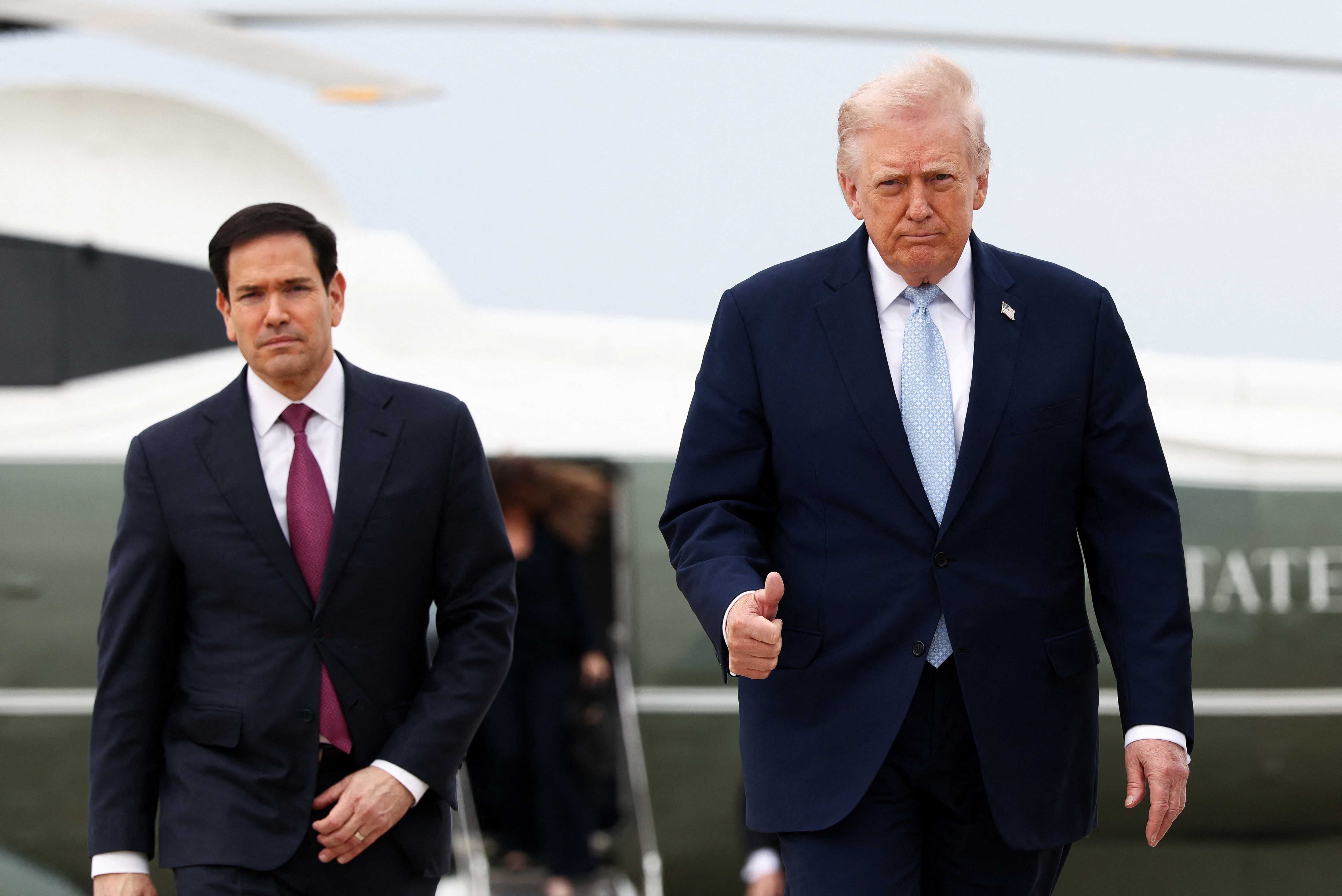
U.S. President Donald Trump with Secretary of State Marco Rubio at Joint Base Andrews in Maryland, U.S., March 20, 2026. REUTERS/Kevin Lamarque
U.S. President Donald Trump with Secretary of State Marco Rubio at Joint Base Andrews in Maryland, U.S., March 20, 2026. REUTERS/Kevin Lamarque
Opponents of U.S. President Donald Trump's Iran war are citing a variety of reasons for their opposition, from the high cost of the war to rising gas prices to the possibility of increased terrorist attacks in the United States. Critics are also noting all the Middle Eastern countries being dragged into the conflict as Iran carries out military strikes against U.S. installations in Saudi Arabia, Bahrain, Qatar, the United Arab Emirates (UAE) and other countries.
According to researcher Logan McMillen, another negative effect is a likely credit downgrade for the United States.
"Let's set the scene," McMillen explains in an article published by The New Republic on March 26. "The U.S. government is staring down a projected $1.9 trillion deficit for this fiscal year, with the total national debt now pushing $39 trillion. Simultaneously, the expanding war in Iran and the subsequent crisis in the Strait of Hormuz have fractured global energy supply chains, driving Brent crude to $119 a barrel and sparking a massive inflationary shock. By any standard metric of sovereign risk, a state that is rapidly accelerating its debt issuance while engaging in a war of choice that is throttling the worldwide supply of oil should be facing the possibility of having its bonds repriced."
McMillen argues that although "Wall Street and Washington continue to treat" U.S. treasuries like "the ultimate risk-free asset," that can't go on forever.
"This pristine rating is no longer a reflection of reality," McMillen warns. "Many countries are beginning to explore alternatives to the petrodollar. And the physical infrastructure and foreign policy that underpin its value are in tatters, replaced by a series of ad hoc military strikes in the Persian Gulf and temporary waivers to 'protect' American consumers from the resulting inflation…. Simultaneously, Trump is calling on the U.S. to borrow trillions of dollars to finance the military, while signaling that the U.S. may withdraw from policing the Strait of Hormuz altogether."
The researcher adds, "Viewed in this light, the 'full faith and credit' of the U.S. government is poised to hit a hard limit in the near future."
According to McMillen, the U.S. government's debt has "relied on a geopolitical bargain with the rest of the world.
"The U.S. could run perpetual deficits because its military secured global trade, keeping the commodity inputs for industrialization at the periphery cheap and plentiful," McMillen notes. "This arrangement allowed the U.S. to export its inflation and import the world’s surpluses at massive discounts, passing the savings along to domestic consumers as their wages began to stagnate in the late 1970s. But now, the clocks are running out, and the bills are coming due…. The Federal Reserve will soon be confronted with an inflationary shock that monetary policy is ill equipped to fix…. . There are only two exits, and both are likely to diminish the value of U.S. treasuries. Path 1 is monetization."
McMillen continues, "To keep the war machine running and prevent the federal budget from collapsing under its own weight, the Fed can choose to absorb ballooning wartime deficits…. Path 2 is hiking interest rates. But here, the Fed runs into the practical limits of America's $39 trillion national debt. The federal government is already spending over $1 trillion annually just to service its existing debt. Pushing rates higher to crush inflation will cause those servicing costs to explode, eating the federal budget and pushing the U.S. closer to functional insolvency."