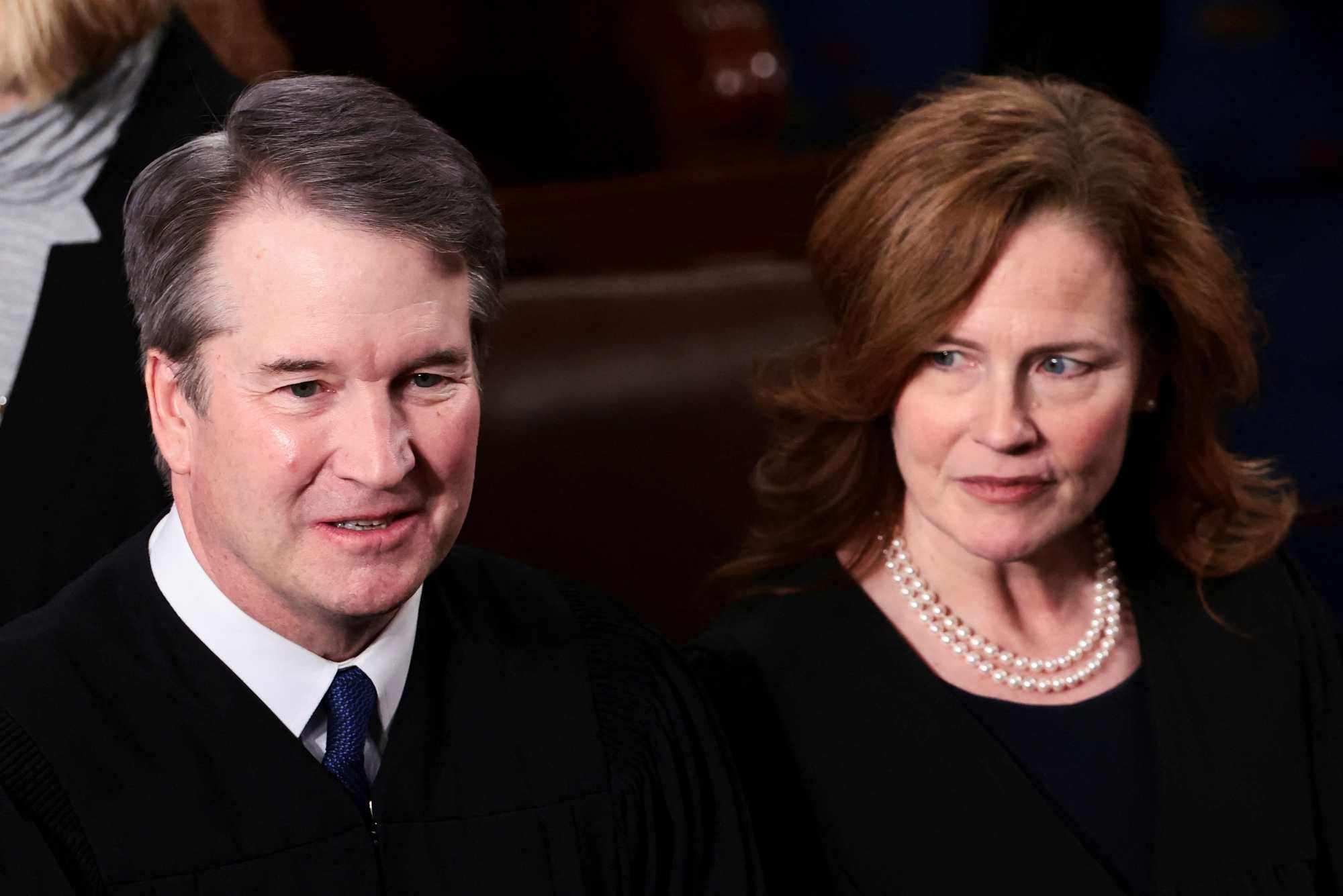
U.S. Supreme Court Justices Brett M. Kavanaugh and Justice Amy Coney Barrett during President Donald Trump's State of the Union address, February 24, 2026. REUTERS/Evelyn Hockstein
U.S. Supreme Court Justices Brett M. Kavanaugh and Justice Amy Coney Barrett during President Donald Trump's State of the Union address, February 24, 2026. REUTERS/Evelyn Hockstein
In early March, the U.S. Supreme Court heard oral arguments in United States v. Hemani — a case that is bringing together an unlikely combination of liberal and progressive opponents of the War on Drugs and right-wing conservative and libertarian critics of gun control.
At issue in Hemani is a federal law that prohibits gun ownership if someone "is an unlawful user of or addicted to any controlled substance." The Hemani in the case, Texas resident Ali Daniel Hemani, is arguing that his constitutional rights were violated by the law in question. In 2022, FBI agents searched Hemani's home and found a gun, marijuana and cocaine.
In an article published by The New Republic on March 10, Harry Litman — a legal scholar and former federal prosecutor for the U.S. Department of Justice (DOJ) — examines the "chaos" that has surrounded the Hemani case.
"The oral arguments before the Supreme Court last week in United States v. Hemani were lively and at times illuminating, but not because they clarified the Second Amendment," Litman writes. "Rather, they showed how unworkable the Court's current framework has become. For nearly two hours, the justices and the lawyers debated drugs, alcohol, gummies, cough syrup, Ambien, ayahuasca, anabolic steroids, and marijuana. They also wandered into the drinking habits of John Adams, James Madison, and Thomas Jefferson…. The spectacle was entertaining."
Litman adds, "It was also revealing, and what it revealed was the incoherence of the Court's current Second Amendment framework."
According to Litman, the Hemani case "arrives" at the High Court "as the latest stop in a very peculiar doctrinal journey."
"Now," Litman explains, "the Supreme Court must decide whether the statute violates the Second Amendment as applied to Hemani…. In 2022, the Court adopted a new test for gun regulations. Under that framework, restrictions on citizens' gun use are constitutional only if they are consistent with the nation's historical 'tradition' of firearms regulation, especially — though not exclusively — around the time of the founding. That is why courts confronting challenges to gun restrictions now have to delve into antediluvian gun regulations, while also confronting a thicket of questions about which historical laws and which historical periods matter and which ones don't."
Litman continues, "Little wonder that the Court's guidance has produced chaos in the lower courts. Monday's argument illustrated why…. The Second Amendment does not prevent the government from disarming people whose drug use makes them dangerous with firearms. Courts should apply ordinary tools of statutory interpretation to determine when that condition exists. They should rely on expertise and evidence, not scavenger hunts through colonial history."