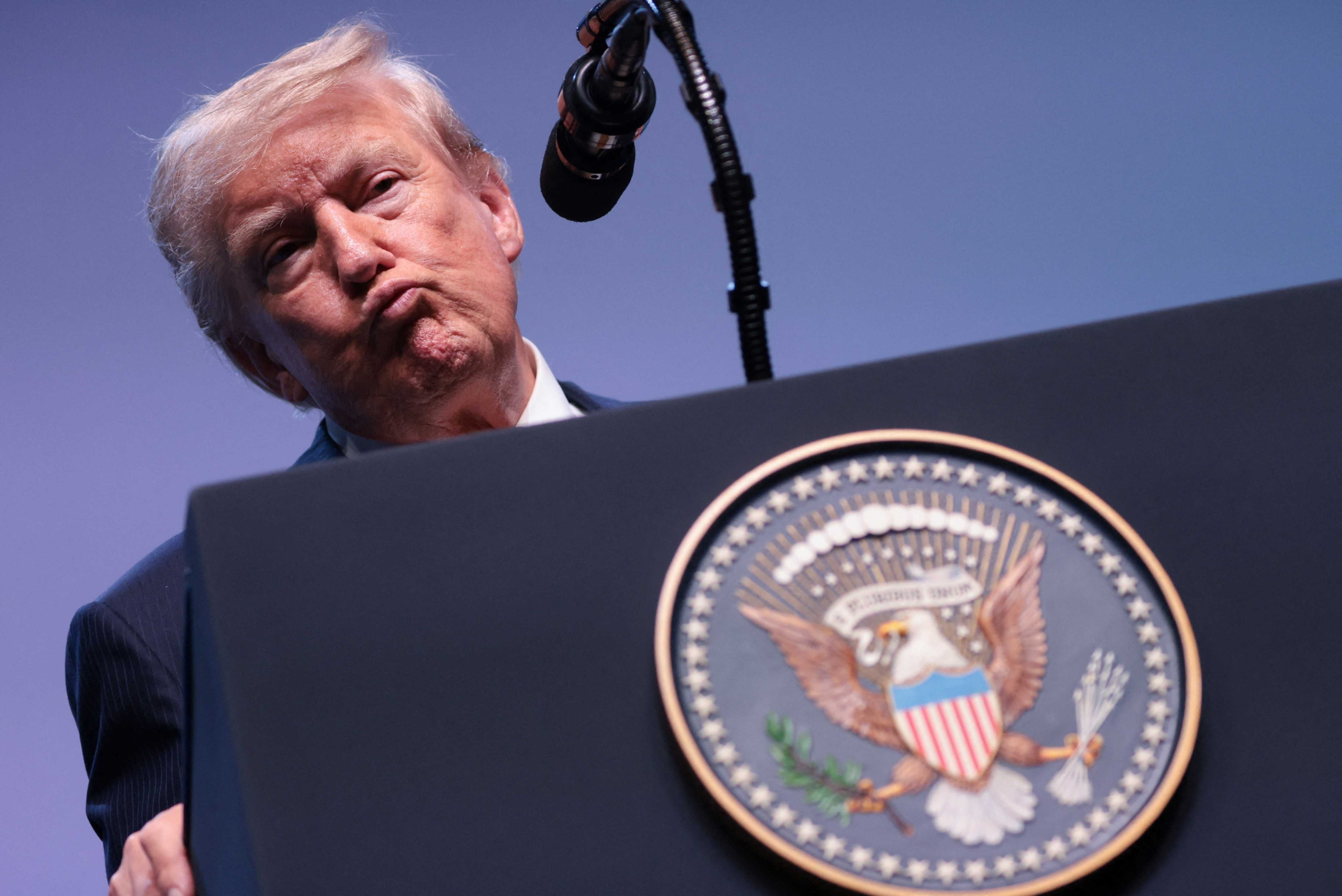
U.S. President Donald Trump reacts as he holds a press conference at the end of his participation in the NATO leaders summit at the Bestepe Presidential Compound in Ankara, Turkey, July 8, 2026.
President Donald Trump continues to struggle in polls because of America’s failing economy, but according to a prominent White House correspondent, he finds economic issues boring.
“Let's talk about how the White House could physically look different in the next few years,” CNN correspondent Bianna Golodryga asked Maggie Haberman, a journalist from The New York Times who co-authored a book on Trump’s White House called “Regime Change.” “Before we go, President Trump had this to say about his White House ballroom project, during a White House event on school choice.”
Golodryga then said Trump “spends about 70 percent of his time on construction projects. The Washington Post appears to undercut the president's argument that the White House needs a secure structure, noting that federal officials built a highly protected underground bunker more than a decade ago that can shelter the president and his top aides in a national security emergency, according to three former officials. What's your reaction to that?”
When Haberman explained that the White House has pivoted between a number of explanations for why Trump wants a ballroom, Golodryga followed up by asking if Trump spends “70-75 percent of his time on construction, what does that say about how much time he's putting into policy, both domestic and foreign?”
“A couple of things,” Haberman responded.” First, on the bunker the Washington Post reported — that's absolutely going to further undercut the White House's argument, though I'm not sure what the courts will do with it. As for how the president is spending his time: Jonathan and I write in our book about how much time he spends on these monuments to himself, these renovation projects, making sure he leaves a permanent mark on Washington.”
She added, “There are presidents who've done both, but the economy bores this president — that came up repeatedly with people who talked to him in 2024, and clearly that hasn't changed. Things aren't going well with the Iran war either, so I don't think he wants to spend much time on that — it's an intractable problem of his own making that he can't quite escape. These physical projects just underscore, for people hurting economically around the country, that the president's mind is elsewhere.”
Earlier in the same interview, Haberman reflected to Golodryga that even though Trump’s son-in-law Jared Kushner met with House Minority Leader Hakeem Jeffries to discuss possible areas where the White House could work with a Democrat-led Congress, Trump himself was likely not privy to those policy discussions.
“There are still things we don't know, like who hosted the meeting, among other things,” Haberman told Golodryga. “But the main areas would be cost of living, housing, and immigration. As you said, the possibilities of compromise on those are remote. In our reporting, what Kushner was telling people — and Kushner is not working for the government; he's been working outside the government on foreign endeavors, as you know well and we've both been covering — is unusual because he's one of the only people who has a relationship with Hakeem Jeffries in this current White House. This isn't a White House that has developed real relationships with Democrats.”
Speaking with AlterNet in July, a former top economic adviser to President Bill Clinton explained how Trump’s tariffs specifically are hurting the economy.
“It's about uncertainty,” former Undersecretary of Commerce for Economic Affairs Robert Shapiro explained. “Every investment is based on an assessment of the likely future demand for whatever you're investing in, and how much it's going to cost to produce it. So there are assumptions about labor costs, material costs and other input costs — and again, about demand. If you have a set of arrangements that give you some confidence about the price of your inputs coming from Mexico or Canada, or about demand for goods in Canada — and don't forget, we have virtually no trade deficit with Canada; we have enormous trade, and it goes in both directions — so it's certainly right, and it's not just about investments based on these probabilities that the trade agreement can help reduce uncertainty about.”
Shapiro added, “It's also about how much you're going to produce today, apart from investment, because you've got thousands of companies selling goods or services into Canada. And so there's uncertainty about whether this will lead to more conflict with Canada, which would hurt Canadian demand for US goods, or whether Canada will impose a new tariff in retaliation for ours that makes my goods less competitive there. Of course it's bad — it's bad for American workers, it's bad for American investment.”
Despite these concerns, Trump continues to dismiss the American economy’s ongoing problems, both in terms of the tariffs he levied and the war in Iran which he started and has caused oil prices to go up.
“Mr. President, what extent are Americans’ financial situation motivating you to make a deal [with Iran]?” a reporter shouted at Trump in May regarding the economy.
“Not even a little bit,” Trump replied.