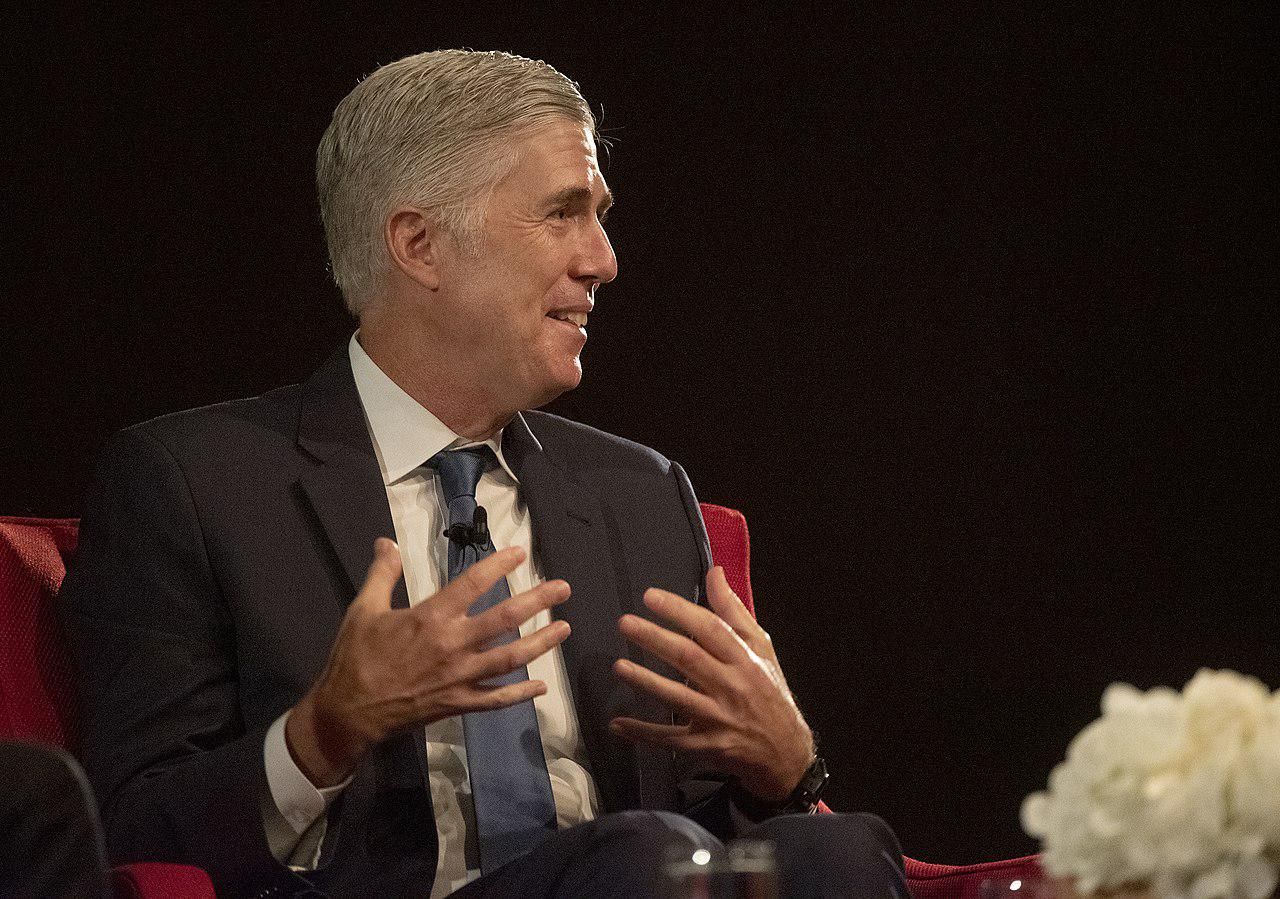
U.S. Supreme Court Justice Neil Gorsuch speaking at the LBJ Presidential Library on September 19, 2019, Wikimedia Commons
When Justice Neil Gorsuch warned the rest of the Supreme Court against President Donald Trump’s “veto-proof” tariff policies, he was foreshadowing how Republicans may rebuke that power grab. There is a catch, though — and it involves the largely “symbolic” nature of the current protest.
“Supreme Court Justice Neil Gorsuch is having an I-told-you-so moment when it comes to President Trump’s tariffs,” reported The Hill’s Ella Lee and Zach Schonfeld in a piece about the upcoming Supreme Court decision on Trump’s tariffs. Inside sources indicated to The Hill that a decision may come soon, based on the uncharacteristically open buzz surrounding that specific issue. They also recalled that Gorsuch warned it is logistically difficult for the legislature to “veto-proof” bad laws in our highly polarized era, and he was not alone.
“Let’s say that we adopt your interpretation of the statute,” Justice Amy Coney Barrett is quoted by The Hill from the November hearing in which Gorsuch also spoke. “If Congress said, ‘whoa, we don’t like that, that gives a president too much authority under IEEPA,’ it’s going to have a very hard time pulling the tariff power out of IEEPA, correct?”
Since that time, The Hill pointed out, six Republicans joined their Democratic counterparts in a vote to repeal Trump’s Canada tariffs. Lee and Schonfeld warn, though, that the House repeal of the tariffs is “symbolic” since it does not have the votes in the Senate to become law. Even if it did, though, it would then be vetoed by the White House, with the legislature unable to override that veto.
“Speculation is still running rampant about when the Supreme Court will drop the highly anticipated decision,” The Hill wrote. “Some 105 days have now passed since oral arguments, longer than other recent expedited cases.”
The Hill is not alone among publications identifying a connection between half-a-dozen congressional Republicans’ rejection of Trump’s tariffs and the Republican justices’ seeming wariness. Reporting for the Financial Times, journalist Alan Beattie observed that as a result Trump's "rush of bilateral ‘gunboat deals’ is a high-stakes game of bluff, with the US holding a position that could weaken markedly. Trading partners surely know the US wants to get its tariffs down.”
He added, "It's now implanted in public discourse that American companies and consumers, not foreigners, are paying the tariff costs.”
Even Republicans in deep red states like Texas are turning against Trump’s tariffs.
“Here are three cheers for the six House Republicans who voted with nearly all Democrats to repeal President Trump’s tariffs against Canada,” Texas state chair Merrill Matthews of Our Republican Legacy wrote for The Hill. “They bucked their party and their leadership, and especially Trump, to do the right thing.” Even traditionally Republican interest groups like a farmers’ association are trashing Trump’s tariffs.
“The National Cattlemen’s Beef Association and its members cannot stand behind the president while he undercuts the future of family farmers and ranchers by importing Argentinian beef in an attempt to influence prices,” Colin Woodall, head of the National Cattlemen’s Beef Association, said in a statement.