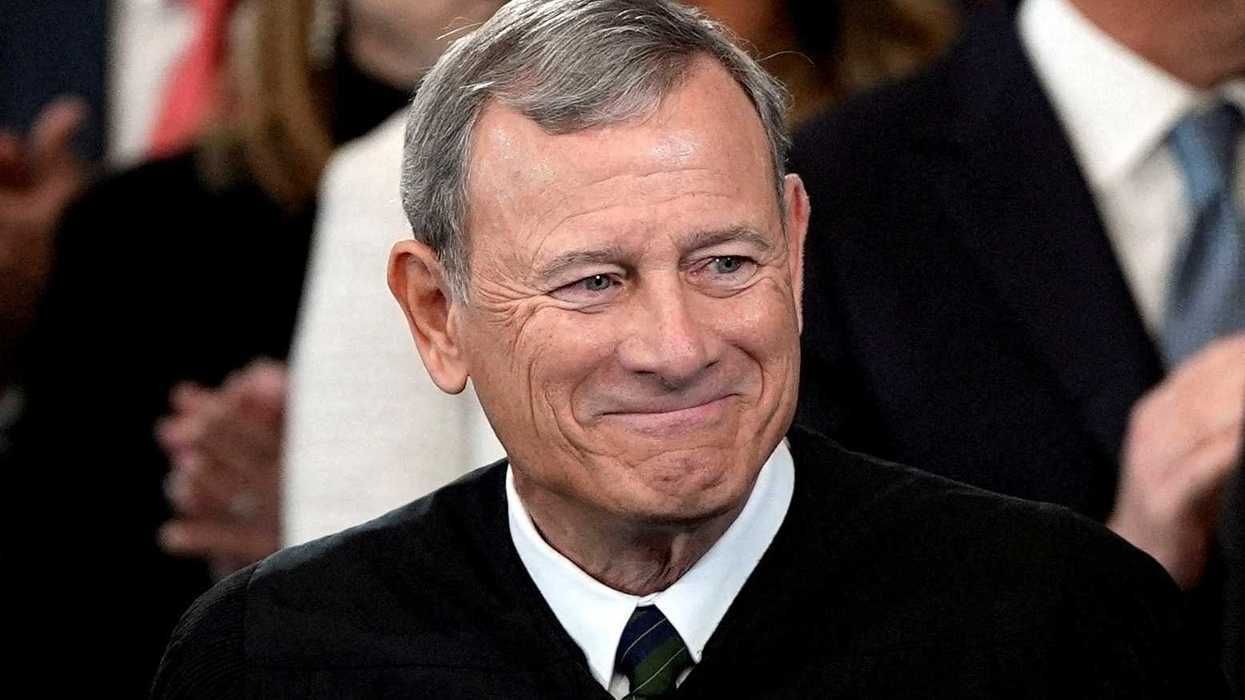
Chief Justice of the United States John Roberts in Washington, Monday, Jan. 20, 2025. Julia Demaree Nikhinson/Pool via REUTERS
Many U.S. Supreme Court rulings of the 2020s are coming down along strict partisan lines, with the six GOP-appointees justices on one side and the three Democratic appointees comprising the dissent. But in Pitchford v. Cain, a 5-4 ruling handed down on May 28, the majority united the three Democratic appointees (Justices Sonia Sotomayor, Elena Kagan and Ketanji Brown Jackson) with Chief Justice John Roberts and Justice Brett Kavanaugh, while the conservative dissenters were Justices Neil Gorsuch, Samuel Alito, Amy Coney Barrett and Clarence Thomas. And according to Reason's Damon Root, the decision showed a major disagreement between Donald Trump appointees Gorsuch and Kavanaugh.
"On the surface, Justices Neil Gorsuch and Brett Kavanaugh share much in common," Root explains in the libertarian-oriented Reason. "They are both judicial conservatives, both self-professed originalists, both former federal appellate court judges with respected records, and both were appointed to the U.S. Supreme Court by the same president. Yet there are certain legal issues that have brought out notable differences between them. The Supreme Court's recent 5-4 decision in Pitchford v. Cain offers a fascinating case in point."
In Pitchford, the Roberts Court examined the precedent in 1986's Batson v. Kentucky, which said that prospective jurors cannot be excluded from juries solely on the basis of their race.
"In Pitchford, the Supreme Court was tasked with deciding whether Terry Pitchford's rights were violated when a lower court decided that his defense lawyer had waived the right under Batson to challenge the prosecution's supposedly race-neutral rationales for peremptorily excluding four out of five prospective black jurors in the case," Root notes. "Writing for the majority, Kavanaugh, joined by Chief Justice John Roberts and Justices Sonia Sotomayor, Elena Kagan, and Ketanji Brown Jackson, held that Pitchford's constitutional rights had indeed been violated…. Writing in dissent, Gorsuch, joined by Justices Clarence Thomas, Samuel Alito, and Amy Coney Barrett, denied that any such injustice had occurred."
Root argues that Pitchford wasn't the first time that Kavanaugh and Gorsuch disagreed on criminal justice matters.
"Normally, when it comes to matters of criminal justice, Gorsuch is the one with the reputation for being more sympathetic to criminal defendants," the libertarian journalist observes. "Kavanaugh, meanwhile, generally has a reputation for being the more reliable vote in favor of law enforcement. But this case flipped the script. Here, thanks to an opinion by Kavanaugh, written over Gorsuch's dissent, a Death Row inmate's conviction and death sentence were tossed out. This time around, it was Kavanaugh, not Gorsuch, who gave the civil liberties side the win."