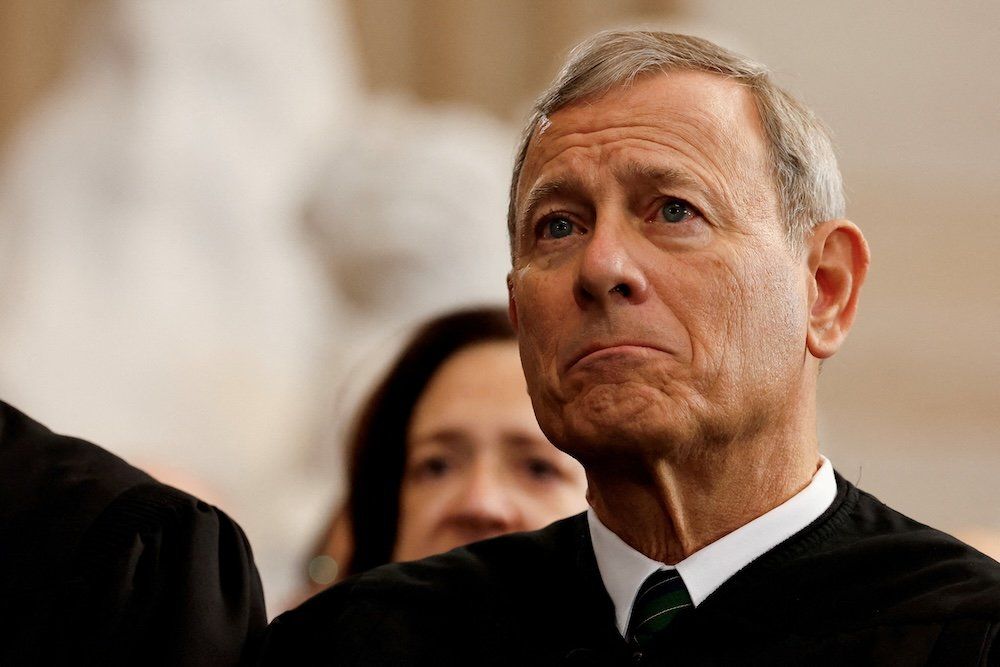
As Republicans celebrate the Supreme Court’s decision to effectively end a key part of the Voting Rights Act, allowing the party to redraw congressional maps in a way that will eliminate previously-protected Black Democratic seats, some are arguing that this could in fact backfire, providing Democrats with a powerful means to “counter a MAGA power grab.”
Writing for the Washington Post, senior fellow at the Ethics and Public Policy Center Henry Olsen asserts that while the short-term effect of the decision will favor Republicans who fear major losses in the November midterms, by 2032, “they may find that the hand that giveth can also take away.”
As Olsen explains, the change opens some undeniable opportunities for Republicans for the immediate future, writing, “Louisiana, Alabama and Tennessee are already reconvening their legislatures to eliminate three or four Democratic-held seats ahead of the election. Mississippi and South Carolina may join in, too, and outgoing Georgia Gov. Brian Kemp (R) has suggested that a redraw of that state’s map is likely before the 2028 election. Add Indiana, where Democratic Rep. André Carson’s Indianapolis-based seat is a potential target, and the GOP might gain as many as 10 seats by 2028.”
Democrats should not be expected, however, “to stand idly by in this unseemly race to the redistricting bottom. Many blue states also hold minority seats. Many of these states are constrained now by redistricting commissions or state-level legal provisions that bar mid-decade gerrymandering. It would take time to undo those barriers, but a GOP purge of Black representation in the South will put enormous pressure on the Democratic Party to fight fire with fire.”
According to Olsen, “New Jersey is an excellent example. In 2024, its heavily gerrymandered map produced nine Democrats and three Republicans in a state where Donald Trump received 46 percent of the vote. But a map that would all but guarantee the election of 11 Democrats is already circulating on the internet. It could easily be adopted if the state’s redistricting commission is abolished. New York, California and Colorado could also follow suit, and the Democratic trifecta in Maryland could join them. Michigan and Wisconsin could also be in play if Democrats win trifectas in this year’s elections… California and Virginia have just shown that the popular vote on redistricting referendums mostly followed partisan trends. It’s hard to imagine that a blue-state electorate wouldn’t want to free its Democratic-dominated legislatures to do unto Republicans what red states have done unto them.”
He notes that for this to work, many Black Democratic lawmakers would have to risk their seats in party primaries, which opens debates over Black representation. But “would a desire to counter a MAGA power grab overcome that painful history?” Olsen “wouldn’t bet against it.”
He also explains how, because Republicans have already gerrymandered so extensively, “it’s hard to see where they could answer. Kansas, Nebraska and Indiana could redraw four existing or potential Democratic seats, and Utah’s Republicans are already trying to undo a court-ordered map that created a new Democratic seat in Salt Lake City. Perhaps Texas, Florida or North Carolina could squeeze a couple more seats out of their already partisan maps. But even all that would not be enough to counteract a full-out Democratic surge.”
So while the conservative Supreme Court justices may have had partisan goals in mind with their ruling, in the end, it might backfire. But as Olsen points out, this could have a negative impact on American politics as a whole.
“Should things play out this way,” he writes, “I fear that American democracy would truly become farcical at the congressional level. Virtually every seat would be safe for one of the two parties… The only avenue for change would come in party primaries, where both parties’ ideological bases would probably be empowered at the expense of moderates and swing voters.”
Olsen wonders how conservative institutionalists on the court will look back on the decision, arguing that “by unleashing partisan gerrymandering without installing any practical limiting principle, then eliminating mandated racial protections, they would have set in motion the forces that carved up America to suit entrenched interests in both camps. That surely is not the republican government that America’s founders wanted to establish.”
He comes to a dire conclusion, writing, “America faces a choice: Either it can have unrestrained partisan gerrymandering, or it can have a democratic republic. It can’t have both.”