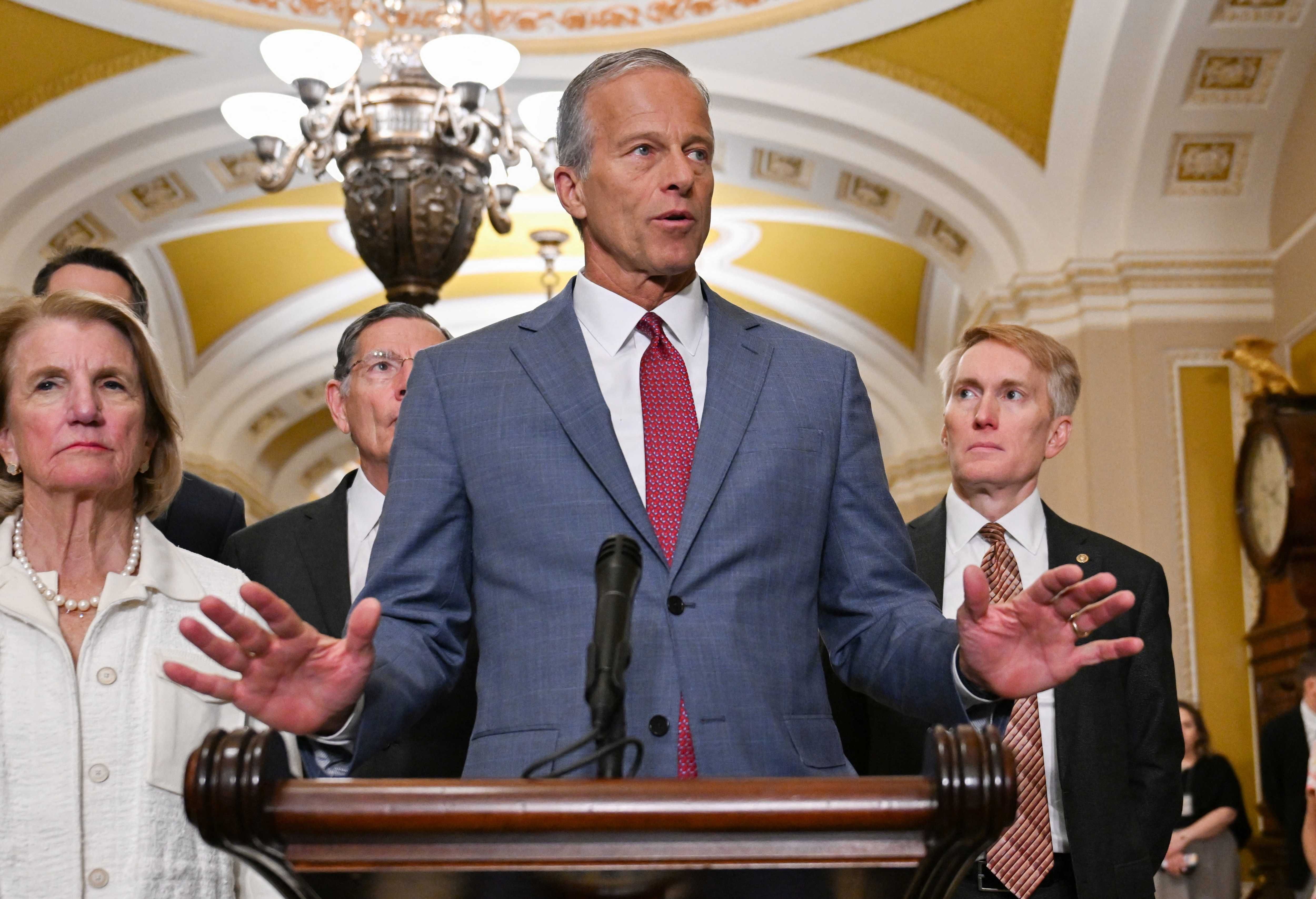
U.S. Senate Majority Leader John Thune (R-SD) speaks to reporters during a press conference, following the Republicans' weekly policy lunch, on Capitol Hill in Washington, D.C., U.S. June 9, 2026.
For a long time, the Deep South was one of the safest bets in the Republican column. But afterthe midterms last week, perhaps that’s no longer the case.
In a column on Wednesday, the New York Times’ Jamelle Bouie argues that this is a problem of the Republicans’ own making. He says that the GOP’s eagerness to take advantage of a Supreme Court ruling on voting rights has sparkeda backlash that’s changed the national political landscape.
“The South has not been this competitive in national politics since the 1970s and ’80s,” Bouie writes.
South Carolina elected Democrat Annie Andrews to fill the seat of Lindsey Graham, making her the first Democrat elected to the Senate in the state since Fritz Hollings in 1998. As Bouie notes, Andrews now holds a seat previously held by Strom Thurmond and John C. Calhoun.
But that’s not all. In Georgia, Democrats control all three top statewide offices for the first time since the first term of George W. Bush. And in Mississippi, a state that hasn’t elected a Democrat to statewide office since 2015, voters are on the verge ofelecting Democrat Scott Colom to the Senate.
Bouie argues that this all started with theSupreme Court’s decision in Louisiana v. Callais in April. In the majority opinion,Justice Samuel Alito gutted the remaining parts of the Voting Rights Act. He ruled that mandating majority-minority districts is itself an act of racial discrimination, and that states could engage in gerrymandering for partisan gain even if Black voters were harmed.
Alito went further, arguing that, if you control for race, voting in the South is not racially polarized at all. As Bouie put it, it’s “a C-minus rhetorical move that should embarrass an undergraduate.”
Tennessee wasted no time in reacting by splitting up the majority-Black city of Memphis into bits and pieces and spreading them out into mostly rural districts.Louisiana, Mississippi and Alabama did the same, and some Republicans went so far as to cancel elections already underway.
“Republicans reacted to the Callais decision like it was a gold rush,” Bouie writes.
It didn’t work out quite the way they’d expected. Black voters and their allies mobilized, tying the issue of voting rights to other bread-and-butter issues such as health care and wages.
“Black Americans voted at a whopping 96 percent of the presidential turnout,” Bouie writes, citing an analysis of Deep South turnout from Strength in Numbers.
Without this turnout, Bouie argues, South Carolina and Mississippi might have slipped away from the Democrats, and the party might not have swept Georgia and North Carolina.
“It is possible that these victories are a one-off,” Bouie writes. But he argues that Democrats are still obligated to deliver a new Voting Rights Act andend partisan gerrymandering for the voters, even though Trump almost certainly wouldn’t sign such a bill.
“The party can either honor the work of the voters who made their success possible or see whatever advantage they now have dissipate in disappointment and anger,” Bouie writes.