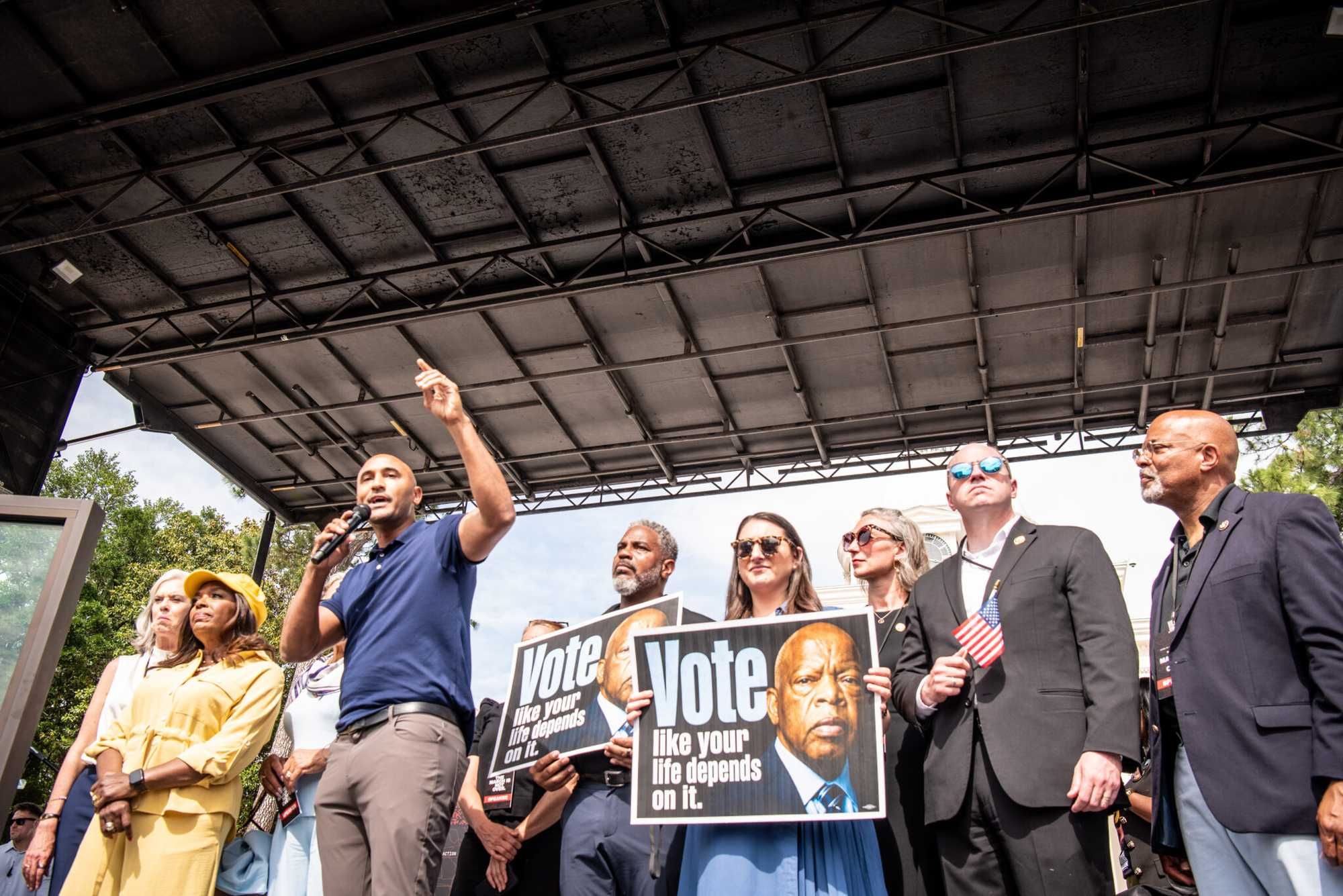
Several Alabama Republican Party candidates have expressed worries about signs of flagging GOP enthusiasm in the fall campaign and fear it could give Democrats a boost in November.
While turnout for the May primary elections was 23% statewide, the number of people taking Democratic ballots jumped from four years before, while turnout in Republican areas was flat. In the August 13 special congressional primaries in four districts, most of which featured Republican races, turnout was just 5%.
“Republicans control the state. Most of the people in this state are Republican, they vote Republican reliably,” said State Auditor Andrew Sorrell, a Republican seeking re-election, in an interview Thursday. “If we ever perform poorly in an election, it is not because people woke up and decided they were Democrats today. Anytime we lose, it is when our people stay home and don’t go vote.”
Multiple messages were sent to Scott Stadthagen, chair of the Alabama Republican Party, seeking comment.
Alabama state government has been fully controlled by Republicans since 2012. Democrats have been a superminority in the Alabama Legislature since 2010 and have not won a governor’s race since 1998.
But Republicans are facing significant headwinds entering the midterm election cycle, due to concerns over inflation and President Donald Trump’s unpopularity. GOP legislators earlier this year redrew the 2nd Congressional District, currently represented by U.S. Rep. Shomari Figures, D-Mobile, to favor a Republican.
But Sabato’s Crystal Ball, which analyzes races, recently shifted the contest from “Likely Republican” to “Leans Republican,” due in part to expectations of strong turnout by Black voters, who tend to vote Democratic. Black turnout is expected to climb across the South after Republican efforts this spring to draw Figures and other Black members of Congress out of their seats.
“Maybe if it is higher Black enthusiasm, maybe if turnout is lower in, let’s say, the Wiregrass part of the state, you could see Rep. Figures getting a large turnout in Montgomery, whereas keeping the rural areas a little closer because they might have lower turnout, him holding his seat in that way,” said J. Miles Coleman, associate editor at The Center for Politics.
Rep. Rhett Marques, R-Enterprise, the Republican nominee for the 2nd Congressional District, has been vocal about expressing his concerns about the low voter turnout during the primary election. During a campaign event, he said that “voting is going to matter, not only for this state but for the direction of our country.”
Tabitha Isner, former vice chair of the Alabama Democratic Party, said she was encouraged by the vote totals during the primary election season earlier this year.
“Big picture, I think we are seeing higher than normal levels of Democratic engagement and we are seeing lower than normal levels of Republican engagement,” she said in an interview Monday.
Others said that voter turnout matters regardless of party.
“There is not an elected official or candidate in the United States of America who is not concerned about voter turnout,” Rep. Chris Pringle, R-Mobile, said in an interview on Tuesday. “We are candidates, we need people to come out and vote.”
Midterm lag
Midterm turnout tends to lag presidential turnout. In 2024, voter turnout in Alabama was almost 59%, which was a 30-year low in the state. In the midterms in 2022, it was only about 38%, according to the Election Lab at the University of Florida that tracks voter turnout numbers.
However, the particulars of the political environment for the current cycle add to the Republican Party’s problems.
“With the emergence of Trump, Trump was able to win the popular vote in 2024, and he was able to do that because he realigned the Republican Party, bringing in these voters who had never participated before, bringing in a lot of rural Americans, a lot of, what we could call in political science, ‘low propensity voters,” said Spencer Goidel, assistant professor of political science at Auburn University.
Trump, who can rally his voters to the polls, is not on the ballot, and that could be problematic for Republican candidates. Trump implored supporters to vote in the coming election at a recent midterm convention in Texas.
“You know what happens if you don’t vote? You go to hell,” he said at the convention. “Go out and vote, go out and vote!”
Other Republicans expressed alarm over possible Republican apathy as Democrats appear engaged.
“The Democratic base is excited,” said John Wahl, former chair of the Alabama Republican Party and the Republican nominee for lieutenant governor. “They are not happy with what is going on in Washington. They don’t like Donald Trump, and they are engaged in this election process, they are going to turn out to vote. And I think Republicans have to give our base that same excitement in order to get out and vote.”
In the May primary, the percentage of Democratic primary ballots chosen reached 43%, up from 22% four years ago. Democrats also saw significant jumps in primary votes cast in Madison, Mobile and Tuscaloosa counties, all critical for the party’s success.
“If the same thing happens in the general election where Democrats are seeing the same level of increase, we ought to be winning some statewide seats,” Isner said. “I think that is making a lot of Democrats feel really excited and hopeful and making a lot of Republicans very nervous.”
According to data on the Alabama Secretary of State’s website, almost 170,000 people voted to nominate the party’s nominee for Governor in 2022. Earlier this year, that same contest garnered more than 365,000 votes, an increase of about 117%.
“I think Democrats are really motivated by what we have seen in terms of attacks on the Voting Rights Act, attacks on basic liberties, the way in which standards and norms for governance have been broken,” Isner said. “The people feel disrespected by those things.”
Will it matter?
It is not clear whether voter turnout for the coming general election contest will remain as low as it was for the primaries. And even if it does, it is unclear how much that will benefit Democratic congressional candidates. Alabama Republicans have benefitted from straight ticket voting in the state: in 2024, about two-thirds of all ballots cast were straight-ticket, and of those, about two-thirds were cast for the Republican Party.
“It feels like a real long shot to me,” said Mitchell Brown, a professor of political science at Auburn University. “If you look at the margins in the last midterm, they were pretty big. The closest race was 67% Republican and 29% Democrat. I would be really surprised if, all of a sudden, the Democratic turnout was so high and Republican turnout was so low that a Democrat could ever overcome these margins.”
She also said that the margin for the governor’s race favors Republicans.
“It will matter in some places, local level races, or where the numbers are really small because that is where funny things happen,” Brown said.
Brown said low voter turnout will matter in places where the electorate features a mix of registered voters between Republican and Democrats, and the size of the eligible voting population is less.
Democrats are pushing in Madison County, where demographics have shifted in their favor in the last several years, though Republicans continue to dominate elected offices.
“There are swing legislative districts in Madison County, for instance, that I think could be in trouble,” Sorrell said. “I also have some opinions on a couple of statewide races that look like they will be closer than they should be, but I don’t want to give you names there.”
Wahl said the 2nd Congressional District would probably be “the biggest battleground in the state of Alabama.”
“This is a must-win district for the Republican Party,” he said.
Sorrell said Republicans have got to keep our voters enthusiastic whether Trump is on the ballot or not.”
“That is on us as candidates,” he said. “If voter turnout is poor, that is on the candidates. It is nobody’s job but the candidates to motivate people to go vote.”