An idea almost as awful as the lunacy Republicans started in Texas
03 March
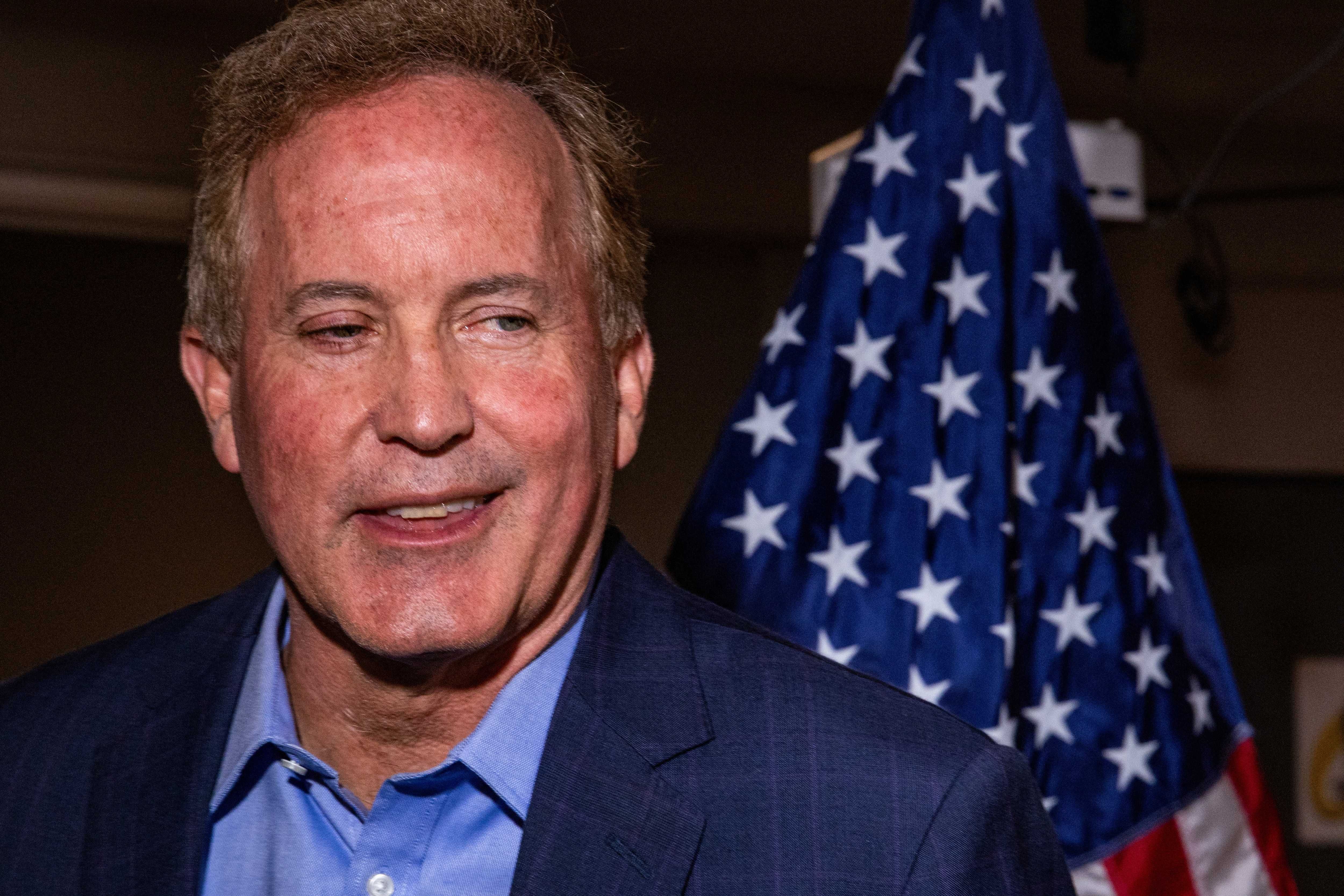
Texas Attorney General Ken Paxton appears during a rally for his senatorial campaign at George’s Banquet Hall in Waco, Texas, U.S. March 2, 2026. REUTERS/Kaylee Greenlee
It’s a ridiculous idea: temporarily revert to hyper-partisan reapportionment just six years after Virginia voters, weary of its abuses, put an independent bipartisan commission in charge of drawing fairer, more sensible lines.
Virginia voters are being asked to backtrack on a noble choice they made in 2020. Under a bizarre new map proposed by Democratic majorities that rule the General Assembly, Republicans could shrink from five of Virginia’s 11 U.S. House seats to just one.
To enable that, Virginians would have to ratify a state constitutional amendment in a referendum next month that momentarily suspends the independent Virginia Redistricting Commission that took decades of work to bring to life. In its place would be a brutally partisan reapportionment that makes the most notorious gerrymandering of yore seem quaint.
It’s madness — a highly contagious and virulent strain of madness engineered last summer in the laboratory of MAGA chicanery that is Texas, and released upon the body politic at the urging of MAGA’s leader, Donald Trump.
With Trump’s popularity cratering, the president exhorted GOP-ruled states to redraw their congressional districts to purge nearly all Democratic-held seats halfway through the decade of the 2020s rather than await the 2030 census.
This had nothing to do with population shifts or proportional representation. It’s a cynical hedge against an increasingly likely Democratic sweep of Congress this fall and the certainty that a Democratic House and Senate will launch one damning investigation after another into scams, scandals and coverups in Trump’s second White House term.
Lone Star Republicans eagerly raised their hands and said, “I’m your huckleberry!”
A redistricting designed to give five Democratic-held Texas U.S. House seats to the GOP cleared the Texas House on a party-line 88-52 vote. Then the state Senate did the same, also on partisan lines. On Aug. 29, the nation’s second most-populous state was carved into a new map with geopolitical distortions resembling a Rorshach test when Gov. Greg Abbott, an unfailing Trump footman, signed it into law.
Thus commenced America’s race to the bottom. The nation’s most populous state, deep blue California, responded with a map designed to flip five GOP-held seats.
Republican states are painting their districts red; Democratic ones like Virginia are painting theirs blue. According to the National Conference of State Legislatures, Missouri, North Carolina, Ohio and Utah have joined California and Texas in enacting new, partisan districts. Virginia is among four where legislation to do the same is pending. Indiana and Florida are considering it, both quite late to the game. Alabama, Louisiana, North Dakota and Wisconsin await court rulings or are in litigation that could force mid-cycle remapping.
For a huge swath of the electorate, this raises many questions with no good answers.
Voters, already exhausted, confused and disenchanted, didn’t want yet another rip in the fabric of American civic life. The latest polling shows most voters here prefer our current redistricting process, not the chaotic proposed remapping that’s being pitched to them now.
Tens of millions now must reorient themselves to unfamiliar elected officials and candidates in strange, misshapen new districts in which communities separated by several hours’ drive share little in common economically, historically or culturally.
Is all this really necessary?
In Virginia, where Trump is winless as a candidate and has been an albatross for Republicans in every state election when he’s been in office or on the ballot, Democrats might be able to achieve their goals under the existing congressional lines, said Mark J. Rozell, a political science professor at George Mason University and dean of its Schar School of Policy and Government.
“With the typical midterm reaction against the party in the White House and the fast-declining public approval of this president, Democrats are well-positioned to pick up seats without going through a redistricting process that will just set in motion other such efforts when they are not in power,” he said. “They might even come close to what they’re aiming to get by redistricting.”
Also, a short-term fix may have adverse long-term consequences, Rozell noted. In politics, as in physics, every action has an equal and opposite reaction. Something this drastic sets a precedent that invites in-kind retaliation later, when Republicans might control state government wall-to-wall.
Such a tit-for-tat escalation could doom independent redistricting, which Democrats once overwhelmingly embraced.
“I get it that this has become somewhat analogous to an arms race and that the Democrats don’t want to disarm,” he said. “On the other hand, there’s no denying that what the Democrats are proposing to do flies in the face of the position most of them took five years ago, which was very principled.”
Like a broad swath of Virginians, I find the GOP provocation and the Democrats’ response dispiriting.
I understand the Democrats’ argument. In the rabid partisanship ahead of November’s desperate, win-at-all-costs midterm election, expecting them not to respond to Texas Republicans’ naked power grab would be akin to expecting Ukraine President Volodymyr Zelenskyy to greet Vladimir Putin and his invading Russian army at the gates of Kyiv with the key to the city.
The guardrails of civic and individual decency that once bounded acceptable political conduct are gone. Witness Trump’s seething, unhinged, ego-glutting litany of insults and grievances last Tuesday night that, at 107 minutes, was history’s longest State of the Union speech. (Virginia’s Democratic governor, Abigail Spanberger, delivered a scathing rebuttal that countered much of Trump’s vitriol.)
If Trump’s purpose was to further segregate Americans into hostile tribes and destabilize national cohesiveness, he succeeded.
I don’t know how this all ends. Nobody does. The Virginia Supreme Court has yet to take up Democratic appeals of two rulings by a Tazewell County judge in lawsuits Republicans filed to stop the referendum.
Nor do I know how — or even whether — I will vote in this referendum. I suspect I’m not alone.
I know without question that this fight has produced a malicious strain of politics in a state once known for respectful public discourse — or at least the veneer of it. I know I miss who we used to be.