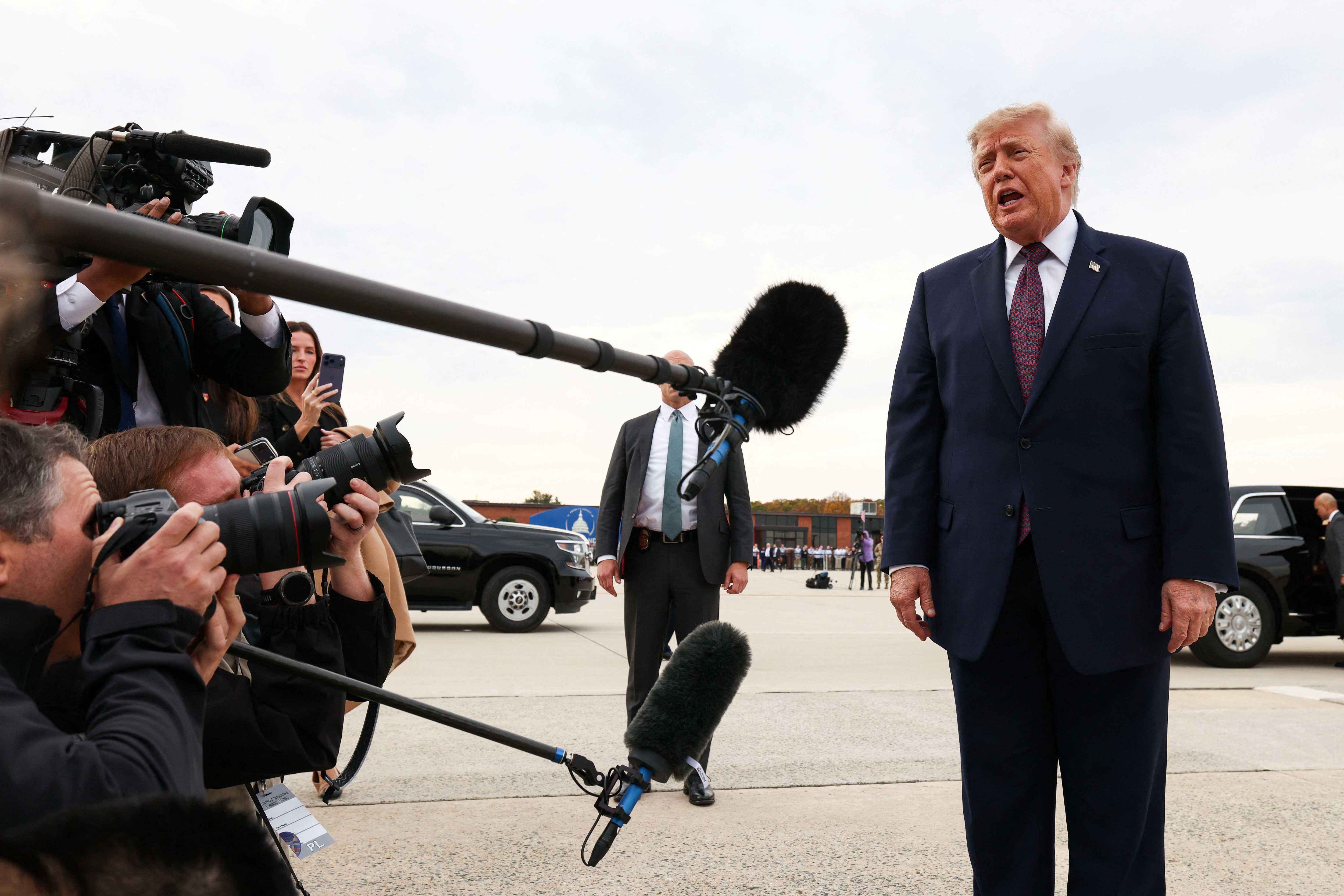
US President Donald Trump speaks to the press, before departing for Chillicothe, Ohio, at Joint Base Andrews in Maryland, US, October 28, 2026. REUTERS/Kevin Lamarque
I do not know what is happening, but I am sure it is not good.
Last week, a series of widespread technology outages began with Microsoft’s email system, affecting programs such as Outlook and Teams. The FAA grounded every departing flight because it could not safely track planes, customers of Chase and other megabanks had problems accessing their online accounts and completing transactions because of a “software bug,” and hackers successfully inserted malicious code into the websites of almost 200 major organizations worldwide. On Tuesday, the National Security Agency announced that its own internal highly secure network, used by employees to send classified information, had gone offline. The agency’s story is that this outage was caused by scheduled maintenance. That same day, Apple Pay was down.
As I write this essay on Wednesday, Vice President Vance abruptly cancelled his planned appearance at the New York Times DealBook Summit to attend meetings about the wave of technology failures and the chaos they are causing across the country. President Trump is in Asia.
On top of all this, the Trump administration issued a warning on Monday that the Iranians are potentially planning a “dirty bomb” or chemical weapon attack on Washington, D.C.
Members of Trump’s cabinet and other senior administration officials are now living on military bases. Last September, Secretary of Defense Hegseth ordered the Fortress America initiative, under which military bases must be self-sufficient for at least 90 days.
A dear friend messaged me late Monday night saying, “honestly, everything is so messed up. It’s hard to tell what is incompetence, what is subterfuge, and what is real.” He is right. I truly do not know what is happening.
Unfortunately, success as a pundit, opinion writer, columnist, or other type of public thinker in the 24/7 cable news environment and today’s digital attention economy requires the performance of near-absolute certainty and confidence.
In this news-as-entertainment environment, “I don’t know” can literally be the death of a career. Instead, as we are now seeing, a public voice is supposed to perform expertise on the airlines one day, cybersecurity the next, then AI, all the while putting these subjects in the context of national security, the Iran war, and how the public is feeling about all these disruptions.
Instead, I have tried to follow the advice in political scientist Philip Tetlock’s book, co-authored with Dan Gardner, Superforecasting: The Art and Science of Prediction: “Knowing what we don’t know is better than thinking we know what we don’t.”
In addition, I frequently return to another piece of advice from Tetlock: “Be careful about making assumptions of expertise, ask experts if you can find them, reexamine your assumptions from time to time.”
As I try to make sense of a week where the system seems to be falling apart — at an even faster rate than before — I start with impressions and intuitions rather than firm conclusions, which I do not have.
All in all, I feel like we are stuck in a bad Tom Clancy novel where a rogue AI program was trained on Idiocracy, Passenger 57,Air Force One,Airplane!, Mr. Robot, and Terminator 3.
What did the American people expect? The country is being run by a visibly aging professional wrestling heel billionaire, whose shadow president, Stephen Miller, is like a supervillain from one of the bad James Bond films. A trillionaire in the form of Elon Musk is skulking about and pulling levers. A former reality TV show star and a mixed martial arts fighter who made his money from a successful plumbing business are overseeing the government’s response to these massive technology failures.
The fear is amplified by the fact that the Trump regime has less than zero credibility.
On Wednesday, Director of National Intelligence Jay Clayton reportedly told a congressional committee that the recent technology outages were separate incidents, not a coordinated cyberattack. The FAA outages were supposedly caused by a faulty router.
A huge question that looms over this whole debacle: What play are the tech fascists running?
Always follow the money. The Heritage Foundation’s Project 2025 — the literal playbook for the Trump regime — contains a proposal to privatize the Federal Aviation Administration.
The deeper story of America’s failing infrastructure and other systems is about wealth and income inequality, greed, corruption, and the privatization of public services and public goods.
Once I get past my intuitions and my initial thinking aloud, I ask myself: What is this an example of?
Authoritarians, autocrats, and other illiberal leaders systematically purge experts because they see them as threats to their political projects.
In his newsletter, social entrepreneur and activist Xander Schultz explained how Trump’s “coup-proofing” has weakened America’s security and democracy:
Coup-proofing is how strongmen protect themselves from their own people. Promote for loyalty instead of skill. Rotate commanders so no one builds a following. Punish bad news. Run every decision through the top.
It works… for a while.
Coup-proofed regimes rarely fall from inside, but the leader pays for that safety with competence. Political scientist Caitlin Talmadge showed in The Dictator’s Army how the same steps that stop coups wreck an army’s ability to fight….
Trump has always treated disagreement as disloyalty. Trump’s first term was full of people who knew their jobs and sometimes told him no. They didn’t last….
He fired about 17 inspectors general, the NSA chief after a meeting with Laura Loomer, the Joint Chiefs chairman, and the head of labor statistics after a bad jobs report.
When it comes to the most important roles in our federal government, [he] has picked leaders based on one characteristic — loyalty….
Predictably, the American people’s trust in the ability of their government to solve problems has fallen to historic lows.
Listen to the real experts.
In a new essay, Miles Taylor, former Chief of Staff of the Department of Homeland Security, explains that:
First, it’s true that there’s no public evidence tying all of these outages to a nefarious hacker. The companies and agencies involved blame bad updates and aging equipment. I have nothing that contradicts them directly and nothing that would suggest we’re under some sweeping cyber assault by one of our foreign enemies.
But that’s not very reassuring. If these were all accidents from fragile systems, you can only imagine what happens when someone tries to take them down deliberately. And bad actors have at their disposal today offensive cyber capabilities like we’ve never seen. So what’s happening now is a preview of what could become a new normal.
And this is what the Trump administration is scared to tell you truthfully: the federal government is unprepared to respond.
In a widely read social media post, Nicole Perlroth, who is a former New York Times reporter and an expert on technology, cybersecurity and digital espionage, offers this measured clarity:
We are seeing:
An explosion in severe and critical vulnerabilities, with AI accelerating discovery to 3X the number of vulnerabilities discovered in the same period last year….
Mean time to exploit those vulnerabilities has collapsed to NEGATIVE SEVEN DAYS. AI allows attackers to find/exploit vulns far faster than software makers have time to fix them…
We are now entirely dependent on software systems that almost nobody understands end to end, that increasingly few people can repair, and that attackers can now probe at machine speed…. The cavalry is disappearing…
‘Software Beirut’ is an incredibly apt analogy. We are in for a period of cascading failures, whether triggered by attackers, bad updates, or our own accumulated complexity.
We are in an interregnum between the midterms, when the Democrats take control of Congress in January, and the end of Trump’s presidential term in 2028 — assuming he decides to surrender power. America’s infrastructure and other systems are going to continue to collapse. Trump and his inner circle have no interest in the common good and the overall well-being of the American people and the nation. As grossly self-interested actors, their first response will be: what is in it for me? Of that, I am certain.
Chauncey DeVega is a veteran politics and opinion writer and former senior politics writer at Salon. Read the full, expanded version of this essay at his free Substack newsletter, Indomitable.You can also find more of his commentary, analysis, and interviews with leading newsmakers on his two podcasts, The Chauncey DeVega Show and The Truth Report.