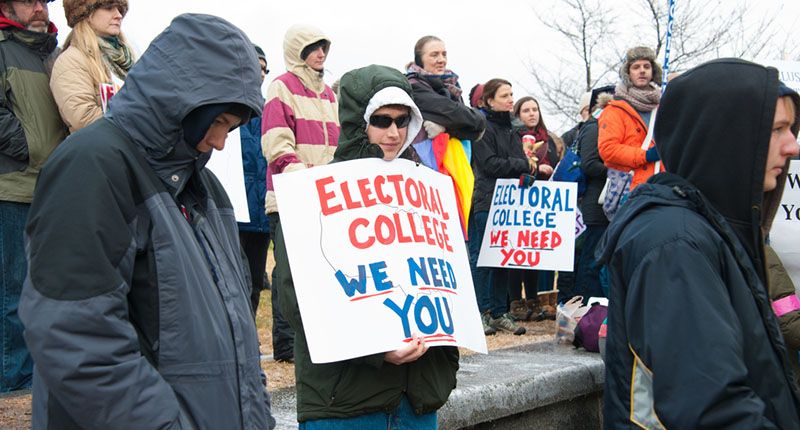
Royalty-free stock photo ID: 537978892. December 17: Protesters demonstrate against Donald Trump in Washington DC in anticipation of the December 19 meeting of the electoral college.
The results of the recent midterm elections have put the prospect of ending the Electoral College closer than ever before, but according to one prominent New York Times columnist and critic of the system, the current plan to get around it is far from guaranteed to succeed.
The Electoral College — a system by which U.S. presidential races are determined by votes allocated to each state based on congressional representation, instead of a national popular vote — has long faced scrutiny from voters, who have questioned it as an overly complicated and undemocratic relic of the nation's founding. The antipathy towards it was supercharged in the wake of President Donald Trump winning the 2016 election despite losing the popular vote, as well as the contentious 2000 presidential race, where George W. Bush won in a similar fashion.
National Popular Vote Interstate Compact is a plan to potentially get around the Electoral College on a state-by-state basis. If implemented, states that sign on to the compact would agree to award their electoral votes to whichever candidate eventually wins the national popular vote, and if enough states sign on to meet the 270-vote threshold needed to win via the Electoral College, the system could be effectively circumvented, handing the presidency to the popular-vote winner no matter how certain states vote. After the midterm results, there are now enough states with new Democratic trifectas at the state level in order to meet the 270 threshold if they join the compact.
Discussing the prospect in his latest "Takes" video on YouTube, liberal Times columnist Jamelle Bouie, himself an outspoken critic of the Electoral College, explained why the National Popular Vote Interstate Compact could still fail to do away with the system, largely based on the untested nature of such a compact and the possibility that the parties involved would not honor results that do not bode well for them.
"I'm skeptical that if a Republican wins the popular vote, Democratic states will want to give up their Electoral College votes and vice versa," Bouie explained. "And I'm skeptical that this Supreme Court would let it stand. There's something of an open constitutional question about whether states could effectively circumvent the Constitution through the form of a compact. It's never been tried before. And I have a feeling that Republicans on the Supreme Court may not go for it."
Bouie took time to dispel the idea that the Electoral College should be respected as a meaningful creation of the nation's founders, arguing that it was not "some sort of genius thing produced by the framers," but rather that it was "not one of the things they spent a lot of time thinking about."
"It was a kludge. They couldn't figure out how to elect a president for both practical reasons, technological reasons," Bouie said. "How could you even do a popular vote? For ideological reasons, skepticism of mass democracy. And in the case of some Southern delegates, they wanted to ensure that they got some representation for their slave populations in the presidential realm as well. So a combination of things, most of them involving disinterest and self-interest in just a general we're exhausted, we want to get out of here, produced a system that basically stopped working after George Washington declined to stand for a third term."