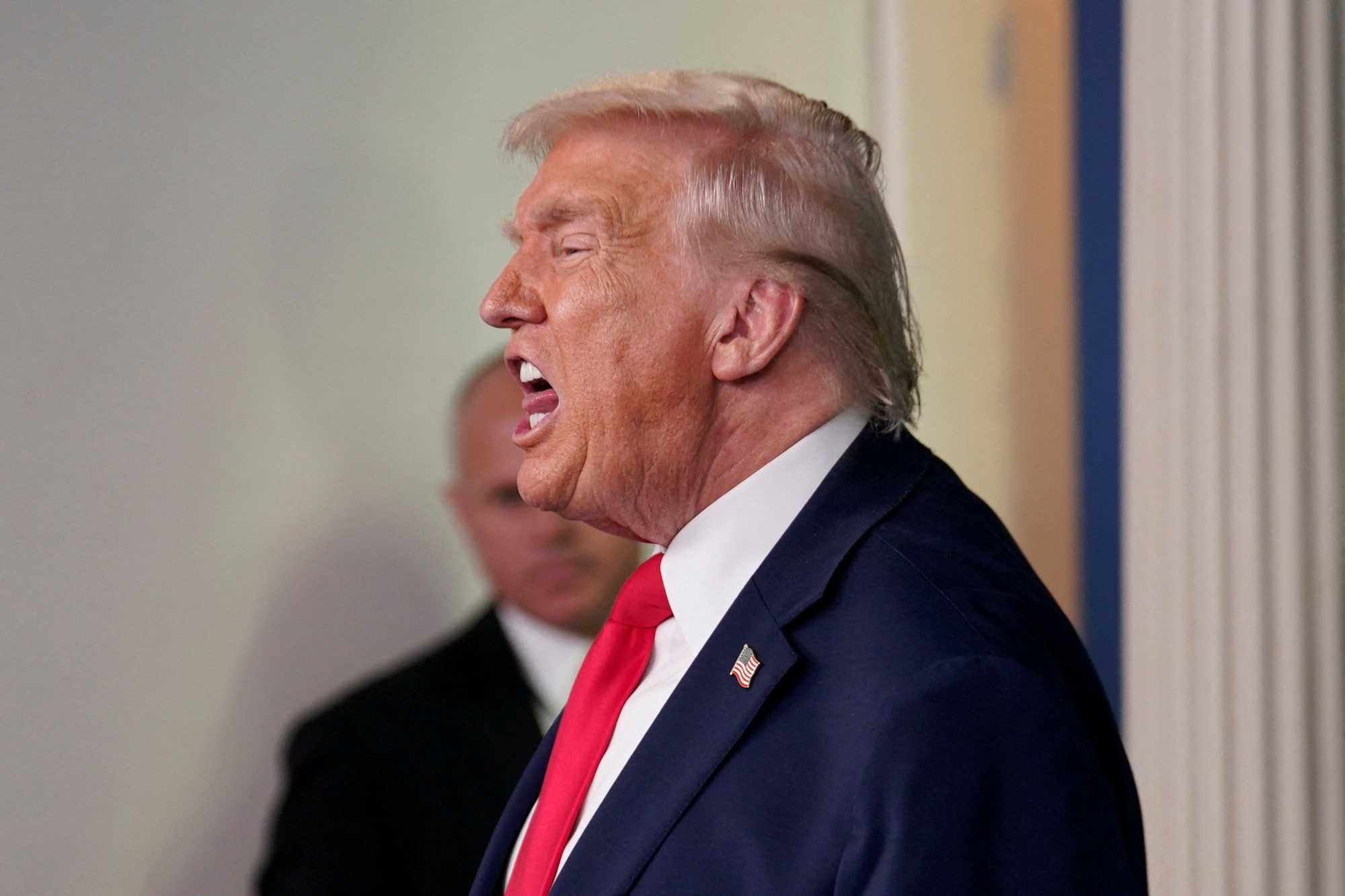
U.S. President Donald Trump speaks during a press briefing at the White House, on the one-year mark into his second term in office, in Washington, D.C., U.S., January 20, 2026. REUTERS Nathan Howard
President Donald Trump got a strong legal pushback from three major media organizations — CNN, MS NOW and Politico — after banning them from the White House press pool ahead of Chinese President Xi Jinping's visit to Washington, DC. In an article for The Atlantic, legal expert Quinta Jurecic warns that the media ban is a "preview" of the "two-year temper tantrum" that lies ahead during the second half of Trump's second presidency.
"The whole kerfuffle was a display of both Trump's power and his impotence: damaging to democracy yet also undermining of his own authority," Jurecic explains in her Atlantic article. "What prompted this particular round of White House abuse of the press is not entirely clear. But Trump often resorts to attacking the media when he receives news he dislikes — and between rising fuel prices caused by the war in Iran, sinking poll numbers for the congressional GOP, and Trump's own declining popularity, there is a lot of bad news for the president to avoid. So he created a safe space."
Jurecic argues that Trump's "standoff with the press reflects" the "fury of a man who has grasped, however dimly, that he cannot control everything."
"Yesterday, when a judge ordered President Trump to lift a ban on journalists accessing the White House, the immediate crisis appeared to be averted: Trump had lost, and reporters from CNN, MS NOW, and Politico largely returned to their normal work on the grounds," the attorney explains. "But the maneuver Trump had attempted is a preview of what to expect over Trump's remaining time in office — especially if Democrats take control of one or both chambers of Congress. To put it another way, the country is headed toward a two-year temper tantrum."
According to Jurecic, Trump's battle with CNN, MS NOW and Politico "is also the fury of someone insistent on exerting as much power as he can over the steadily shrinking universe of what does remain directly under his control."
"If Republicans lose unified control of Congress in the midterms," Jurecic writes, "then Trump's old allies will be less likely to swear fealty, and that universe will diminish even further. There is a danger to democracy here, but it is less the danger of a strategic shift toward authoritarianism and more the danger of petulance and stupidity. Every president struggles with irrelevance in the waning years of their power, and Trump has never been one to decline gracefully."